
- Học kỳ
- SP2026
- Thời Gian
- 6/5/26
- Loại tài liệu
- FE
WDU203c SP26 FE RE
Câu 1 (Multiple Choice):What makes a problem "wicked" in design?
- A. It has no single clear solution
- B. It relates to app performance issues
- C. It requires coding expertise
- D. It is solved through visual design
Câu 2 (Choose Multiple Choice):In the "Questions, Options, Criteria" framework, what does "Criteria" refer to?
- A. The possible solutions to a design problem
- B. The questions that need answers
- C. The standards used to evaluate different design options
- D. The tools used in prototyping
Câu 3 (Multiple Choice):One of the questions a wireframe cannot answer is:
- A. Does the overall layout make sense?
- B. Are proper navigation elements provided?
- C. Which components should appear on the screen?
- D. Is the color scheme visually appealing?
Câu 4 (Choose Multiple Choice):Which of the following represents the system's state:
- A. Information about the user's current location
- B. User profile information
- C. Rules for providing feedback to the user
- D. Current values of all system inputs and variables, and rules for operating on those values
Câu 5 (Choose 1 Multiple Choice):Although there are different types of input, UX designers only need to focus on designing the information that users will explicitly enter into the system.
- A. True
- B. False
Câu 6 (Choose Multiple Choice):Which of the following best represents the key stages of the design process?
- A. Sketching, coding, testing, launching
- B. Framing, exploring, refining, finalizing
- C. Planning, wireframing, prototyping, feedback
- D. Researching, modeling, developing, shipping
Câu 7 (1 Multiple Choice):Which of the following is NOT a type of passive input?
- A. Application data like contacts, calendar events, or user's health information (e.g., steps)
- B. Weather data
- C. Picture taken by the user using the phone camera
- D. User's current location
Câu 8 (Choose Multiple Choice):What does the designer need to know in order to design effective output?
- A. What information the user needs to accomplish the task
- B. Context in which the information will be accessed
- C. User's knowledge base
- D. All of the others
Câu 9 (Choose 1 Multiple Choice)esigning thoughtful defaults is important for several reasons. Which of the following is not a reason for designing good defaults.
- A. Defaults define out-of-the-box experience
- B. Defaults are easily changed.
- C. Defaults decrease onboarding time
- D. Defaults can have large consequences.
Câu 10 (Choose Multiple Choice):Which position on the social effects of technology claims that technological adoption is primarily governed by the needs of different social groups and that it has little to do with the properties of the actual technology?
- A. Social determinists
- B. Technical determinists
- C. Interactionists
Câu 11 (Multiple Choice):What are the stages of visual perception?
- A. Perception, Memory, Response
- B. Feature detection, pattern recognition, object recognition
- C. Visual search, cognitive processing, feedback
- D. Short-term memory, long-term memory, object recall.
Câu 12 (Choose Multiple Choice):What is the 4-point severity scale used for in Heuristic Evaluation?
- A. To assess the cost of resolving an issue
- B. To prioritize usability issues based on their severity
- C. To track the amount of user feedback received
- D. To measure the visual appeal of the UI
Câu 13 (Multiple Choice):What is one benefit of iterative prototyping in UX design?
- A. It helps designers avoid testing the product
- B. It allows the final product to be delivered without any mistakes
- C. It ensures the product is optimized based on user feedback
- D. It reduces the number of features in the product
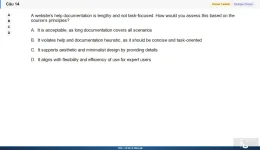
Câu 14 (Choose Multiple Choice):A website's help documentation is lengthy and not task-focused. How would you assess this based on the course's principles?
- A. It is acceptable, as long documentation covers all scenarios
- B. It violates help and documentation heuristic, as it should be concise and task-oriented
- C. It supports aesthetic and minimalist design by providing details
- D. It aligns with flexibility and efficiency of use for expert users
Câu 15 (Multiple Choice):What does a prototype help designers achieve?
- A. Testing ideas, assessing user needs, and reflecting on the design
- B. Defining user personas
- C. Creating high-quality visuals
- D. Avoiding the design process
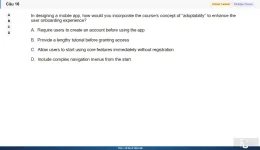
Câu 16 (Choose Multiple Choice):In designing a mobile app, how would you incorporate the course's concept of "adoptability to enhance the user onboarding experience?
- A. Require users to create an account before using the app
- B. Provide a lengthy tutorial before granting access
- C. Allow users to start using core features immediately without registration
- D. Include complex navigation menus from the start
Câu 17 (Choose 1 Multiple Choice):Which principle in UX design emphasizes the importance of consistency in interface design?
- A. Visual hierarchy principle
- B. Accessibility principle
- C. Consistency principle
- D. Feedback principle
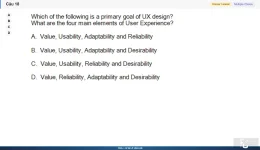
Câu 18 (Choose Multiple Choice):What are the four main elements of User Experience?
- A. Value, Usability, Adaptability and Reliability
- B. Value, Usability, Adaptability and Desirability
- C. Value, Usability, Reliability and Desirability
- D. Value, Reliability, Adaptability and Desirability
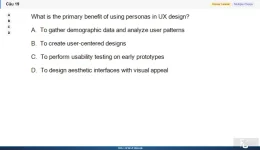
Câu 19 (1 Multiple Choice):What is the primary benefit of using personas in UX design?
- A. To gather demographic data and analyze user patterns
- B. To create user-centered designs
- C. To perform usability testing on early prototypes
- D. To design aesthetic interfaces with visual appeal
Câu 20 (Choose Multiple Choice):Because some users learn how to use a system through trial and error, it is important to:
- A. provide extensive documentation to ensure that users always do the right thing
- B. force users to undergo training before using a system so they don't break anything
- C. provide users with only one option at a time so that they cannot make mistakes
- D. support "undo" and "redo" to help users recover from mistakes
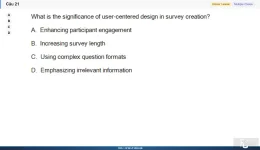
Câu 21 (Multiple Choice):What is the significance of user-centered design in survey creation?
- A. Enhancing participant engagement
- B. Increasing survey length
- C. Using complex question formats
- D. Emphasizing irrelevant information
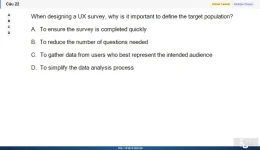
Câu 22 (Choose Multiple Choice):When designing a UX survey, why is it important to define the target population?
- A. To ensure the survey is completed quickly
- B. To reduce the number of questions needed
- C. To gather data from users who best represent the intended audience
- D. To simplify the data analysis process
Câu 23 (Multiple Choice):What term is used to describe the set of questions you ask survey participants?
- A. Respondent
- B. Instrument
- C. Frame
- D. Population
Câu 24 (Choose Multiple Choice):How can survey researchers minimize the cognitive burden on participants?
- A. By asking long, open-ended questions
- B. By using complex skip patterns and technical jargon
- C. By keeping surveys simple, clear, and to the point
- D. By asking personal questions to gather detailed insights
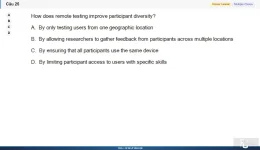
Câu 25 (Multiple Choice):How does remote testing improve participant diversity?
- A. By only testing users from one geographic location
- B. By allowing researchers to gather feedback from participants across multiple locations
- C. By ensuring that all participants use the same device
- D. By limiting participant access to users with specific skills
Câu 26 (Choose Multiple Choice):Which of the following is NOT a best practice when creating ordinal closed-ended questions?
- A. Provide a balanced scale
- B. Use specific metrics rather than vague quantifiers
- C. Avoid labeling response categories
- D. Choose between unipolar and bipolar scales
Câu 27 (Multiple Choice):Which of the following is NOT a dimension of survey modes?
- A. Cost
- B. Respondent burden
- C. Sampling frame
- D. Flexibility
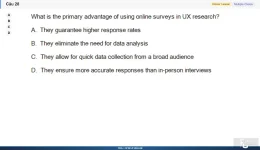
Câu 28 (Choose Multiple Choice):What is the primary advantage of using online surveys in UX research?
- A. They guarantee higher response rates
- B. They eliminate the need for data analysis
- C. They allow for quick data collection from a broad audience
- D. They ensure more accurate responses than in-person interviews
Câu 29 (Choose 1 Multiple Choice):This is error that is introduced when your questions somehow don't actually get to the concept you're interested in.
- A. Coverage Error
- B. Sampling Error
- C. Measurement error
- D. Nonresponse Error
Câu 30 (Choose Multiple Choice):Why design surveys to maximize clarity and minimize time?
- A. To increase error
- B. For accurate data
- C. To prioritize stakeholders
- D. To reduce sampling needs
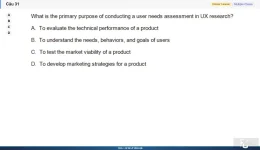
Câu 31 (Choose 1 Multiple Choice):What is the primary purpose of conducting a user needs assessment in UX research?
- A. To evaluate the technical performance of a product
- B. To understand the needs, behaviors, and goals of users
- C. To test the market viability of a product
- D. To develop marketing strategies for a product
Câu 32 (Choose Multiple Choice):Which of the following is worth noticing in an observation? I. The physical context where the user is. II. Pauses or missteps the user makes. III. Comments the user makes during a task.
- A. II only
- B. III only
- C. II and III
- D. I, II and III
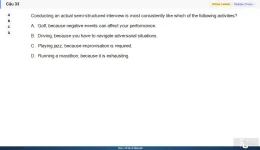
Câu 33 (Choose 1 Multiple Choice):Conducting an actual semi-structured interview is most consistently like which of the following activities?
- A. Golf, because negative events can affect your performance.
- B. Driving, because you have to navigate adversarial situations.
- C. Playing jazz, because improvisation is required.
- D. Running a marathon, because it is exhausting.
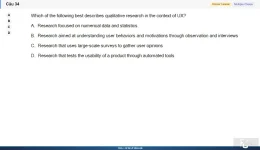
Câu 34 (Choose Multiple Choice):Which of the following best describes qualitative research in the context of UX?
- A. Research focused on numerical data and statistics
- B. Research aimed at understanding user behaviors and motivations through observation and interviews
- C. Research that uses large-scale surveys to gather user opinions
- D. Research that tests the usability of a product through automated tools
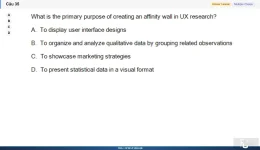
Câu 35 (1 Multiple Choice):What is the primary purpose of creating an affinity wall in UX research?
- A. To display user interface designs
- B. To organize and analyze qualitative data by grouping related observations
- C. To showcase marketing strategies
- D. To present statistical data in a visual format
Câu 36 (Choose Multiple Choice):What type of question is best for encouraging detailed responses?
- A. Yes/no questions
- B. Ranking questions
- C. Open-ended questions
- D. Multiple choice
Câu 37 (Choose 1 Multiple Choice):Which of the following is a good open-ended question to ask in a semi-structured interview?
- A. How many times a week do you use a GPS device recently?
- B. Can you tell me about the most recent time when you used a GPS device?
- C. Was the GPS interface poorly designed?
- D. Why didn't you use the landmark feature on your GPS device?
Câu 38 (Choose Multiple Choice):After conducting interviews and observations, a UX researcher identifies conflicting user needs. What is an appropriate next step?
- A. Disregard the conflicting data as anomalies
- B. Prioritize the needs of the majority without further analysis
- C. Re-examine the data and possibly conduct follow-up research to understand the conflicts
- D. Choose the needs that align with the original design goals
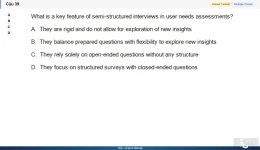
Câu 39 (Choose 1 Multiple Choice):What is a key feature of semi-structured interviews in user needs assessments?
- A. They are rigid and do not allow for exploration of new insights
- B. They balance prepared questions with flexibility to explore new insights
- C. They rely solely on open-ended questions without any structure
- D. They focus on structured surveys with closed-ended questions
Câu 40 (Choose Multiple Choice):Which type of research method is best suited for gathering in-depth, narrative-based insights from users?
- A. Quantitative
- B. Analytical
- C. Qualitative
- D. Statistical
Câu 41 (Choose 1 Multiple Choice):Which of the following would be a good reason for using a high-end usability testing lab with separate control and observation room?
- A. You will be providing a computer for participants to use during the test
- B. You will be using the think-aloud protocol
- C. You plan to administer a post-test questionnaire
- D. You plan to invite multiple stakeholders to observe the test sessions
Câu 42 (Choose Multiple Choice):The person who greets participants and communicates with them throughout a user test session is called the:
- A. Logger
- B. Moderator
- C. Interviewer
- D. Technician
Câu 43 (Choose 1 Multiple Choice):True or False: If you take good notes, there is no reason to capture a screen recording of user test sessions for later review.
- A. True
- B. False
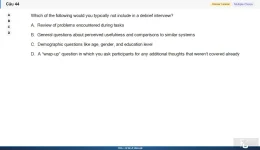
Câu 44 (Choose Multiple Choice):Which of the following would you typically not include in a debrief interview?
- A. Review of problems encountered during tasks
- B. General questions about perceived usefulness and comparisons to similar systems
- C. Demographic questions like age, gender, and education level
- D. A "wrap-up" question in which you ask participants for any additional thoughts that weren't covered already
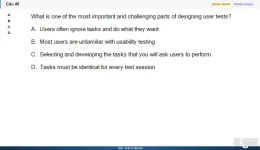
Câu 45 (Choose 1 Multiple Choice):What is one of the most important and challenging parts of designing user tests?
- A. Users often ignore tasks and do what they want
- B. Most users are unfamiliar with usability testing
- C. Selecting and developing the tasks that you will ask users to perform
- D. Tasks must be identical for every test session
Câu 46 (Choose Multiple Choice):Which of the following are research methods that can be applied in formative research?
- A. Interviews
- B. Observations
- C. Asking friends and family members about their experiences
- D. Participatory design groups
- E. All of the others
- F. None of the others
Câu 47 (Choose 1 Multiple Choice)roblem scoping is a fundamental part of the design process.
- A. True
- B. False
Câu 48 (Choose Multiple Choice):Which of the following best describes the role of a participant in a user test?
- A. They are being evaluated to see if they are competent enough to use the system tested
- B. Once they have agreed to participate, they are obligated to complete all tasks and answer all questions, regardless of their discomfort
- C. They are partners with the researchers administering the test, working with together to find flaws in the system design
- D. They should remain ignorant of the goals of the test, so that they can offer more creative feedback and design suggestions
Câu 49 (Choose 1 Multiple Choice):True or False: It is not the role of the UX researcher to assign severity to problems found in user testing--this should be left up to the product owner.
- A. True
- B. False
Câu 50 (Choose Multiple Choice):Why should tasks be realistic and verifiable in usability tests?
- A. To meet academic standards
- B. To simplify data entry
- C. To mirror real behavior and allow measurable outcomes
- D. To impress clients
Đính kèm
-
 WDU203c SP26 FE RE_001.webp45 KB · Lượt xem: 9
 -
 WDU203c SP26 FE RE_002.webp53.2 KB · Lượt xem: 9
 -
 WDU203c SP26 FE RE_003.webp54.5 KB · Lượt xem: 6
 -
 WDU203c SP26 FE RE_004.webp47.9 KB · Lượt xem: 6
 -
 WDU203c SP26 FE RE_005.webp30.1 KB · Lượt xem: 5
 -
 WDU203c SP26 FE RE_006.webp55.6 KB · Lượt xem: 4
 -
 WDU203c SP26 FE RE_007.webp46.7 KB · Lượt xem: 3
 -
 WDU203c SP26 FE RE_008.webp54 KB · Lượt xem: 3
 -
 WDU203c SP26 FE RE_009.webp46.3 KB · Lượt xem: 2
 -
 WDU203c SP26 FE RE_010.webp43.6 KB · Lượt xem: 2
 -
 WDU203c SP26 FE RE_011.webp56.4 KB · Lượt xem: 2
 -
 WDU203c SP26 FE RE_012.webp57.5 KB · Lượt xem: 2
 -
 WDU203c SP26 FE RE_013.webp62.7 KB · Lượt xem: 2
 -
 WDU203c SP26 FE RE_014.webp60.4 KB · Lượt xem: 2
 -
 WDU203c SP26 FE RE_015.webp50.3 KB · Lượt xem: 2
 -
 WDU203c SP26 FE RE_016.webp55.1 KB · Lượt xem: 2
 -
 WDU203c SP26 FE RE_017.webp39.4 KB · Lượt xem: 2
 -
 WDU203c SP26 FE RE_018.webp66.2 KB · Lượt xem: 2
 -
 WDU203c SP26 FE RE_019.webp58.8 KB · Lượt xem: 2
 -
 WDU203c SP26 FE RE_020.webp70.1 KB · Lượt xem: 2
 -
 WDU203c SP26 FE RE_021.webp49.9 KB · Lượt xem: 2
 -
 WDU203c SP26 FE RE_022.webp57.9 KB · Lượt xem: 2
 -
 WDU203c SP26 FE RE_023.webp33.8 KB · Lượt xem: 2
 -
 WDU203c SP26 FE RE_024.webp60.5 KB · Lượt xem: 2
 -
 WDU203c SP26 FE RE_025.webp56.7 KB · Lượt xem: 2
 -
 WDU203c SP26 FE RE_026.webp48.7 KB · Lượt xem: 2
 -
 WDU203c SP26 FE RE_027.webp34.8 KB · Lượt xem: 2
 -
 WDU203c SP26 FE RE_028.webp63.4 KB · Lượt xem: 2
 -
 WDU203c SP26 FE RE_029.webp36.3 KB · Lượt xem: 2
 -
 WDU203c SP26 FE RE_030.webp40.9 KB · Lượt xem: 2
 -
 WDU203c SP26 FE RE_031.webp55 KB · Lượt xem: 2
 -
 WDU203c SP26 FE RE_032.webp50.8 KB · Lượt xem: 2
 -
 WDU203c SP26 FE RE_033.webp52.2 KB · Lượt xem: 3
 -
 WDU203c SP26 FE RE_034.webp57.7 KB · Lượt xem: 2
 -
 WDU203c SP26 FE RE_035.webp56.8 KB · Lượt xem: 2
 -
 WDU203c SP26 FE RE_036.webp41.1 KB · Lượt xem: 2
 -
 WDU203c SP26 FE RE_037.webp59 KB · Lượt xem: 2
 -
 WDU203c SP26 FE RE_038.webp57.5 KB · Lượt xem: 2
 -
 WDU203c SP26 FE RE_039.webp67.9 KB · Lượt xem: 2
 -
 WDU203c SP26 FE RE_040.webp31.4 KB · Lượt xem: 2
 -
 WDU203c SP26 FE RE_041.webp53.7 KB · Lượt xem: 2
 -
 WDU203c SP26 FE RE_042.webp30.1 KB · Lượt xem: 2
 -
 WDU203c SP26 FE RE_043.webp26.7 KB · Lượt xem: 2
 -
 WDU203c SP26 FE RE_044.webp57.2 KB · Lượt xem: 2
 -
 WDU203c SP26 FE RE_045.webp60.2 KB · Lượt xem: 2
 -
 WDU203c SP26 FE RE_046.webp49.8 KB · Lượt xem: 2
 -
 WDU203c SP26 FE RE_047.webp25.6 KB · Lượt xem: 2
 -
 WDU203c SP26 FE RE_048.webp74.9 KB · Lượt xem: 2
 -
 WDU203c SP26 FE RE_049.webp29.3 KB · Lượt xem: 2
 -
 WDU203c SP26 FE RE_050.webp48.2 KB · Lượt xem: 9