
- Học kỳ
- SP2026
- Thời Gian
- 5/5/26
- Loại tài liệu
- FE
SWR302 SP26 B5 FE RE
Question 32 (Choose 1 answer)What happens if a project reaches the requirements agreement stage without complete clarity?A. The project risks significant delays and cost overrunsB. The developers will proceed with an ambiguous understandingC. Customer feedback will be ignoredD. The project will be automatically canceled
Question 33 (Choose 1 answer)Which one of the following is not a step of requirement development?A. elicitationB. designC. analysisD. validationE. documentation
Question 34 (Choose 1 answer)What is Vision and Scope Document derived from?A. System requirementsB. User requirementsC. Business requirementsD. Original requirements
Question 35 (Choose 1 answer)What is the primary challenge of documenting requirements for complex systems?A. Ensuring clarity, consistency, and avoiding ambiguitiesB. Eliminating low-priority requirementsC. Skipping stakeholder validationD. Focusing only on functional needs
Question 36 (Choose 1 answer)The Product vision and project scope describes the?A. Function, performance and constraints of a computer-based systemB. The indicators that stakeholders will use to define and measure success on this project and the statement that is believed to be true in the absence of proof or definitive knowledgeC. The benefits the businessD. The ultimate product that will achieve the business objectives and what portion of the ultimate product vision the current project or development iteration will address
Question 37 (Choose 1 answer)How does prioritization help in managing conflicting requirements?A. It ensures that high-value requirements are implemented first.B. It eliminates non-functional requirements from considerationC. It finalizes all requirements before the design phase.D. It focuses on budget over stakeholder needs
Question 38 (Choose 1 answer)What does a swimlane diagram represent?A. The steps involved in a process and the roles or departments responsible for each stepB. The system's data flowC. The transition of states in a systemD. The user interface design
Question 39 (Choose 1 answer)What is a backlog in the context of agile projects?A. A prioritized list of features, bugs, and tasks to be worked onB. A detailed list of project risksC. A set of predefined user storiesD. A document outlining system architecture
Question 40 (Choose 1 answer)What is a benefit of high-fidelity prototypes in requirements validation?A. They provide a realistic user experience for stakeholder feedback.B. They finalize the system architectureC. They replace low-fidelity prototypesD. They eliminate the need for testing
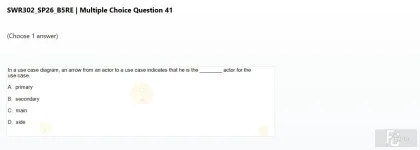
Question 41 (Choose 1 answer)In a use case diagram, an arrow from an actor to a use case indicates that he is the actor for the use case.A. primaryB. secondaryC. mainD. side
Question 42 (Choose 1 answer)Which metric helps monitor the volume and trends of requirements changes?A. Use Case MatrixB. Requirements Volatility ChartC. MOSCOW GndD. Stakeholder Priority Index
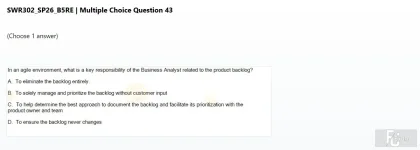
Question 43 (Choose 1 answer)In an agile environment, what is a key responsibility of the Business Analyst related to the product backlog?A. To eliminate the backlog entirelyB. To solely manage and prioritize the backlog without customer inputC. To help determine the best approach to document the backlog and facilitate its prioritization with the product owner and teamD. To ensure the backlog never changes
Question 44 (Choose 1 answer)Which of the following does NOT suggest an overall description of the Software Requirements Specification template?A. Product perspectiveB. User classes and characteristicsC. Operating environmentD. Design and implementation constraintsE. Assumptions and dependenciesF. System feature
Question 45 (Choose 1 answer)How does the MOSCOW method assist in prioritizing requirements?A. By categorizing requirements as Must-have, Should-have, Could-have, and Won't-haveB. By focusing on technical feasibilityC. By skipping stakeholder engagementD. By eliminating low-priority requirements
Question 46 (Choose 1 answer)Which of the following is NOT a typical task of a business analyst?A. Eliciting requirementsB. Analyzing business processesC. Managing the project schedule.D. Validating the requirements
Question 47 (Choose 1 answer)What is the purpose of categorizing requirements into "Must-have" and "Should-have"?A. To prioritize high-value requirements for early implementationB. To eliminate low-priority requirements altogetherC. To finalize coding strategiesD. To reduce the scope of non-functional requirements
Question 48 (Choose 1 answer)Why is traceability essential for managing changing requirements?A. To track changes and ensure alignment with project goalsB. To prioritize functional requirementsC. To reduce stakeholder involvementD. To eliminate ambiguous requirements
Question 49 (Choose 1 answer)Why is the distinction between users and actors important when designing use cases?A. Because it ensures that use cases capture the correct interaction scenarios by clearly defining the roles (actors) that a user can assumeB. Because it allows designers to ignore interactions with non-human systemsC. Because it simplifies the use case diagrams by limiting the number of actorsD. Because it separates the business logic from the technical implementation
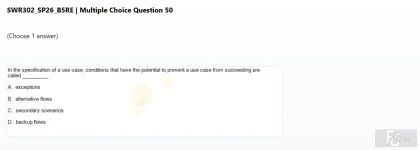
Question 50 (Choose 1 answer)In the specification of a use case, conditions that have the potential to prevent a use case from succeeding are calledA. exceptionsB. alternative flowsC. secondary scenariosD. backup flows
Question 51 (Choose 1 answer)Which of the following is NOT an objective of improving requirements processes?A. Improve the accuracy of project estimatesB. Reduce the cost of creating and maintaining softwareC. Increase the value delivered by projectsD. Increase the complexity of requirements
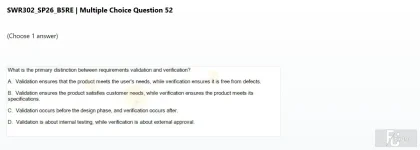
Question 52 (Choose 1 answer)What is the primary distinction between requirements validation and verification?A. Validation ensures that the product meets the user's needs, while verification ensures it is free from defects.B. Validation ensures the product satisfies customer needs, while verification ensures the product meets its specifications.C. Validation occurs before the design phase, and verification occurs afterD. Validation is about internal testing, while verification is about external approval.
Question 53 (Choose 1 answer)What does conceptual testing encourage early in the process?A. Interface designB. Team buildingC. Discovery of requirement gapsD. Detailed coding
Question 54 (Choose 1 answer)What is a primary reason for using visual models in requirements engineering?A. To provide a full picture of the intended system by supplementing textual requirementsB. To completely replace all textual requirements documentsC. To make diagrams look more appealingD. To primarily identify project management tasks.
Question 55 (Choose 2 answers)Which of the following statements correctly describes an action-enabler business rule? Select two.A. An action-enabler business rule triggers some activity only if all conditions are falseB. An action-enabler business rule typically follows the structure "if some condition is true or some event takes place, then something happens>"C. Action-enabler business rules are only applicable to manual processes and cannot be used to specify software functionalityD. A decision table is a useful tool for documenting action-enabler business rules that involve complex logic
Question 56 (Choose 1 answer)What is an example of a KPI that might need to be maintained when replacing a loan application system?A. The number of user interface changes per dayB. The number of loans that loan processors can enter per dayC. The number of features added to the systemD. The total amount of data processed by the system
Question 57 (Choose 1 answer)What are the major activities involved in requirements management?A. Version control, project scheduling, change control and budget managementB. Change control, risk assessment, requirements tracing and stakeholder engagementC. Version control, change control, requirements status tracking, and requirements tracingD. Change control, testing, deployment, and maintenance
Question 58 (Choose 1 answer)Which of the following is a key factor in managing outsourced projects?A. Establishing clear acceptance criteriaB. Focusing only on cost-cutting measuresC. Avoiding regular communicationD. Disregarding change management processes
Question 59 (Choose 1 answer)"The user must be able to sort the project list in forward and reverse alphabetical order" is aA. business requirementB. stake-holder requirementC. functional requirementD. data requirement
Question 60 (Choose 1 answer)What is the key difference between an inference and an action enabler in this pattern?A. Inferences trigger a system action, while action enablers provide new knowledgeB. The "then" clause of an inference simply provides a piece of knowledge, not an action to be takenC. Inferences are always quantitative, while action enablers are qualitativeD. Action enablers are atomic, while inferences are composite
Question 1 (Choose 1 answer)What is the primary role of a Business Analyst (BA)?A. Programming and testing softwareB. Eliciting, analyzing, documenting, and validating the needs of project stakeholders.C. Designing system architecture and databasesD. Managing project budget and schedule
Question 2 (Choose 1 answer)What is the primary purpose of a data dictionary in the context of specifying data requirements?A. To list all functional requirements in a projectB. To define data items and structures with consistent definitions for all project stakeholders.C. To depict the sequence of process flows within a systemD. To model user interface interactions
Question 3 (Choose 2 answers)When specifying the level of detail in software requirements, which of the following practices should be considered? Select twoA. It is always necessary to specify all requirements at the same high level of detail to ensure consistencyB. More detail should be included when the work is being done for an external client or when system testing will be based on the requirementsC. Less detail can be included if the work is being done internally for your company and developers have considerable domain experienceD. Writing all requirements at a very fine-grained level is always better, regardless of the project's context
Question 4 (Choose 3 answers)What does acceptance criteria include? Choose 3 correct answersA. Passing a defined set of acceptance tests based on user requirementsB. Demonstrating satisfaction of specific nonfunctional requirementsC. Tracking open defects and issuesD. Having a trendy user interface
Question 5 (Choose 1 answer)What should be considered when identifying data needs for a packaged solution?A. Data sources, formats, and integration pointsB. Only the storage capacity of the solutionC. User access permissionsD. The cost of data storage
Question 6 (Choose 1 answer)What tool did Seilevel develop to assist with estimating requirements development effort?A. A coding tool for developersB. A requirements effort estimation spreadsheet.C. A time-tracking tool for project managersD. A documentation tool for stakeholders
Question 7 (Choose 1 answer)How can ambiguity be avoided in requirements?A. By using clear, precise terms and avoiding vague languageB. By including as many possible options as possibleC. By being flexible in interpretationD. By relying on user preferences
Question 8 (Choose 1 answer)What are the three main dimensions of requirements reuse?A. Scope, cost, and risk.B. Extent of assets, extent of modification, and mechanism of reuse.C. Technical, business, and user levelsD. Elicitation, analysis, and validation
Question 9 (Choose 1 answer)What is the primary purpose of a standard SRS template?A. To enforce a rigid document structure that cannot be changedB. To provide a consistent structure for recording various groups of requirements-related information and to serve as a reminder of information to exploreC. To eliminate the need for any analysis activitiesD. To ensure that the SRS is always a traditional paper document.
Question 10 (Choose 3 answers)Entries in the data dictionary represent the following types of data elements. (choose 3 correct answers)A. PrimitiveB. StructureC. Repeating groupD. Virtual
Question 11 (Choose 1 answer)Customers are a____ of stakeholdersA. subsetB. representativeC. partnerD. equivalent
Question 12 (Choose 1 answer)Provide an example of an External Quality Attribute and an Internal Quality AttributeA. External: Performance; Internal: SecurityB. External: Reliability; Internal: InstallabilityC. External: Portability; Internal: ScalabilityD. External: Usability; Internal: Verifiability
Question 13 (Choose 1 answer)What is the primary challenge in eliciting non-functional requirements?A. They are often ambiguous and difficult to quantifyB. They are less important than functional requirementsC. They focus only on system designD. They do not require stakeholder input.
Question 14 (Choose 3 answers)What is true about a software prototype? Choose 3 correct answersA. It is a partial implementation of a proposed new productB. It is a possible implementation of a proposed new productC. It is a preliminary implementation of a proposed new product.D. It is a complete implementation of a proposed new product
Question 15 (Choose 1 answer)What would a conditional word, like "if" the chemical is hazardous, map to in an analysis model?A. Processes in a DFDB. Decisions in a Decision TreeC. Entities in an ERDD. Transitions in a State Transition Diagram
Question 16 (Choose 1 answer)Which of the following statements is TRUE about Use Cases?A. Use Cases are static and do not evolve throughout the software development processB. Use case diagrams are the primary tool to document requirementsC. Use Cases are not useful in capturing user requirementsD. Use Cases describe the interactions between the system and external entities
Question 17 (Choose 1 answer)A collection of definitions for the data elements and data structures that are relevant to the problem domainA. Data dictionaryB. Data flow diagramC. DatabaseD. Relationship
Question 18 (Choose 3 answers)What is true about a software prototype? Choose 3 correct answersA. It is a partial implementation of a proposed new product.B. It is a possible implementation of a proposed new product.C. It is a preliminary implementation of a proposed new product.D. It is a complete implementation of a proposed new product.
Question 19 (Choose 2 answers)What technique is used to represent the scope of a project? (Choose 2 correct answers)A. Ecosystem mapB. Use caseC. Context diagramD. ERD
Question 20 (Choose 1 answer)Why is stakeholder feedback critical during requirements validation?A. To ensure requirements align with business objectives and user needsB. To finalize coding strategiesC. To skip ambiguous requirementsD. To prioritize testing phases
Question 21 (Choose 1 answer)Which keyword in Planguage defines the goal or minimum acceptable achievement level?A. AMBITIONB. SCALEC. GOALD. WISH
Question 22 (Choose 1 answer)What is Planguage?A. It is a programming languageB. It is a language with a rich set of keywords that permits precise statements of quality attributes and other project goals.C. It is a planning language used in project managementD. It is a language to express non functional requirements.
Question 23 (Choose 1 answer)What is the primary reason for reusing requirements?A. To reduce the effort and cost of requirements developmentB. To improve system securityC. To validate requirements more efficientlyD. To develop new requirements faster
Question 24 (Choose 1 answer)What should you not expect a prototype to replace?A. Multiple iterationsB. Written requirementsC. Plausible data.D. The purpose of the prototype
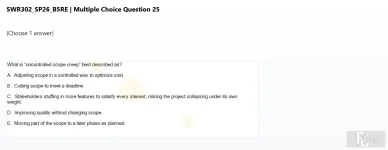
Question 25 (Choose 1 answer)What is "uncontrolled scope creep" best described as?A. Adjusting scope in a controlled way to optimize costB. Cutting scope to meet a deadline.C. Stakeholders stuffing in more features to satisfy every interest, risking the project collapsing under its own weightD. Improving quality without changing scope.E. Moving part of the scope to a later phase as planned
Question 26 (Choose 1 answer)Why is prioritization essential in agile projects, especially when customer expectations are high and timelines are short?A. It ensures that the project manager can handle the project without customer input, focusing solely on cost and efficiencyB. It allows developers to skip less important features, ensuring that only critical bugs are fixed before release.C. It helps in delivering the most critical or valuable functionality as early as possible, ensuring maximum business value within project constraints.D. It lets the project manager choose which requirements to ignore, focusing only on budget and staff limitations
Question 27 (Choose 2 answers)Which of the following statements accurately reflects the distribution of requirements development effort in different software development life cycles? Select twoA. In the waterfall life cycle, most of the requirements development effort is concentrated at the beginning of the projectB. Iterative and phased life cycles involve gathering and refining requirements only once at the start of the projectC. Agile and incremental development projects allocate requirements development effort throughout the project, with small but frequent efforts.D. Regardless of the life cycle, no additional requirements work is needed once the initial requirements phase is complete
Question 28 (Choose 1 answer)Which of the following characteristics should a collection of requirements exhibit?A. Completeness, meaning it is acceptable if some necessary information is absent as long as the core requirements are documented.B. Modifiability which allows changes to be made without maintaining a history of changes or considering dependencies among requirementsC. Consistency, ensuring that requirements do not conflict with other requirements or higher-level business, user, or system requirementsD. Traceability, where requirements should be loosely linked and not necessarily connected to their origin or to derived elements
Question 29 (Choose 1 answer)What is the purpose of a Requirements Traceability Matrix (RTM) in the requirements management process?A. To trace the origin of software bugsB. To document project milestonesC. To track the relationship between requirements and other project artifactsD. To manage project budgets
Question 30 (Choose 1 answer)What percentage of rework costs are due to requirements errors?A. 10-30%B. 30-50%C. 70-85%D. 90-100%
Question 31 (Choose 1 answer)Propose a solution for a scenario where a product owner is unable to understand all user requirements due to the complexity of the project. Which approach would you recommend?A. Replace the product owner with a more knowledgeable individualB. Collaborate with multiple business analysts and product champions to gather comprehensive requirements.C. Simplify the project to reduce complexityD. Delegate all decision-making to the development team
Đính kèm
-
 SWR302 SP26 B5 FE RE_001.webp27.1 KB · Lượt xem: 7
 -
 SWR302 SP26 B5 FE RE_002.webp17.7 KB · Lượt xem: 5
 -
 SWR302 SP26 B5 FE RE_003.webp18.2 KB · Lượt xem: 5
 -
 SWR302 SP26 B5 FE RE_004.webp24.5 KB · Lượt xem: 4
 -
 SWR302 SP26 B5 FE RE_005.webp37.4 KB · Lượt xem: 5
 -
 SWR302 SP26 B5 FE RE_006.webp26.5 KB · Lượt xem: 4
 -
 SWR302 SP26 B5 FE RE_007.webp22.2 KB · Lượt xem: 4
 -
 SWR302 SP26 B5 FE RE_008.webp22.6 KB · Lượt xem: 3
 -
 SWR302 SP26 B5 FE RE_009.webp24.2 KB · Lượt xem: 3
 -
 SWR302 SP26 B5 FE RE_010.webp17.9 KB · Lượt xem: 3
 -
 SWR302 SP26 B5 FE RE_011.webp19.9 KB · Lượt xem: 3
 -
 SWR302 SP26 B5 FE RE_012.webp31.8 KB · Lượt xem: 3
 -
 SWR302 SP26 B5 FE RE_013.webp27.8 KB · Lượt xem: 3
 -
 SWR302 SP26 B5 FE RE_014.webp26 KB · Lượt xem: 3
 -
 SWR302 SP26 B5 FE RE_015.webp20.7 KB · Lượt xem: 3
 -
 SWR302 SP26 B5 FE RE_016.webp26 KB · Lượt xem: 3
 -
 SWR302 SP26 B5 FE RE_017.webp23.6 KB · Lượt xem: 3
 -
 SWR302 SP26 B5 FE RE_018.webp35.5 KB · Lượt xem: 3
 -
 SWR302 SP26 B5 FE RE_019.webp20.8 KB · Lượt xem: 3
 -
 SWR302 SP26 B5 FE RE_020.webp25.1 KB · Lượt xem: 3
 -
 SWR302 SP26 B5 FE RE_021.webp36.3 KB · Lượt xem: 3
 -
 SWR302 SP26 B5 FE RE_022.webp18.6 KB · Lượt xem: 3
 -
 SWR302 SP26 B5 FE RE_023.webp28.2 KB · Lượt xem: 3
 -
 SWR302 SP26 B5 FE RE_024.webp41.8 KB · Lượt xem: 3
 -
 SWR302 SP26 B5 FE RE_025.webp27.6 KB · Lượt xem: 3
 -
 SWR302 SP26 B5 FE RE_026.webp31.8 KB · Lượt xem: 3
 -
 SWR302 SP26 B5 FE RE_027.webp23.6 KB · Lượt xem: 3
 -
 SWR302 SP26 B5 FE RE_028.webp20.5 KB · Lượt xem: 3
 -
 SWR302 SP26 B5 FE RE_029.webp33.1 KB · Lượt xem: 3
 -
 SWR302 SP26 B5 FE RE_030.webp25.5 KB · Lượt xem: 3
 -
 SWR302 SP26 B5 FE RE_031.webp28.8 KB · Lượt xem: 3
 -
 SWR302 SP26 B5 FE RE_032.webp45.6 KB · Lượt xem: 3
 -
 SWR302 SP26 B5 FE RE_033.webp25.6 KB · Lượt xem: 3
 -
 SWR302 SP26 B5 FE RE_034.webp22.7 KB · Lượt xem: 3
 -
 SWR302 SP26 B5 FE RE_035.webp24.4 KB · Lượt xem: 3
 -
 SWR302 SP26 B5 FE RE_036.webp22.7 KB · Lượt xem: 3
 -
 SWR302 SP26 B5 FE RE_037.webp22.6 KB · Lượt xem: 3
 -
 SWR302 SP26 B5 FE RE_038.webp34.8 KB · Lượt xem: 3
 -
 SWR302 SP26 B5 FE RE_039.webp18.9 KB · Lượt xem: 3
 -
 SWR302 SP26 B5 FE RE_040.webp14.7 KB · Lượt xem: 3
 -
 SWR302 SP26 B5 FE RE_041.webp24.3 KB · Lượt xem: 3
 -
 SWR302 SP26 B5 FE RE_042.webp23.9 KB · Lượt xem: 3
 -
 SWR302 SP26 B5 FE RE_043.webp27.6 KB · Lượt xem: 3
 -
 SWR302 SP26 B5 FE RE_044.webp22 KB · Lượt xem: 3
 -
 SWR302 SP26 B5 FE RE_045.webp30.5 KB · Lượt xem: 3
 -
 SWR302 SP26 B5 FE RE_046.webp19.6 KB · Lượt xem: 3
 -
 SWR302 SP26 B5 FE RE_047.webp27.6 KB · Lượt xem: 3
 -
 SWR302 SP26 B5 FE RE_048.webp18.3 KB · Lượt xem: 3
 -
 SWR302 SP26 B5 FE RE_049.webp23.3 KB · Lượt xem: 3
 -
 SWR302 SP26 B5 FE RE_050.webp17.2 KB · Lượt xem: 3
 -
 SWR302 SP26 B5 FE RE_051.webp26.1 KB · Lượt xem: 3
 -
 SWR302 SP26 B5 FE RE_052.webp22.5 KB · Lượt xem: 3
 -
 SWR302 SP26 B5 FE RE_053.webp18.3 KB · Lượt xem: 3
 -
 SWR302 SP26 B5 FE RE_054.webp31.2 KB · Lượt xem: 3
 -
 SWR302 SP26 B5 FE RE_055.webp46.4 KB · Lượt xem: 3
 -
 SWR302 SP26 B5 FE RE_056.webp48.9 KB · Lượt xem: 3
 -
 SWR302 SP26 B5 FE RE_057.webp45.9 KB · Lượt xem: 3
 -
 SWR302 SP26 B5 FE RE_058.webp26.8 KB · Lượt xem: 3
 -
 SWR302 SP26 B5 FE RE_059.webp16.1 KB · Lượt xem: 4
 -
 SWR302 SP26 B5 FE RE_060.webp35.6 KB · Lượt xem: 5