
- Học kỳ
- SP2026
- Thời Gian
- 4/5/26
- Loại tài liệu
- FE
SSL101c SP26 FE RE
Câu 1
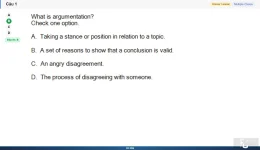
What is argumentation?
Câu 2
- Check one option.
- A. Taking a stance or position in relation to a topic.
- B. A set of reasons to show that a conclusion is valid.
- C. An angry disagreement.
- D. The process of disagreeing with someone.
- Đáp án: B
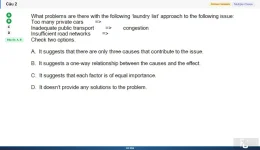
What problems are there with the following 'laundry list' approach to the following issue:
Too many private cars => congestion
Inadequate public transport => congestion
Insufficient road networks => congestion
Câu 3
- Check two options.
- A. It suggests that there are only three causes that contribute to the issue.
- B. It suggests a one-way relationship between the causes and the effect.
- C. It suggests that each factor is of equal importance.
- D. It doesn't provide any solutions to the problem.
- Đáp án: A, B
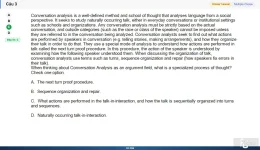
When thinking about Conversation Analysis as an argument field, what is a specialized process of thought?
Câu 4
- Check one option.
- A. The next turn proof procedure.
- B. Sequence organization and repair.
- C. What actions are performed in the talk-in-interaction, and how the talk is sequentially organized into turns and sequences.
- D. Naturally occurring talk-in-interaction.
- Đáp án: A
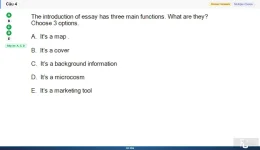
The introduction of essay has three main functions. What are they?
Câu 5
- Choose 3 options.
- A. It's a map.
- B. It's a cover.
- C. It's a background information.
- D. It's a microcosm.
- E. It's a marketing tool.
- Đáp án: A, C, D
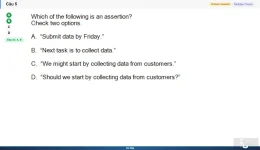
Which of the following is an assertion?
Câu 6
- Check two options.
- A. "Submit data by Friday."
- B. "Next task is to collect data."
- C. "We might start by collecting data from customers."
- D. "Should we start by collecting data from customers?"
- Đáp án: A, B
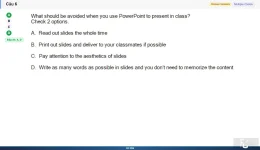
What should be avoided when you use PowerPoint to present in class?
Câu 7
- Check 2 options.
- A. Read out slides the whole time.
- B. Print out slides and deliver to your classmates if possible.
- C. Pay attention to the aesthetics of slides.
- D. Write as many words as possible in slides and you don't need to memorize the content.
- Đáp án: A, D
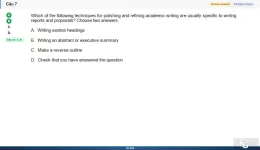
Which of the following techniques for polishing and refining academic writing are usually specific to writing reports and proposals?
Câu 8
- Choose two answers.
- A. Writing section headings.
- B. Writing an abstract or executive summary.
- C. Make a reverse outline.
- D. Check that you have answered the question.
- Đáp án: A, B
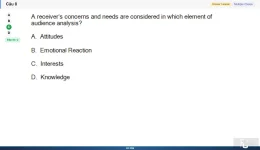
A receiver's concerns and needs are considered in which element of audience analysis?
Câu 9
- Check one option.
- A. Attitudes.
- B. Emotional Reaction.
- C. Interests.
- D. Knowledge.
- Đáp án: C
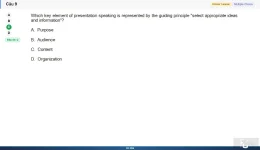
Which key element of presentation speaking is represented by the guiding principle "select appropriate ideas and information"?
Câu 10
- Check one option.
- A. Purpose.
- B. Audience.
- C. Content.
- D. Organization.
- Đáp án: C
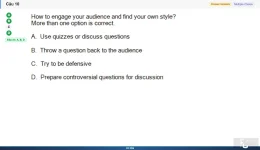
How to engage your audience and find your own style?
Câu 11
- More than one option is correct.
- A. Use quizzes or discuss questions.
- B. Throw a question back to the audience.
- C. Try to be defensive.
- D. Prepare controversial questions for discussion.
- Đáp án: A, B, D
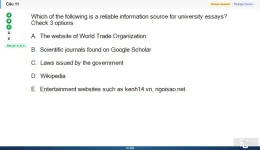
Which of the following is a reliable information source for university essays?
Câu 12
- Check 3 options.
- A. The website of World Trade Organization.
- B. Scientific journals found on Google Scholar.
- C. Laws issued by the government.
- D. Wikipedia.
- E. Entertainment websites such as kenh14.vn, ngoisao.net.
- Đáp án: A, B, C
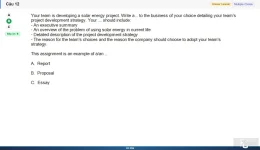
This assignment [solar energy project development strategy] is an example of a/an:
Câu 13
- Check one option.
- A. Report.
- B. Proposal.
- C. Essay.
- Đáp án: B
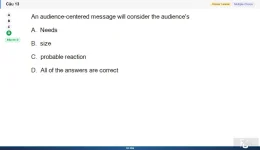
An audience-centered message will consider the audience's:
Câu 14
- Check one option.
- A. Needs.
- B. size.
- C. probable reaction.
- D. All of the answers are correct.
- Đáp án: D
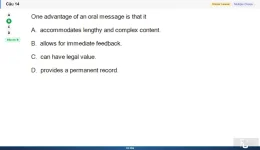
One advantage of an oral message is that it:
Câu 15
- Check one option.
- A. accommodates lengthy and complex content.
- B. allows for immediate feedback.
- C. can have legal value.
- D. provides a permanent record.
- Đáp án: B
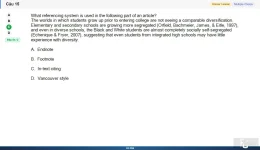
What referencing system is used in the following part of an article? (Citation includes authors and year in parentheses)
Câu 16
- Check one option.
- A. Endnote.
- B. Footnote.
- C. In-text citing.
- D. Vancouver style.
- Đáp án: C
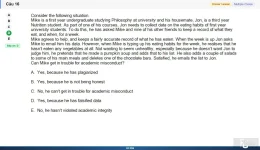
Can Mike get in trouble for academic misconduct? [Situation: Mike fakes data in his eating habit record for Jon]
Câu 17
- Check one option.
- A. Yes, because he has plagiarized.
- B. Yes, because he is not being honest.
- C. No, he can't get in trouble for academic misconduct.
- D. Yes, because he has falsified data.
- E. No, he hasn't violated academic integrity.
- Đáp án: D
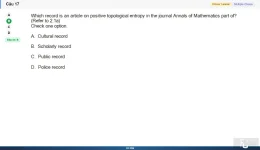
Which record is an article on positive topological entropy in the journal Annals of Mathematics part of?
Câu 18
- Check one option.
- A. Cultural record.
- B. Scholarly record.
- C. Public record.
- D. Police record.
- Đáp án: B
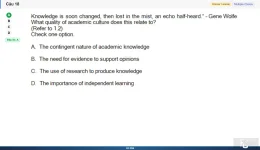
"Knowledge is soon changed, then lost in the mist, an echo half-heard." - Gene Wolfe. What quality of academic culture does this relate to?
Câu 19
- Check one option.
- A. The contingent nature of academic knowledge.
- B. The need for evidence to support opinions.
- C. The use of research to produce knowledge.
- D. The importance of independent learning.
- Đáp án: A
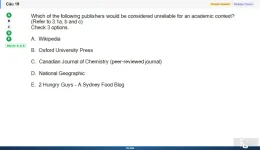
Which of the following publishers would be considered unreliable for an academic context?
Câu 20
- Check 3 options.
- A. Wikipedia.
- B. Oxford University Press.
- C. Canadian Journal of Chemistry (peer-reviewed journal).
- D. National Geographic.
- E. 2 Hungry Guys - A Sydney Food Blog.
- Đáp án: A, D, E
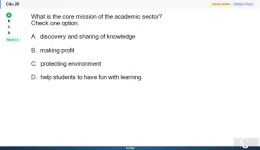
What is the core mission of the academic sector?
Câu 21
- Check one option.
- A. discovery and sharing of knowledge.
- B. making profit.
- C. protecting environment.
- D. help students to have fun with learning.
- Đáp án: A
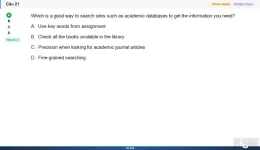
Which is a good way to search sites such as academic databases to get the information you need?
Câu 22
- Check one option.
- A. Use key words from assignment.
- B. Check all the books available in the library.
- C. Precision when looking for academic journal articles.
- D. Fine-grained searching.
- Đáp án: A
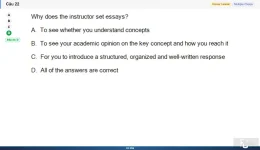
Why does the instructor set essays?
Câu 23
- Check one option.
- A. To see whether you understand concepts.
- B. To see your academic opinion on the key concept and how you reach it.
- C. For you to introduce a structured, organized and well-written response.
- D. All of the answers are correct.
- Đáp án: D
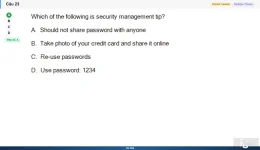
Which of the following is security management tip?
Câu 24
- Check one option.
- A. Should not share password with anyone.
- B. Take photo of your credit card and share it online.
- C. Re-use passwords.
- D. Use password: 1234.
- Đáp án: A
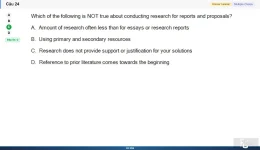
Which of the following is NOT true about conducting research for reports and proposals?
Câu 25
- Check one option.
- A. Amount of research often less than for essays or research reports.
- B. Using primary and secondary resources.
- C. Research does not provide support or justification for your solutions.
- D. Reference to prior literature comes towards the beginning.
- Đáp án: C
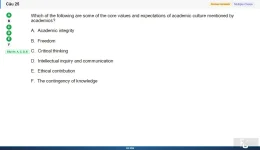
Which of the following are some of the core values and expectations of academic culture mentioned by academics?
Câu 26
- Check more than one (Likely all A-F based on content).
- A. Academic integrity.
- B. Freedom.
- C. Critical thinking.
- D. Intellectual inquiry and communication.
- E. Ethical contribution.
- F. The contingency of knowledge.
- Đáp án: A, B, C, D, E, F
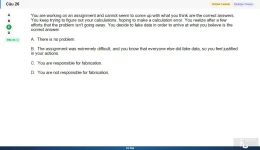
You decide to fake data in order to arrive at what you believe is the correct answer. [Situation analysis]
Câu 27
- Check one option.
- A. There is no problem.
- B. The assignment was extremely difficult... so you feel justified.
- C. You are responsible for fabrication.
- D. You are not responsible for fabrication.
- Đáp án: C
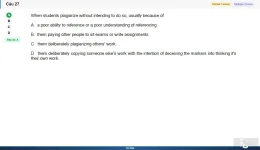
When students plagiarize without intending to do so, usually because of:
Câu 28
- Check one option.
- A. a poor ability to reference or a poor understanding of referencing.
- B. them paying other people to sit exams or write assignments.
- C. them deliberately plagiarizing others' work.
- D. them deliberately copying someone else's work with the intention of deceiving.
- Đáp án: A
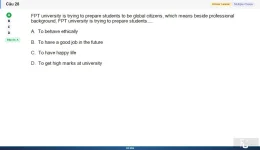
FPT university is trying to prepare students to be global citizens... which means...
Câu 29
- Check one option.
- A. To behave ethically.
- B. To have a good job in the future.
- C. To have happy life.
- D. To get high marks at university.
- Đáp án: A
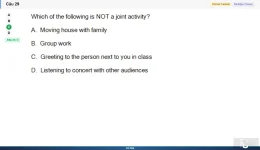
Which of the following is NOT a joint activity?
Câu 30
- Check one option.
- A. Moving house with family.
- B. Group work.
- C. Greeting to the person next to you in class.
- D. Listening to concert with other audiences.
- Đáp án: D (hoặc C tùy vào ngữ cảnh bài học, nhưng đáp án ghi C trong bản text).
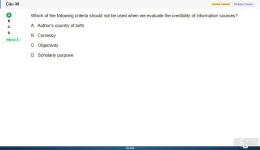
Which of the following criteria should not be used when we evaluate the credibility of information sources?
Câu 31
- Check one option.
- A. Author's country of birth.
- B. Currency.
- C. Objectivity.
- D. Scholarly purpose.
- Đáp án: A
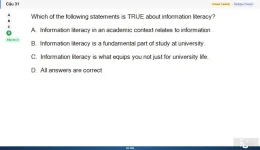
Which of the following statements is TRUE about information literacy?
Câu 32
- Check one option.
- A. Information literacy in an academic context relates to information.
- B. Information literacy is a fundamental part of study at university.
- C. Information literacy is what equips you not just for university life.
- D. All answers are correct.
- Đáp án: D
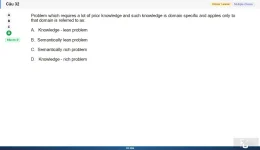
Problem which requires a lot of prior knowledge and such knowledge is domain specific... is referred to as:
Câu 33
- Check one option.
- A. Knowledge - lean problem.
- B. Semantically lean problem.
- C. Semantically rich problem.
- D. Knowledge- rich problem.
- Đáp án: D
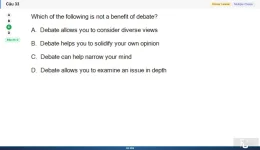
Which of the following is not a benefit of debate?
Câu 34
- Check one option.
- A. Debate allows you to consider diverse views.
- B. Debate helps you to solidify your own opinion.
- C. Debate can help narrow your mind.
- D. Debate allows you to examine an issue in depth.
- Đáp án: C
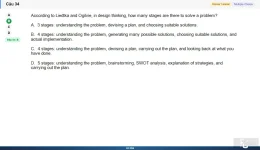
According to Liedtka and Ogilvie, in design thinking, how many stages are there to solve a problem?
Câu 35
- Check one option.
- A. 3 stages.
- B. 4 stages: understanding, generating solutions, choosing solutions, implementation.
- C. 4 stages: understanding, devising a plan, carrying out, looking back.
- D. 5 stages.
- Đáp án: B
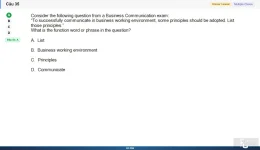
"To successfully communicate in business working environment, some principles should be adopted. List those principles." What is the function word or phrase in the question?
Câu 36
- Check one option.
- A. List.
- B. Business working environment.
- C. Principles.
- D. Communicate.
- Đáp án: A
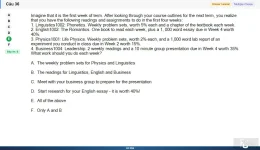
[Situation: Multiple assignments due]. What work should you do each week?
Câu 37
- Check one option.
- A. The weekly problem sets for Physics and Linguistics.
- B. The readings for Linguistics, English and Business.
- C. Meet with your business group.
- D. Start research for your English essay.
- E. All of the above.
- F. Only A and B.
- Đáp án: E
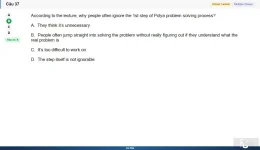
According to the lecture, why people often ignore the 1st step of Polya problem solving process?
Câu 38
- Check one option.
- A. They think it's unnecessary.
- B. People often jump straight into solving... without figuring out if they understand the real problem.
- C. It's too difficult to work on.
- D. The step itself is not ignorable.
- Đáp án: B
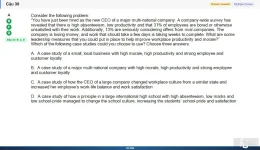
[Situation: New CEO facing company issues]. Which of the following case studies could you choose to use?
Câu 39
- Choose three answers.
- A. Case study of a small local business with high morale.
- B. Case study of a major multi-national company with high morale.
- C. Case study of how a CEO of a large company changed workplace culture.
- D. Case study of how a principal in a large high school managed to change school culture.
- Đáp án: B, C, D
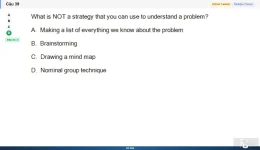
What is NOT a strategy that you can use to understand a problem?
Câu 40
- Check one option.
- A. Making a list of everything we know.
- B. Brainstorming.
- C. Drawing a mind map.
- D. Nominal group technique.
- Đáp án: D
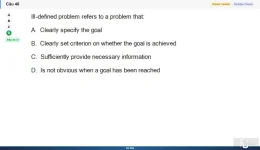
Ill-defined problem refers to a problem that:
Câu 41
- Check one option.
- A. Clearly specify the goal.
- B. Clearly set criterion on whether the goal is achieved.
- C. Sufficiently provide necessary information.
- D. Is not obvious when a goal has been reached.
- Đáp án: D
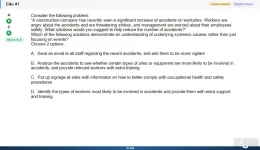
[Situation: Construction accidents]. Which solutions demonstrate an understanding of underlying systemic causes?
Câu 42
- Choose 2 options.
- A. Send an email to all staff... ask them to be more vigilant.
- B. Analyze the accidents to see whether certain types of sites or equipment are more likely... provide extra training.
- C. Put up signage at sites.
- D. Identify the types of workers most likely to be involved... provide extra support and training.
- Đáp án: B, D
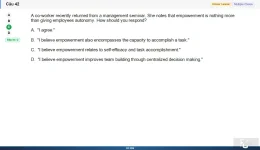
A co-worker notes that empowerment is nothing more than giving employees autonomy. How should you respond?
Câu 43
- Check one option.
- A. "I agree."
- B. "I believe empowerment also encompasses the capacity to accomplish a task."
- C. "I believe empowerment relates to self-efficacy and task accomplishment."
- D. "I believe empowerment improves team building through centralized decision making."
- Đáp án: C
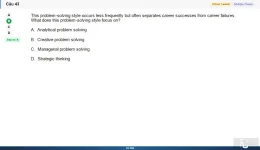
This problem-solving style occurs less frequently but often separates career successes from career failures. What does it focus on?
Câu 44
- Check one option.
- A. Analytical problem solving.
- B. Creative problem solving.
- C. Managerial problem solving.
- D. Strategic thinking.
- Đáp án: B
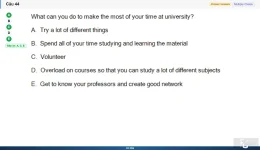
What can you do to make the most of your time at university?
Câu 45
- Choose more than one.
- A. Try a lot of different things.
- B. Spend all of your time studying.
- C. Volunteer.
- D. Overload on courses.
- E. Get to know your professors and create good network.
- Đáp án: A, C, E
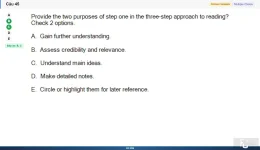
Provide the two purposes of step one in the three-step approach to reading?
Câu 46
- Check 2 options.
- A. Gain further understanding.
- B. Assess credibility and relevance.
- C. Understand main ideas.
- D. Make detailed notes.
- E. Circle or highlight them for later reference.
- Đáp án: B, C
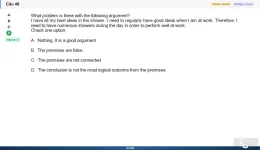
What problem is there with the following argument? "I have all my best ideas in the shower... Therefore, I need to have numerous showers during the day..."
Câu 47
- Check one option.
- A. Nothing. It is a good argument.
- B. The premises are false.
- C. The premises are not connected.
- D. The conclusion is not the most logical outcome from the premises.
- Đáp án: D
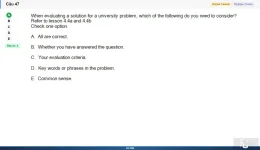
When evaluating a solution for a university problem, which of the following do you need to consider?
Câu 48
- Check one option.
- A. All are correct.
- B. Whether you have answered the question.
- C. Your evaluation criteria.
- D. Key words or phrases in the problem.
- E. Common sense.
- Đáp án: A
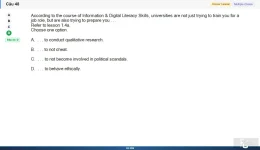
Universities are not just trying to train you for a job role, but are also trying to prepare you...
Câu 49
- Choose one option.
- A. to conduct qualitative research.
- B. to not cheat.
- C. to not become involved in political scandals.
- D. to behave ethically.
- Đáp án: D
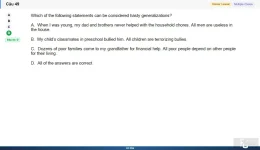
Which of the following statements can be considered hasty generalizations?
Câu 50
- Check one option.
- A. All men are useless in the house.
- B. All children are terrorizing bullies.
- C. All poor people depend on other people.
- D. All of the answers are correct.
- Đáp án: D
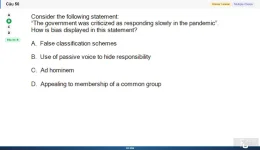
"The government was criticized as responding slowly in the pandemic". How is bias displayed?
Câu 51
- Check one option.
- A. False classification schemes.
- B. Use of passive voice to hide responsibility.
- C. Ad hominem.
- D. Appealing to membership of a common group.
- Đáp án: B
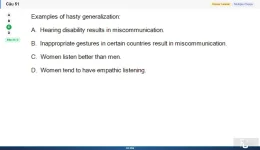
Examples of hasty generalization:
Câu 52
- Check one option.
- A. Hearing disability results in miscommunication.
- B. Inappropriate gestures... result in miscommunication.
- C. Women listen better than men.
- D. Women tend to have empathic listening.
- Đáp án: C
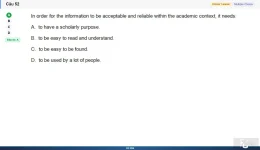
In order for the information to be acceptable and reliable within the academic context, it needs:
Câu 53
- Check one option.
- A. to have a scholarly purpose.
- B. to be easy to read and understand.
- C. to be easy to be found.
- D. to be used by a lot of people.
- Đáp án: A
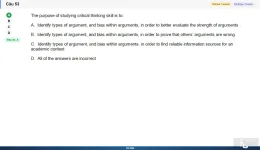
The purpose of studying critical thinking skill is to:
Câu 54
- Check one option.
- A. Identify types of argument, and bias... in order to better evaluate the strength of arguments.
- B. Identify types of argument... to prove others are wrong.
- C. Identify types of argument... to find reliable sources.
- D. All of the answers are incorrect.
- Đáp án: A
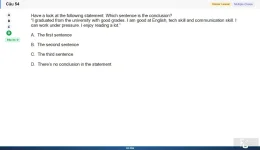
Have a look at the following statement. Which sentence is the conclusion? [Graduation/Skills/Reading]
Câu 55
- Check one option.
- A. The first sentence.
- B. The second sentence.
- C. The third sentence.
- D. There's no conclusion in the statement.
- Đáp án: D
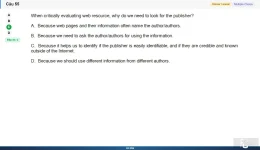
When critically evaluating web resource, why do we need to look for the publisher?
Câu 56
- Check one option.
- A. Because web pages often name authors.
- B. Because we need to ask authors for using information.
- C. Because it helps identify if the publisher is credible/known outside the Internet.
- D. Because we should use different information.
- Đáp án: C
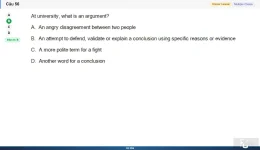
At university, what is an argument?
Câu 57
- Choose one option.
- A. An angry disagreement.
- B. An attempt to defend, validate or explain a conclusion using specific reasons or evidence.
- C. A polite term for a fight.
- D. Another word for a conclusion.
- Đáp án: B
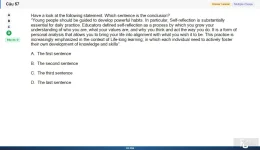
Which sentence is the conclusion? [Young people should be guided to develop powerful habits...]
Câu 58
- Check one option.
- A. The first sentence.
- B. The second sentence.
- C. The third sentence.
- D. The last sentence.
- Đáp án: A
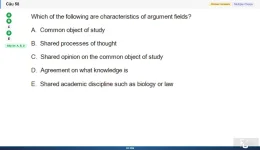
Which of the following are characteristics of argument fields?
Câu 59
- Choose more than one.
- A. Common object of study.
- B. Shared processes of thought.
- C. Shared opinion on the common object of study.
- D. Agreement on what knowledge is.
- E. Shared academic discipline.
- Đáp án: A, B, D
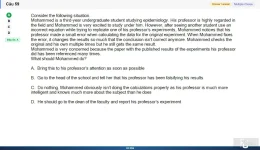
Mohammed notices a small error in his professor's published experiment. What should Mohammed do?
Câu 60
- Check one option.
- A. Bring this to his professor's attention as soon as possible.
- B. Go to the head of the school and say he is falsifying results.
- C. Do nothing.
- D. Go to the dean and report the experiment.
- Đáp án: A
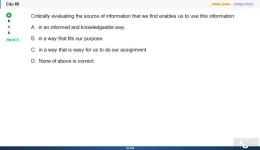
Critically evaluating the source of information enables us to use this information:
- Check one option.
- A. in an informed and knowledgeable way.
- B. in a way that fits our purpose.
- C. in a way that is easy to do assignment.
- D. None of above.
- Đáp án: A
Đính kèm
-
 SSL101c SP26 FE RE_001.webp51.4 KB · Lượt xem: 3
 -
 SSL101c SP26 FE RE_002.webp78.7 KB · Lượt xem: 3
 -
 SSL101c SP26 FE RE_003.webp176.5 KB · Lượt xem: 1
 -
 SSL101c SP26 FE RE_004.webp46.2 KB · Lượt xem: 1
 -
 SSL101c SP26 FE RE_005.webp54 KB · Lượt xem: 1
 -
 SSL101c SP26 FE RE_006.webp56.9 KB · Lượt xem: 1
 -
 SSL101c SP26 FE RE_007.webp48.1 KB · Lượt xem: 1
 -
 SSL101c SP26 FE RE_008.webp40.1 KB · Lượt xem: 1
 -
 SSL101c SP26 FE RE_009.webp32.9 KB · Lượt xem: 1
 -
 SSL101c SP26 FE RE_010.webp55.9 KB · Lượt xem: 1
 -
 SSL101c SP26 FE RE_011.webp61.5 KB · Lượt xem: 0
 -
 SSL101c SP26 FE RE_012.webp67.1 KB · Lượt xem: 0
 -
 SSL101c SP26 FE RE_013.webp36.8 KB · Lượt xem: 0
 -
 SSL101c SP26 FE RE_014.webp46 KB · Lượt xem: 0
 -
 SSL101c SP26 FE RE_015.webp79.3 KB · Lượt xem: 0
 -
 SSL101c SP26 FE RE_016.webp145.3 KB · Lượt xem: 0
 -
 SSL101c SP26 FE RE_017.webp38.2 KB · Lượt xem: 0
 -
 SSL101c SP26 FE RE_018.webp65.5 KB · Lượt xem: 0
 -
 SSL101c SP26 FE RE_019.webp55.7 KB · Lượt xem: 0
 -
 SSL101c SP26 FE RE_020.webp47 KB · Lượt xem: 0
 -
 SSL101c SP26 FE RE_021.webp46.2 KB · Lượt xem: 0
 -
 SSL101c SP26 FE RE_022.webp59.4 KB · Lượt xem: 0
 -
 SSL101c SP26 FE RE_023.webp47.7 KB · Lượt xem: 0
 -
 SSL101c SP26 FE RE_024.webp59.5 KB · Lượt xem: 0
 -
 SSL101c SP26 FE RE_025.webp45.7 KB · Lượt xem: 0
 -
 SSL101c SP26 FE RE_026.webp75.3 KB · Lượt xem: 0
 -
 SSL101c SP26 FE RE_027.webp55.2 KB · Lượt xem: 0
 -
 SSL101c SP26 FE RE_028.webp46.7 KB · Lượt xem: 0
 -
 SSL101c SP26 FE RE_029.webp45.4 KB · Lượt xem: 0
 -
 SSL101c SP26 FE RE_030.webp33.6 KB · Lượt xem: 0
 -
 SSL101c SP26 FE RE_031.webp65.2 KB · Lượt xem: 0
 -
 SSL101c SP26 FE RE_032.webp41.5 KB · Lượt xem: 0
 -
 SSL101c SP26 FE RE_033.webp54.9 KB · Lượt xem: 0
 -
 SSL101c SP26 FE RE_034.webp76.3 KB · Lượt xem: 0
 -
 SSL101c SP26 FE RE_035.webp49.5 KB · Lượt xem: 0
 -
 SSL101c SP26 FE RE_036.webp125.5 KB · Lượt xem: 0
 -
 SSL101c SP26 FE RE_037.webp47.6 KB · Lượt xem: 0
 -
 SSL101c SP26 FE RE_038.webp159.9 KB · Lượt xem: 0
 -
 SSL101c SP26 FE RE_039.webp47.5 KB · Lượt xem: 0
 -
 SSL101c SP26 FE RE_040.webp52.3 KB · Lượt xem: 0
 -
 SSL101c SP26 FE RE_041.webp123.9 KB · Lượt xem: 0
 -
 SSL101c SP26 FE RE_042.webp60.7 KB · Lượt xem: 0
 -
 SSL101c SP26 FE RE_043.webp43.1 KB · Lượt xem: 0
 -
 SSL101c SP26 FE RE_044.webp65.5 KB · Lượt xem: 0
 -
 SSL101c SP26 FE RE_045.webp55.5 KB · Lượt xem: 0
 -
 SSL101c SP26 FE RE_046.webp60.5 KB · Lượt xem: 0
 -
 SSL101c SP26 FE RE_047.webp49.5 KB · Lượt xem: 0
 -
 SSL101c SP26 FE RE_048.webp47.9 KB · Lượt xem: 0
 -
 SSL101c SP26 FE RE_049.webp60.7 KB · Lượt xem: 0
 -
 SSL101c SP26 FE RE_050.webp64.9 KB · Lượt xem: 0
 -
 SSL101c SP26 FE RE_051.webp54.5 KB · Lượt xem: 0
 -
 SSL101c SP26 FE RE_052.webp42.5 KB · Lượt xem: 0
 -
 SSL101c SP26 FE RE_053.webp60.6 KB · Lượt xem: 0
 -
 SSL101c SP26 FE RE_054.webp50.7 KB · Lượt xem: 0
 -
 SSL101c SP26 FE RE_055.webp63.8 KB · Lượt xem: 0
 -
 SSL101c SP26 FE RE_056.webp46 KB · Lượt xem: 0
 -
 SSL101c SP26 FE RE_057.webp94.8 KB · Lượt xem: 0
 -
 SSL101c SP26 FE RE_058.webp61.6 KB · Lượt xem: 0
 -
 SSL101c SP26 FE RE_059.webp150.2 KB · Lượt xem: 0
 -
 SSL101c SP26 FE RE_060.webp46 KB · Lượt xem: 3