
- Học kỳ
- SP2026
- Thời Gian
- 4/5/26
- Loại tài liệu
- FE
PMG201c SP26 FE RE
Câu 1 (Chọn 1 đáp án - Multiple Choice)
True or False: A Project is defined as being unique and temporary, with an defined start and finish.
A. True
B. False
Câu 2 (Chọn 1 đáp án - Multiple Choice)
True or False: The worst organization to use to run a project will always be the functional organization.
A. True
B. False
Câu 3 (Chọn 1 đáp án - Multiple Choice)
The three components of the triple constraint are:
A. Scope, Cost, Time
B. Scope, Quality, Cost
C. Scope, Performance, Cost
D. Scope, Performance, Time
Câu 4 (Chọn 1 đáp án - Multiple Choice)
The primary role of the project manager is:
A. Distributing work packages
B. Measuring performance
C. Communication
D. Project initiation
Câu 5 (Chọn 1 đáp án - Multiple Choice)
Which of the following best describes the project manager's role as an integrator?
A. Help team members become familiar with the project
B. Put all the pieces of a project into a cohesive whole
C. Put all the pieces of a project into a program
D. Get all team members together into a cohesive whole
Câu 6 (Chọn 1 đáp án - Multiple Choice)
Which of the following is included in a project charter?
A. A risk management strategy
B. Work package estimates
C. Detailed resources estimates
D. The business case for the project
Câu 7 (Chọn 1 đáp án - Multiple Choice)
One of the stakeholders of the project contacts the project manager to discuss some additional scope they would like to add to the project. The project manager asks for details in writing and then works through the Control Scope process. What should the project manager do next when the evaluation of the requested scope is complete?
A. Ask the stakeholder if any more changes are expected
B. Complete integrated change control
C. Make sure the impact of the change is understood by the stakeholder
D. Find out the root cause of why the scope was not identified during project planning
Câu 8 (Chọn 1 đáp án - Multiple Choice)
During executing, the project manager determines that a change is needed to material purchased for the project. The project manager calls a meeting of the team to plan how to make the changes. This is an example of:
A. Management by objectives
B. Lack of a change management plan
C. Good team relations
D. Lack of a clear work breakdown structure
Câu 9 (Chọn 1 đáp án - Multiple Choice)
The Scope Management section of your project plan document would include information on:
A. How to ask for more money for the project.
B. Who can suggest changes to the project.
C. How risks are to be managed.
D. What type of scheduling software to use.
Câu 10 (Chọn 1 đáp án - Multiple Choice)
True or False: Project scope statement is better to define inclusions (in-scope items) than identify only exclusions (out of scope items).
A. False
B. True
Câu 11 (Chọn 1 đáp án - Multiple Choice)
True or False: A Work Breakdown Structure (WBS) is a deliverable-oriented hierarchical decomposition of the work to be executed just by the Project Manager.
A. False
B. True
Câu 12 (Chọn 1 đáp án - Multiple Choice)
To manage a project effectively, work should be broken down into small pieces. Which of the following does not describe how far to decompose the work?
A. Until it has a meaningful conclusion
B. Until it cannot be logically subdivided further
C. Until it can be done by one person
D. Until it can be realistically estimated
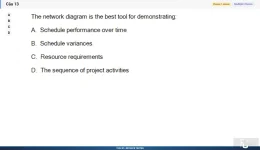
Câu 13 (Chọn 1 đáp án - Multiple Choice)
The network diagram is the best tool for demonstrating:
A. Schedule performance over time
B. Schedule variances
C. Resource requirements
D. The sequence of project activities
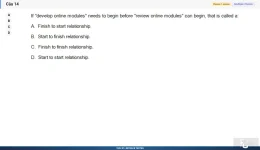
Câu 14 (Chọn 1 đáp án - Multiple Choice)
If "develop online modules" needs to begin before "review online modules" can begin, that is called a:
A. Finish to start relationship.
B. Start to finish relationship.
C. Finish to finish relationship.
D. Start to start relationship.
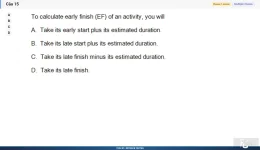
Câu 15 (Chọn 1 đáp án - Multiple Choice)
To calculate early finish (EF) of an activity, you will:
A. Take its early start plus its estimated duration.
B. Take its late start plus its estimated duration.
C. Take its late finish minus its estimated duration.
D. Take its late finish.
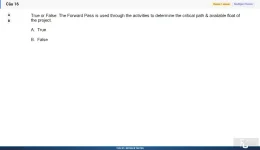
Câu 16 (Chọn 1 đáp án - Multiple Choice)
True or False. The Forward Pass is used through the activities to determine the critical path & available float of the project.
A. True
B. False
Câu 17 (Chọn 1 đáp án - Multiple Choice)
Which one is NOT the approach to shorten your project schedule?
A. Fast Tracking
B. Crashing
C. Reducing
Câu 18 (Chọn 1 đáp án - Multiple Choice)
True or False: When you are concerned that your estimates might not be correct, especially if you think they are too low, you should pad the estimate and add extra.
A. True
B. False
Câu 19 (Chọn 1 đáp án - Multiple Choice)
Which of the following is NOT the advantages of top-down estimating?
A. Quick
B. Activities do not need to be identified
C. Less costly to create
D. More accurate
Câu 20 (Chọn 1 đáp án - Multiple Choice)
Which of the following is the most correct statement regarding management and contingency reserves?
A. Both of them are included into the cost baseline of the project.
B. Both of them are not included into the cost baseline of the project
C. Management reserve is included into the cost baseline but contingency reserve is not
D. Contingency reserve is included into the cost baseline but management reserve is not.
Câu 21 (Chọn 1 đáp án - Multiple Choice)
True or False: Earned value integrates budget, quality and scope and uses monetary values to assess project status.
A. False
B. True
Câu 22 (Chọn 1 đáp án - Multiple Choice)
True or False: When it comes to projects, the emphasis is on strategic quality management. Quality is not an accident, quality is part of the plan, and quality is everyone's job.
A. False
B. True
Câu 23 (Chọn 1 đáp án - Multiple Choice)
True or False: Product quality focuses on the goods and services.
A. False
B. True
Câu 24 (Chọn 1 đáp án - Multiple Choice)
True or False: The Process Improvement Plan is a component of the project management plan that details how project management and development processes are to be analyzed in order to identify how to increase their value.
A. False
B. True
Câu 25 (Chọn 1 đáp án - Multiple Choice)
True or False: Performing quality assurance within the context of a project involves applying the planned systematic quality activities to ensure that the project correctly employs all processes needed to meet project objectives and product requirements.
A. False
B. True
Câu 26 (Chọn 1 đáp án - Multiple Choice)
True or False: Your role as the project manager during quality control is to implement the quality management plan using the appropriate tools and techniques, in order to ensure that work is being performed according to required quality standards.
A. False
B. True
Câu 27 (Chọn 1 đáp án - Multiple Choice)
True or False: Authority means you have the right to apply resources, make decisions and give approvals.
A. False
B. True
Câu 28 (Chọn 1 đáp án - Multiple Choice)
True or False: Project Human Resource Management includes the processes that define the tasks and assign them to suitable resources, and motivate project team to complete the tasks.
A. False
B. True
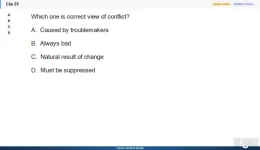
Câu 29 (Chọn 1 đáp án - Multiple Choice)
Which one is correct view of conflict?
A. Caused by troublemakers
B. Always bad
C. Natural result of change
D. Must be suppressed
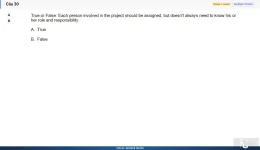
Câu 30 (Chọn 1 đáp án - Multiple Choice)
True or False: Each person involved in the project should be assigned, but doesn't always need to know his or her role and responsibility.
A. True
B. False
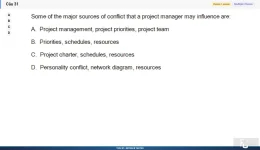
Câu 31 (Chọn 1 đáp án - Multiple Choice)
Some of the major sources of conflict that a project manager may influence are:
A. Project management, project priorities, project team
B. Priorities, schedules, resources
C. Project charter, schedules, resources
D. Personality conflict, network diagram, resources
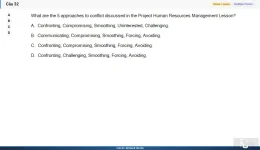
Câu 32 (Chọn 1 đáp án - Multiple Choice)
What are the 5 approaches to conflict discussed in the Project Human Resources Management Lesson?
A. Confronting, Compromising, Smoothing, Uninterested, Challenging.
B. Communicating, Compromising, Smoothing, Forcing, Avoiding
C. Confronting, Compromising, Smoothing, Forcing, Avoiding.
D. Confronting, Challenging, Smoothing, Forcing, Avoiding.
Câu 33 (Chọn 1 đáp án - Multiple Choice)
What does RAM stand for:
A. Responsibility Action Matrix
B. Responsibility Activity Matrix
C. Responsibility Ambiguity Matrix
D. Responsibility Assignment Matrix
Câu 34 (Chọn 1 đáp án - Multiple Choice)
True or False: To do communication effectively, the project manager needs to consider all the factors like the different realities, the space the communication takes place in, verbal as well as non-verbal messages, and the intended meaning versus the perceived meaning, etc.
A. True
B. False
Câu 35 (Chọn 1 đáp án - Multiple Choice)
Which item would most likely NOT be part of a basic communication plan:
A. What they need to know.
B. The amount of their annual bonus.
C. With whom to communicate.
D. The best medium for the communication.
Câu 36 (Chọn 1 đáp án - Multiple Choice)
Upward communication is communication to/from:
A. Your senior management.
B. Your social groups.
C. Your direct reports.
D. Your peers.
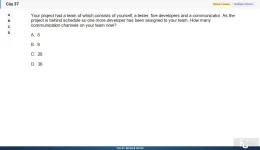
Câu 37 (Chọn 1 đáp án - Multiple Choice)
Your project had a team of which consists of yourself, a tester, five developers and a communicator. As the project is behind schedule so one more developer has been assigned to your team. How many communication channels on your team now?
A. 8
B. 9
C. 28
D. 36
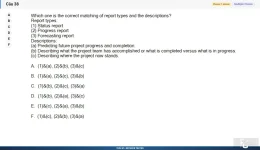
Câu 38 (Chọn 1 đáp án - Multiple Choice)
Which one is the correct matching of report types and the descriptions?
Report types: (1) Status report, (2) Progress report, (3) Forecasting report.
Descriptions: (a) Predicting future project progress and completion. (b) Describing what the project team has accomplished or what is completed versus what is in progress. (c) Describing where the project now stands.
A. (1)&(a), (2)&(b), (3)&(c)
B. (1)&(a), (2)&(c), (3)&(b)
C. (1)&(b), (2)&(c), (3)&(a)
D. (1)&(b), (2)&(a), (3)&(c)
E. (1)&(c), (2)&(a), (3)&(b)
F. (1)&(c), (2)&(b), (3)&(a)
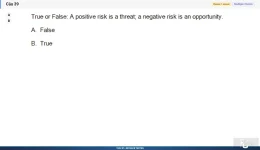
Câu 39 (Chọn 1 đáp án - Multiple Choice)
True or False: A positive risk is a threat, a negative risk is an opportunity.
A. False
B. True
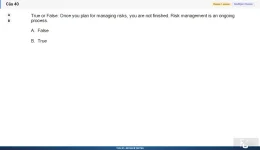
Câu 40 (Chọn 1 đáp án - Multiple Choice)
True or False: Once you plan for managing risks, you are not finished. Risk management is an ongoing process.
A. False
B. True
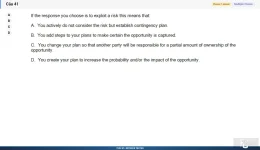
Câu 41 (Chọn 1 đáp án - Multiple Choice)
If the response you choose is to exploit a risk this means that:
A. You actively do not consider the risk but establish contingency plan.
B. You add steps to your plans to make certain the opportunity is captured.
C. You change your plan so that another party will be responsible for a partial amount of ownership of the opportunity.
D. You create your plan to increase the probability and/or the impact of the opportunity.
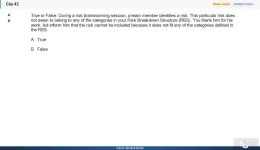
Câu 42 (Chọn 1 đáp án - Multiple Choice)
True or False: During a risk brainstorming session, a team member identifies a risk. This particular risk does not seem to belong to any of the categories in your Risk Breakdown Structure (RBS). You thank him for his work, but inform him that the risk cannot be included because it does not fit any of the categories defined in the RBS.
A. True
B. False
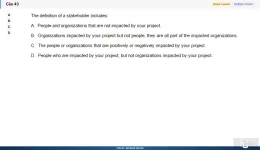
Câu 43 (Chọn 1 đáp án - Multiple Choice)
The definition of a stakeholder includes:
A. People and organizations that are not impacted by your project.
B. Organizations impacted by your project but not people, they are all part of the impacted organizations.
C. The people or organizations that are positively or negatively impacted by your project.
D. People who are impacted by your project, but not organizations impacted by your project.
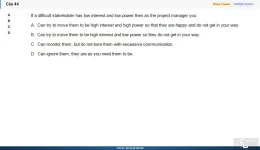
Câu 44 (Chọn 1 đáp án - Multiple Choice)
If a difficult stakeholder has low interest and low power then as the project manager you:
A. Can try to move them to be high interest and high power so that they are happy and do not get in your way.
B. Can try to move them to be high interest and low power so they do not get in your way.
C. Can monitor them, but do not bore them with excessive communication.
D. Can ignore them, they are as you need them to be.
Câu 45 (Chọn 1 đáp án - Multiple Choice)
You just came from a meeting with one of your project stakeholders, he knew about your project and was not against it, but did not seem to be particularly interested in it either. How would you classify him?
A. Supportive
B. Neutral
C. Unaware
D. Resistant
Câu 46 (Chọn 1 đáp án - Multiple Choice)
True or False: The Project Sponsor is responsible for stakeholder expectations management.
A. False
B. True
Câu 47 (Chọn 1 đáp án - Multiple Choice)
Your stakeholder register should not contain:
A. Identification information
B. Assessment information
C. Stakeholder classification
D. Scope information
Câu 48 (Chọn 1 đáp án - Multiple Choice)
Given 7 days is the most likely of the estimated duration of the activity, 4 days is the optimistic value and 22 days is the pessimistic one. By using the PERT (Program Evaluation and Review Technique) analysis to calculate the expected activity duration, which of the following is the result?
A. 11 days
B. 7.5 days
C. 6 days
D. 16.5 days
Câu 49 (Chọn 1 đáp án - Multiple Choice)
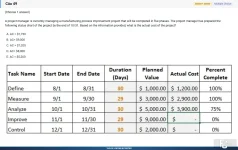
A project manager is currently managing a manufacturing process improvement project that will be completed in five phases. The project manager has prepared the following status chart of the project by the end of 10/31. Based on the information provided, what is the actual cost of the project?
A. $AC = \$7,750$
B. $AC = \$9,000$
C. $AC = \$7,025$
D. $AC = \$8,000$
E. $AC = \$5,200$
Câu 50 (Chọn 1 đáp án - Multiple Choice)
In Earned Value Management Technique, you can compute the Estimate To Completion (ETC) by applying which of following formula? (Notes: EAC: Estimate At Completion)
A. $ETC = EAC - AC$
B. $ETC = EAC + AC$
C. $ETC = EAC * AC$
D. $ETC = EAC / AC$
Đính kèm
-
 PMG201c SP26 FE RE_001.webp25.6 KB · Lượt xem: 14
 -
 PMG201c SP26 FE RE_002.webp25.6 KB · Lượt xem: 14
 -
 PMG201c SP26 FE RE_003.webp39.8 KB · Lượt xem: 10
 -
 PMG201c SP26 FE RE_004.webp36.9 KB · Lượt xem: 10
 -
 PMG201c SP26 FE RE_005.webp57.2 KB · Lượt xem: 8
 -
 PMG201c SP26 FE RE_006.webp45.4 KB · Lượt xem: 9
 -
 PMG201c SP26 FE RE_007.webp78.8 KB · Lượt xem: 10
 -
 PMG201c SP26 FE RE_008.webp53.4 KB · Lượt xem: 8
 -
 PMG201c SP26 FE RE_009.webp46.8 KB · Lượt xem: 10
 -
 PMG201c SP26 FE RE_010.webp29.9 KB · Lượt xem: 12
 -
 PMG201c SP26 FE RE_011.webp31.1 KB · Lượt xem: 6
 -
 PMG201c SP26 FE RE_012.webp47.2 KB · Lượt xem: 6
 -
 PMG201c SP26 FE RE_013.webp44.4 KB · Lượt xem: 6
 -
 PMG201c SP26 FE RE_014.webp38.9 KB · Lượt xem: 6
 -
 PMG201c SP26 FE RE_015.webp49.9 KB · Lượt xem: 6
 -
 PMG201c SP26 FE RE_016.webp26.5 KB · Lượt xem: 7
 -
 PMG201c SP26 FE RE_017.webp31.6 KB · Lượt xem: 8
 -
 PMG201c SP26 FE RE_018.webp31.3 KB · Lượt xem: 8
 -
 PMG201c SP26 FE RE_019.webp41.5 KB · Lượt xem: 7
 -
 PMG201c SP26 FE RE_020.webp62.1 KB · Lượt xem: 7
 -
 PMG201c SP26 FE RE_021.webp26 KB · Lượt xem: 6
 -
 PMG201c SP26 FE RE_022.webp32.3 KB · Lượt xem: 8
 -
 PMG201c SP26 FE RE_023.webp26.2 KB · Lượt xem: 6
 -
 PMG201c SP26 FE RE_024.webp38.3 KB · Lượt xem: 7
 -
 PMG201c SP26 FE RE_025.webp42 KB · Lượt xem: 7
 -
 PMG201c SP26 FE RE_026.webp40.4 KB · Lượt xem: 7
 -
 PMG201c SP26 FE RE_027.webp25.3 KB · Lượt xem: 6
 -
 PMG201c SP26 FE RE_028.webp33.8 KB · Lượt xem: 7
 -
 PMG201c SP26 FE RE_029.webp36.8 KB · Lượt xem: 6
 -
 PMG201c SP26 FE RE_030.webp28.2 KB · Lượt xem: 6
 -
 PMG201c SP26 FE RE_031.webp53.7 KB · Lượt xem: 5
 -
 PMG201c SP26 FE RE_032.webp54.8 KB · Lượt xem: 5
 -
 PMG201c SP26 FE RE_033.webp43.2 KB · Lượt xem: 6
 -
 PMG201c SP26 FE RE_034.webp42.9 KB · Lượt xem: 7
 -
 PMG201c SP26 FE RE_035.webp49 KB · Lượt xem: 5
 -
 PMG201c SP26 FE RE_036.webp36.3 KB · Lượt xem: 6
 -
 PMG201c SP26 FE RE_037.webp42.3 KB · Lượt xem: 6
 -
 PMG201c SP26 FE RE_038.webp77.6 KB · Lượt xem: 5
 -
 PMG201c SP26 FE RE_039.webp27.4 KB · Lượt xem: 5
 -
 PMG201c SP26 FE RE_040.webp25.9 KB · Lượt xem: 5
 -
 PMG201c SP26 FE RE_041.webp59.3 KB · Lượt xem: 6
 -
 PMG201c SP26 FE RE_042.webp50.1 KB · Lượt xem: 6
 -
 PMG201c SP26 FE RE_043.webp59.2 KB · Lượt xem: 6
 -
 PMG201c SP26 FE RE_044.webp58.2 KB · Lượt xem: 5
 -
 PMG201c SP26 FE RE_045.webp40.1 KB · Lượt xem: 5
 -
 PMG201c SP26 FE RE_046.webp26.7 KB · Lượt xem: 5
 -
 PMG201c SP26 FE RE_047.webp39.7 KB · Lượt xem: 6
 -
 PMG201c SP26 FE RE_048.webp49.6 KB · Lượt xem: 6
 -
 PMG201c SP26 FE RE_049.webp100.3 KB · Lượt xem: 6
 -
 PMG201c SP26 FE RE_050.webp40 KB · Lượt xem: 12