
- Học kỳ
- SP2026
- Thời Gian
- 9/5/26
- Loại tài liệu
- FE
OSG202 SP26 B5 FE
1. (Choose 1 answer)
Which file is a sequence of bytes organized into blocks understandable by the system's linker?
A. Text file
B. Object file
C. Source file
D. Executable file
2. (Choose 1 answer)
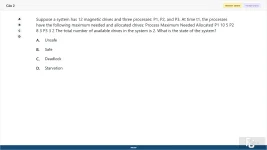
Suppose a system has 12 magnetic drives and three processes: P1, P2, and P3. At time t1, the processes have the following maximum needed and allocated drives: Process Maximum Needed Allocated P1 10 5 P2 8 3 P3 3 2 The total number of available drives in the system is 2. What is the state of the system?
A. Unsafe
B. Safe
C. Deadlock
D. Starvation
3. (Choose 1 answer)
Which of the following UNIX system calls is equivalent to the Win32 CreateProcess function?
A. fork
B. waitpid
C. execve
D. Combination of fork and execve
4. (Choose 1 answer)
What is the primary difference between L1 and L2 cache in modern CPUs?
A. L1 cache is in the CPU and accessed instantly; L2 has slight delay.
B. L1 cache is used for data only, while L2 cache stores only instructions
C. L2 cache is inside the CPU, whereas L1 cache is located outside the CPU
D. L1 cache is larger than L2 cache and stores more frequently used data.
5. (Choose 1 answer)
What is the key difference between a process and a thread?
A. Threads are faster but more isolated than processes
B. Threads execute in parallel without synchronization
C. Threads run in kernel mode; processes do not
D. Threads share the same memory space; processes do not
6. (Choose 1 answer)
Which is not a valid process state?
A. Running
B. Sleeping
C. Ready
D. Blocked
7. (Choose 1 answer)
Which I/O mode is most suitable for transferring data between memory and I/O devices without the CPU being bothered?
A. Direct Memory Access
B. Programmed I/O
C. Interrupt-driven I/O
D. Polling
8. (Choose 1 answer)
Which synchronization primitive solves producer-consumer?
A. Semaphore
B. Paging
C. Deadlock
D. Multiprogramming
E. Caching
9. (Choose 1 answer)
Differentiate between Type 1 and Type 2 hypervisors in terms of their implementation and performance. Which type is generally more efficient for enterprise environments, and why?
A. Type 1 hypervisors, as they run directly on hardware
B. Type 2 hypervisors, as they offer more flexibility
C. Type 1 hypervisors, for simpler management than Type 2
D. Both types are equally efficient in enterprises
10. (Choose 2 answers)
What is the primary purpose of using paging in memory management?choose correct answers
A. To reduce the access time for data in memory.
B. To allow multiple processes to share the same physical memory.
C. To eliminate fragmentation and improve memory utilization.
D. To organize memory into fixed-size blocks for efficient storage.
11. (Choose 1 answer)
With demand paging, what increases when page size is reduced?
A. Page fault rate
B. Internal fragmentation
C. External fragmentation
D. Hit ratio
E. None
12. (Choose 1 answer)
In a system with 16 GB of memory, an operating system taking 2 GB, and each user program taking up 512 MB with a 70% average I/O wait, what is the CPU utilization?
A. 85.71%
B. 95.71%
C. 87.71%
D. 90.71%
13. (Choose 1 answer)
Which of the following methods is used to track memory?
A. Linked Lists
B. Best fit
C. Paging
D. Segmentation
14. (Choose 1 answer)
Blu-ray discs are examples of which type of I/O device?
A. Block device
B. Disk device
C. Input device
D. Character device
15. (Choose 1 answer)
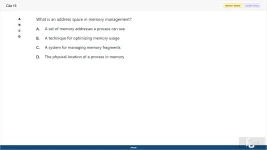
What is an address space in memory management?
A. A set of memory addresses a process can use
B. A technique for optimizing memory usage
C. A system for managing memory fragments
D. The physical location of a process in memory
16. (Choose 1 answer)
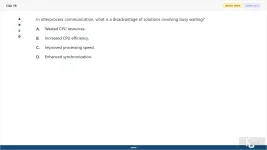
In interprocess communication, what is a disadvantage of solutions involving busy waiting?
A. Wasted CPU resources.
B. Increased CPU efficiency.
C. Improved processing speed.
D. Enhanced synchronization.
17. (Choose 1 answer)
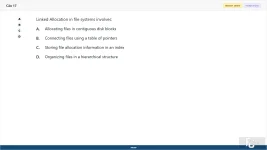
Linked Allocation in file systems involves:
A. Allocating files in contiguous disk blocks
B. Connecting files using a table of pointers
C. Storing file allocation information in an index
D. Organizing files in a hierarchical structure
18. (Choose 1 answer)
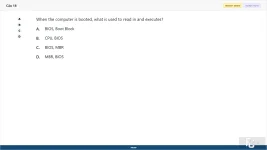
When the computer is booted, what is used to read in and executes?
A. BIOS, Boot Block
B. CPU, BIOS
C. BIOS, MBR
D. MBR, BIOS
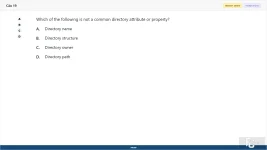
19. (Choose 1 answer)
Which of the following is not a common directory attribute or property?
A. Directory name
B. Directory structure
C. Directory owner
D. Directory path
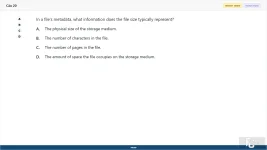
20. (Choose 1 answer)
In a file's metadata, what information does the file size typically represent?
A. The physical size of the storage medium.
B. The number of characters in the file.
C. The number of pages in the file.
D. The amount of space the file occupies on the storage medium.
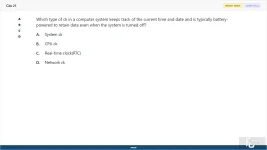
21. (Choose 1 answer)
Which type of ck in a computer system keeps track of the current time and date and is typically battery-powered to retain data even when the system is turned off?
A. System ck
B. CPU ck
C. Real-time clock(RTC)
D. Network ck
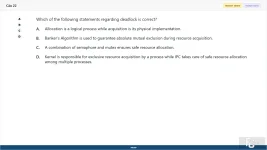
22. (Choose 1 answer)
Which of the following statements regarding deadlock is correct?
A. Allocation is a logical process while acquisition is its physical implementation.
B. Banker's Algorithm is used to guarantee absolute mutual exclusion during resource acquisition.
C. A combination of semaphore and mutex ensures safe resource allocation.
D. Kernel is responsible for exclusive resource acquisition by a process while IPC takes care of safe resource allocation among multiple processes.
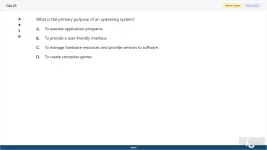
23. (Choose 1 answer)
What is the primary purpose of an operating system?
A. To execute application programs.
B. To provide a user-friendly interface.
C. To manage hardware resources and provide services to software.
D. To create computer games.
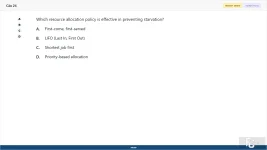
24. (Choose 1 answer)
Which resource allocation policy is effective in preventing starvation?
A. First-come, first-served
B. LIFO (Last In, First Out)
C. Shortest job first
D. Priority-based allocation
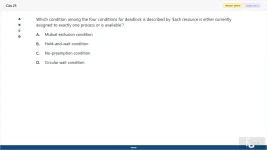
25. (Choose 1 answer)
Which condition among the four conditions for deadlock is described by 'Each resource is either currently assigned to exactly one process or is available'?
A. Mutual exclusion condition
B. Hold-and-wait condition
C. No-preemption condition
D. Circular wait condition
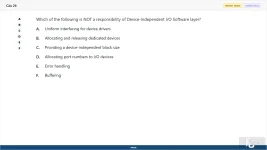
26. (Choose 1 answer)
Which of the following is NOT a responsibility of Device-Independent I/O Software layer?
A. Uniform interfacing for device drivers
B. Allocating and releasing dedicated devices
C. Providing a device-independent block size
D. Allocating port numbers to I/O devices
E. Error handling
F. Buffering
27. (Choose 1 answer)
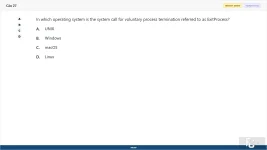
In which operating system is the system call for voluntary process termination referred to as ExitProcess?
A. UNIX
B. Windows
C. macOS
D. Linux
28. (Choose 1 answer)
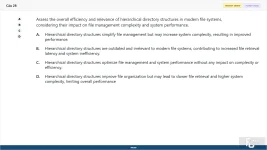
Assess the overall efficiency and relevance of hierarchical directory structures in modern file systems, considering their impact on file management complexity and system performance.
A. Hierarchical directory structures simplify file management but may increase system complexity, resulting in improved performance.
B. Hierarchical directory structures are outdated and irrelevant to modern file systems, contributing to increased file retrieval latency and system inefficiency.
C. Hierarchical directory structures optimize file management and system performance without any impact on complexity or efficiency.
D. Hierarchical directory structures improve file organization but may lead to slower file retrieval and higher system complexity, limiting overall performance
29. (Choose 1 answer)
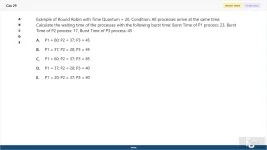
Example of Round Robin with Time Quantum = 20. Condition: All processes arrive at the same time. Calculate the waiting time of the processes with the following burst time: Burst Time of P1 process: 23, Burst Time of P2 process: 17, Burst Time of P3 process: 45
A. P1 = 60; P2 = 37; P3 = 45
B. P1 = 37; P2 = 20; P3 = 45
C. P1 = 60; P2 = 37; P3 = 85
D. P1 = 37; P2 = 20; P3 = 40
E. P1 = 20; P2 = 37; P3 = 40
30. (Choose 1 answer)
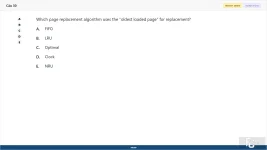
Which page replacement algorithm uses the "oldest loaded page" for replacement?
A. FIFO
B. LRU
C. Optimal
D. Clock
E. NRU
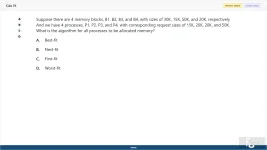
31. (Choose 1 answer)
Suppose there are 4 memory blocks, B1, B2, B3, and B4, with sizes of 30K, 15K, 50K, and 20K, respectively And we have 4 processes, P1, P2, P3, and P4, with corresponding request sizes of 15K, 20K, 20K, and 50K. What is the algorithm for all processes to be allocated memory?
A. Best-fit
B. Next-fit
C. First-fit
D. Worst-fit
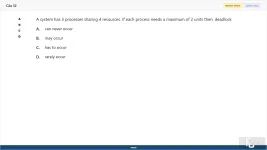
32. (Choose 1 answer)
A system has 3 processes sharing 4 resources. If each process needs a maximum of 2 units then, deadlock
A. can never occur
B. may occur
C. has to occur
D. rarely occur
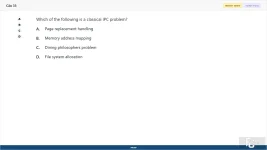
33. (Choose 1 answer)
Which of the following is a classical IPC problem?
A. Page replacement handling
B. Memory address mapping
C. Dining philosophers problem
D. File system allocation
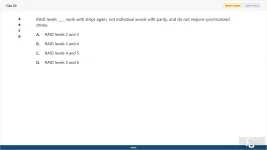
34. (Choose 1 answer)
RAID levels ____ work with strips again, not individual words with parity, and do not require synchronized drives.
A. RAID levels 2 and 3
B. RAID levels 3 and 4
C. RAID levels 4 and 5
D. RAID levels 5 and 6
35. (Choose 1 answer)
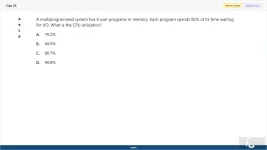
A multiprogrammed system has 6 user programs in memory. Each program spends 82% of its time waiting for I/O. What is the CPU utilization?
A. 70.2%
B. 60.5%
C. 80.7%
D. 90.8%
36. (Choose 1 answer)
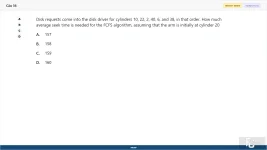
Disk requests come into the disk driver for cylinders 10, 22, 2, 40, 6, and 38, in that order. How much average seek time is needed for the FCFS algorithm, assuming that the arm is initially at cylinder 20
A. 157
B. 158
C. 159
D. 160
37. (Choose 1 answer)
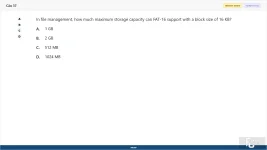
In file management, how much maximum storage capacity can FAT-16 support with a block size of 16 KB?
A. 1 GB
B. 2 GB
C. 512 MB
D. 1024 MB
38. (Choose 1 answer)
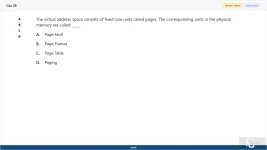
The virtual address space consists of fixed-size units called pages. The corresponding units in the physical memory are called _____
A. Page Fault
B. Page Frames
C. Page Table
D. Paging
39. (Choose 1 answer)
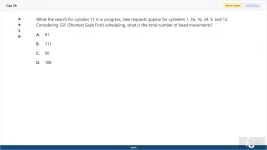
While the search for cylinder 11 is in progress, new requests appear for cylinders 1, 36, 16, 34, 9, and 12. Considering SSF (Shortest Seek First) scheduling, what is the total number of head movements?
A. 61
B. 111
C. 60
D. 108
40. (Choose 1 answer)
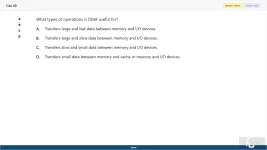
What types of operations is DMA useful for?
A. Transfers large and fast data between memory and I/O devices.
B. Transfers large and slow data between memory and I/O devices.
C. Transfers slow and small data between memory and I/O devices.
D. Transfers small data between memory and cache or memory and I/O devices.
41. (Choose 1 answer)
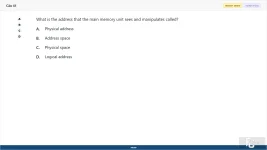
What is the address that the main memory unit sees and manipulates called?
A. Physical address
B. Address space
C. Physical space
D. Logical address
42. (Choose 1 answer)
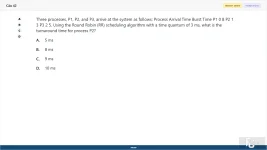
Three processes, P1, P2, and P3, arrive at the system as follows: Process Arrival Time Burst Time P1 0 8 P2 1 3 P3 2 5. Using the Round Robin (RR) scheduling algorithm with a time quantum of 3 ms, what is the turnaround time for process P2?
A. 5 ms
B. 8 ms
C. 9 ms
D. 10 ms
43. (Choose 1 answer)
What is a significant advantage of a microkernel-based operating system structure compared to a monolithic system, especially for mission-critical applications?
A. It allows the entire operating system to run as a single, highly efficient executable in kernel mode
B. It makes the system fully portable across different hardware platforms without recompilation
C. It greatly reduces the size of the trusted computing base (TCB), enhancing reliability and security
D. It ensures that all system services, including file systems and process management, run entirely in user space
44. (Choose 1 answer)
Which of the following key techniques were popularized by third-generation operating systems (1965-1980)?
A. The use of vacuum tubes and the concept of personal control over the entire machine
B. Batch systems where jobs were collected on magnetic tape and processed sequentially
C. The development of graphical user interfaces (GUIs) and personal computers
D. None of the others
45. (Choose 1 answer)
Why is journaling used in modern file systems such as ext4?
A. To prevent fragmentation
B. To improve file read speed
C. To recover from crashes and ensure metadata consistency
D. To enable compression techniques that reduce file sizes during background maintenance operations
46. (Choose 1 answer)
Consider a system with two modes: user mode and kernel mode. Which operation requires kernel mode?
A. Integer addition
B. Floating point multiplication
C. Writing to disk
D. Array traversal
E. Stack push
47. (Choose 1 answer)
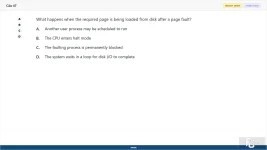
What happens when the required page is being loaded from disk after a page fault?
A. Another user process may be scheduled to run
B. The CPU enters halt mode
C. The faulting process is permanently blocked
D. The system waits in a loop for disk I/O to complete
48. (Choose 1 answer)
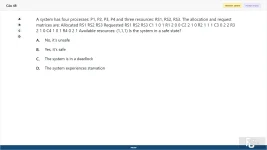
A system has four processes: P1, P2, P3, P4 and three resources: RS1, RS2, RS3. The allocation and request matrices are: Allocated RS1 RS2 RS3 Requested RS1 RS2 RS3 C1 1 0 1 R1 2 0 0 C2 2 1 0 R2 1 1 1 C3 0 2 2 R3 2 1 0 C4 1 0 1 R4 0 2 1 Available resources: (1,1,1) Is the system in a safe state?
A. No, it's unsafe
B. Yes, it's safe
C. The system is in a deadlock
D. The system experiences starvation
49. (Choose 1 answer)
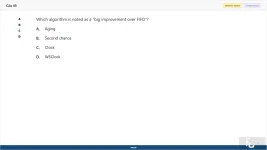
Which algorithm is noted as a "big improvement over FIFO"?
A. Aging
B. Second chance
C. Clock
D. WSClock
50. (Choose 1 answer)
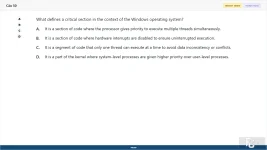
What defines a critical section in the context of the Windows operating system?
A. It is a section of code where the processor gives priority to execute multiple threads simultaneously.
B. It is a section of code where hardware interrupts are disabled to ensure uninterrupted execution.
C. It is a segment of code that only one thread can execute at a time to avoid data inconsistency or conflicts.
D. It is a part of the kernel where system-level processes are given higher priority over user-level processes.
Đính kèm
-
 OSG202 SP26 B5 FE_10.webp32.2 KB · Lượt xem: 2
 -
 OSG202 SP26 B5 FE_01.webp18.3 KB · Lượt xem: 2
 -
 OSG202 SP26 B5 FE_02.webp33.1 KB · Lượt xem: 1
 -
 OSG202 SP26 B5 FE_03.webp18.8 KB · Lượt xem: 1
 -
 OSG202 SP26 B5 FE_04.webp33 KB · Lượt xem: 1
 -
 OSG202 SP26 B5 FE_05.webp27.8 KB · Lượt xem: 1
 -
 OSG202 SP26 B5 FE_06.webp13.1 KB · Lượt xem: 1
 -
 OSG202 SP26 B5 FE_07.webp22 KB · Lượt xem: 1
 -
 OSG202 SP26 B5 FE_08.webp17 KB · Lượt xem: 1
 -
 OSG202 SP26 B5 FE_09.webp36.6 KB · Lượt xem: 1
 -
 OSG202 SP26 B5 FE_11.webp18.8 KB · Lượt xem: 1
 -
 OSG202 SP26 B5 FE_12.webp22.5 KB · Lượt xem: 1
 -
 OSG202 SP26 B5 FE_13.webp15.5 KB · Lượt xem: 1
 -
 OSG202 SP26 B5 FE_14.webp16.3 KB · Lượt xem: 1
 -
 OSG202 SP26 B5 FE_15.webp24.9 KB · Lượt xem: 1
 -
 OSG202 SP26 B5 FE_16.webp22.6 KB · Lượt xem: 1
 -
 OSG202 SP26 B5 FE_17.webp23.7 KB · Lượt xem: 1
 -
 OSG202 SP26 B5 FE_18.webp16.8 KB · Lượt xem: 1
 -
 OSG202 SP26 B5 FE_19.webp18.2 KB · Lượt xem: 1
 -
 OSG202 SP26 B5 FE_20.webp26 KB · Lượt xem: 1
 -
 OSG202 SP26 B5 FE_21.webp23.6 KB · Lượt xem: 1
 -
 OSG202 SP26 B5 FE_22.webp42.1 KB · Lượt xem: 1
 -
 OSG202 SP26 B5 FE_23.webp24.2 KB · Lượt xem: 1
 -
 OSG202 SP26 B5 FE_24.webp19.6 KB · Lượt xem: 1
 -
 OSG202 SP26 B5 FE_25.webp26.8 KB · Lượt xem: 1
 -
 OSG202 SP26 B5 FE_26.webp29.3 KB · Lượt xem: 1
 -
 OSG202 SP26 B5 FE_27.webp17.7 KB · Lượt xem: 1
 -
 OSG202 SP26 B5 FE_28.webp65.3 KB · Lượt xem: 1
 -
 OSG202 SP26 B5 FE_29.webp35 KB · Lượt xem: 1
 -
 OSG202 SP26 B5 FE_30.webp16.5 KB · Lượt xem: 1
 -
 OSG202 SP26 B5 FE_31.webp30.9 KB · Lượt xem: 1
 -
 OSG202 SP26 B5 FE_32.webp19.2 KB · Lượt xem: 1
 -
 OSG202 SP26 B5 FE_33.webp20 KB · Lượt xem: 1
 -
 OSG202 SP26 B5 FE_34.webp21.4 KB · Lượt xem: 1
 -
 OSG202 SP26 B5 FE_35.webp20.7 KB · Lượt xem: 1
 -
 OSG202 SP26 B5 FE_36.webp23.6 KB · Lượt xem: 1
 -
 OSG202 SP26 B5 FE_37.webp17.4 KB · Lượt xem: 1
 -
 OSG202 SP26 B5 FE_38.webp20.4 KB · Lượt xem: 1
 -
 OSG202 SP26 B5 FE_39.webp23.3 KB · Lượt xem: 1
 -
 OSG202 SP26 B5 FE_40.webp31.4 KB · Lượt xem: 1
 -
 OSG202 SP26 B5 FE_41.webp18.4 KB · Lượt xem: 1
 -
 OSG202 SP26 B5 FE_42.webp26.4 KB · Lượt xem: 1
 -
 OSG202 SP26 B5 FE_43.webp50 KB · Lượt xem: 1
 -
 OSG202 SP26 B5 FE_44.webp36.4 KB · Lượt xem: 1
 -
 OSG202 SP26 B5 FE_45.webp28.3 KB · Lượt xem: 1
 -
 OSG202 SP26 B5 FE_46.webp22.5 KB · Lượt xem: 1
 -
 OSG202 SP26 B5 FE_47.webp26.6 KB · Lượt xem: 1
 -
 OSG202 SP26 B5 FE_48.webp35.3 KB · Lượt xem: 1
 -
 OSG202 SP26 B5 FE_49.webp15.2 KB · Lượt xem: 1
 -
 OSG202 SP26 B5 FE_50.webp44.4 KB · Lượt xem: 2