
- Học kỳ
- SP2026
- Thời Gian
- 4/5/26
- Loại tài liệu
- FE
- Mã Đề
- EMF301c_SP26_RE_937414
EMF301c SP26 FE RE
1. (Choose 1 answer)
What is a fundamental property of electric fields that distinguishes them from magnetic fields?
A. They exist around stationary charges
B. They are unaffected by distance
C. They influence moving charges perpendicularly
D. They require motion to exist
2. (Choose 1 answer)
What is the main focus when transitioning from electrodynamics to electric field analysis?
A. Concentrating on static and dynamic electric fields
B. Analyzing vector fields exclusively
C. Focusing solely on electric charges
D. Transitioning to magnetic field interactions
3. (Choose 2 answers)
Identify the resources where you can find physical constants useful for electric field analysis.
A. Scientific journals
B. Physics textbooks
C. Reference tables
D. Online forums
4. (Choose 2 answers)
Which factors are crucial in differentiating between magnetic fields and magnetic vector potentials? Select all that apply.
A. Magnetic fields have direct physical manifestations, while vector potentials do not.
B. Vector potentials are only mathematical constructs without practical relevance.
C. The vector potential can influence quantum phases without changing classical outcomes.
D. Magnetic fields and vector potentials have the same physical effects.
5. (Choose 2 answers)
Which of the following statements correctly differentiate between magnetic fields and magnetic vector potentials? Select all that apply.
A. Magnetic fields are the curl of the vector potential.
B. Magnetic vector potentials are the gradient of the magnetic field.
C. Magnetic vector potentials can exist even if the magnetic field is zero.
D. Magnetic vector potentials are directly related to the force on a charged particle.
6. (Choose 1 answer)
What is the primary implication of electromagnetic wave propagation in physics?
A. They propagate at the speed of light and transfer energy through the vacuum.
B. They require a medium to propagate.
C. They follow the same paths as gravitational waves.
D. They produce electric fields as a by-product.
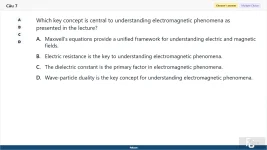
7. (Choose 1 answer)
Which key concept is central to understanding electromagnetic phenomena as presented in the lecture?
A. Maxwell's equations provide a unified framework for understanding electric and magnetic fields.
B. Electric resistance is the key to understanding electromagnetic phenomena.
C. The dielectric constant is the primary factor in electromagnetic phenomena.
D. Wave-particle duality is the key concept for understanding electromagnetic phenomena.
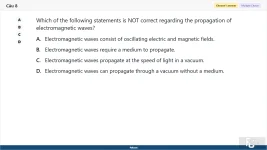
8. (Choose 1 answer)
Which of the following statements is NOT correct regarding the propagation of electromagnetic waves?
A. Electromagnetic waves consist of oscillating electric and magnetic fields.
B. Electromagnetic waves require a medium to propagate.
C. Electromagnetic waves propagate at the speed of light in a vacuum.
D. Electromagnetic waves can propagate through a vacuum without a medium.
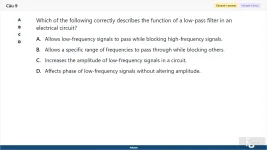
9. (Choose 1 answer)
Which of the following correctly describes the function of a low-pass filter in an electrical circuit?
A. Allows low-frequency signals to pass while blocking high-frequency signals.
B. Allows a specific range of frequencies to pass through while blocking others.
C. Increases the amplitude of low-frequency signals in a circuit.
D. Affects phase of low-frequency signals without altering amplitude.
10. (Choose 1 answer)
What is the potential difference across the ends of a conductor with resistance R carrying a current I?
A. V = IR
B. V = IR
C. V = I R
D. V = I²R
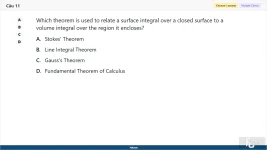
11. (Choose 1 answer)
Which theorem is used to relate a surface integral over a closed surface to a volume integral over the region it encloses?
A. Stokes' Theorem
B. Line Integral Theorem
C. Gauss's Theorem
D. Fundamental Theorem of Calculus
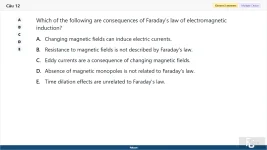
12. (Choose 2 answers)
Which of the following are consequences of Faraday's law of electromagnetic induction?
A. Changing magnetic fields can induce electric currents.
B. Resistance to magnetic fields is not described by Faraday's law.
C. Eddy currents are a consequence of changing magnetic fields.
D. Absence of magnetic monopoles is not related to Faraday's law.
E. Time dilation effects are unrelated to Faraday's law.
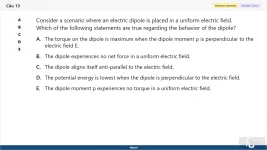
13. (Choose 2 answers)
Consider a scenario where an electric dipole is placed in a uniform electric field. Which of the following statements are true regarding the behavior of the dipole?
A. The torque on the dipole is maximum when the dipole moment p is perpendicular to the electric field E.
B. The dipole experiences no net force in a uniform electric field.
C. The dipole aligns itself anti-parallel to the electric field.
D. The potential energy is lowest when the dipole is perpendicular to the electric field.
E. The dipole moment p experiences no torque in a uniform electric field.
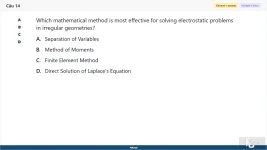
14. (Choose 1 answer)
Which mathematical method is most effective for solving electrostatic problems in irregular geometries?
A. Separation of Variables
B. Method of Moments
C. Finite Element Method
D. Direct Solution of Laplace's Equation
15. (Choose 2 answers)
[no text]
A. A
B. B
C. C
D. D
E. E
16. (Choose 1 answer)
Which of the following materials is best suited for use as an insulator in high-voltage electrostatic applications?
A. Glass
B. Copper
C. Aluminum
D. Silver
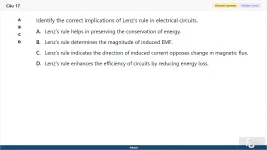
17. (Choose 2 answers)
Identify the correct implications of Lenz's rule in electrical circuits.
A. Lenz's rule helps in preserving the conservation of energy.
B. Lenz's rule determines the magnitude of induced EMF.
C. Lenz's rule indicates the direction of induced current opposes change in magnetic flux.
D. Lenz's rule enhances the efficiency of circuits by reducing energy loss.
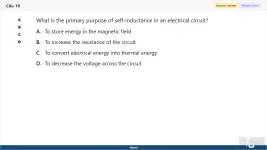
18. (Choose 1 answer)
What is the primary purpose of self-inductance in an electrical circuit?
A. To store energy in the magnetic field
B. To increase the resistance of the circuit
C. To convert electrical energy into thermal energy
D. To decrease the voltage across the circuit
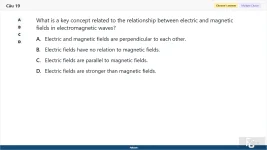
19. (Choose 1 answer)
What is a key concept related to the relationship between electric and magnetic fields in electromagnetic waves?
A. Electric and magnetic fields are perpendicular to each other.
B. Electric fields have no relation to magnetic fields.
C. Electric fields are parallel to magnetic fields.
D. Electric fields are stronger than magnetic fields.
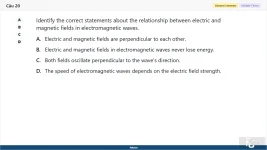
20. (Choose 2 answers)
Identify the correct statements about the relationship between electric and magnetic fields in electromagnetic waves.
A. Electric and magnetic fields are perpendicular to each other.
B. Electric and magnetic fields in electromagnetic waves never lose energy.
C. Both fields oscillate perpendicular to the wave's direction.
D. The speed of electromagnetic waves depends on the electric field strength.
21. (Choose 1 answer)
[no text]
A. A
B. B
C. C
D. D
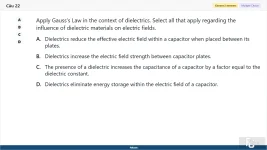
22. (Choose 2 answers)
Apply Gauss's Law in the context of dielectrics. Select all that apply regarding the influence of dielectric materials on electric fields.
A. Dielectrics reduce the effective electric field within a capacitor when placed between its plates.
B. Dielectrics increase the electric field strength between capacitor plates.
C. The presence of a dielectric increases the capacitance of a capacitor by a factor equal to the dielectric constant.
D. Dielectrics eliminate energy storage within the electric field of a capacitor.
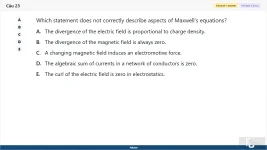
23. (Choose 1 answer)
Which statement does not correctly describe aspects of Maxwell's equations?
A. The divergence of the electric field is proportional to charge density.
B. The divergence of the magnetic field is always zero.
C. A changing magnetic field induces an electromotive force.
D. The algebraic sum of currents in a network of conductors is zero.
E. The curl of the electric field is zero in electrostatics.
24. (Choose 1 answer)
Identify the scientist who did NOT contribute significantly to the field of electrodynamics.
A. James Clerk Maxwell
B. Michael Faraday
C. Isaac Newton
D. Andre-Marie Ampere
25. (Choose 1 answer)
If two charges q1 and q2 are separated by a distance r, what happens to the force between them when r is doubled?
A. The force is reduced to a quarter.
B. The force is reduced by half.
C. The force remains unchanged.
D. The force doubles.
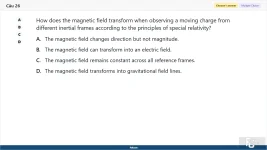
26. (Choose 1 answer)
How does the magnetic field transform when observing a moving charge from different inertial frames according to the principles of special relativity?
A. The magnetic field changes direction but not magnitude.
B. The magnetic field can transform into an electric field.
C. The magnetic field remains constant across all reference frames.
D. The magnetic field transforms into gravitational field lines.
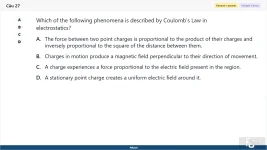
27. (Choose 1 answer)
Which of the following phenomena is described by Coulomb's Law in electrostatics?
A. The force between two point charges is proportional to the product of their charges and inversely proportional to the square of the distance between them.
B. Charges in motion produce a magnetic field perpendicular to their direction of movement.
C. A charge experiences a force proportional to the electric field present in the region.
D. A stationary point charge creates a uniform electric field around it.
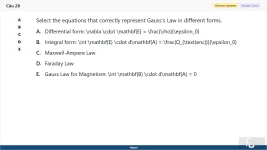
28. (Choose 2 answers)
Select the equations that correctly represent Gauss's Law in different forms.
A. Differential form: \nabla \cdot \mathbf{E} = \frac{\rho}{\epsilon_0}
B. Integral form: \int \mathbf{E} \cdot d\mathbf{A} = \frac{Q_{\text{enc}}}{\epsilon_0}
C. Maxwell-Ampere Law
D. Faraday Law
E. Gauss Law for Magnetism: \int \mathbf{B} \cdot d\mathbf{A} = 0
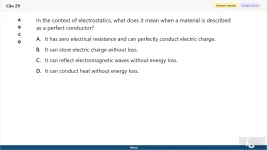
29. (Choose 1 answer)
In the context of electrostatics, what does it mean when a material is described as a perfect conductor?
A. It has zero electrical resistance and can perfectly conduct electric charge.
B. It can store electric charge without loss.
C. It can reflect electromagnetic waves without energy loss.
D. It can conduct heat without energy loss.
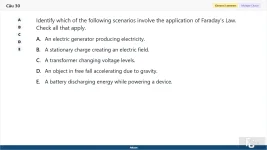
30. (Choose 2 answers)
Identify which of the following scenarios involve the application of Faraday's Law. Check all that apply.
A. An electric generator producing electricity.
B. A stationary charge creating an electric field.
C. A transformer changing voltage levels.
D. An object in free fall accelerating due to gravity.
E. A battery discharging energy while powering a device.
31. (Choose 1 answer)
Which of the following is NOT considered a fundamental force in nature?
A. Gravitational force
B. Electromagnetic force
C. Nuclear force
D. Weak nuclear force
32. (Choose 1 answer)
In solving electrostatic problems using complex variables, which step is crucial for ensuring accurate results?
A. Properly mapping the physical domain to the complex plane.
B. Using numerical software for complex calculations.
C. Choosing a random starting point for analysis.
D. Simplifying equations by ignoring complex components.
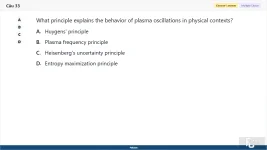
33. (Choose 1 answer)
What principle explains the behavior of plasma oscillations in physical contexts?
A. Huygens' principle
B. Plasma frequency principle
C. Heisenberg's uncertainty principle
D. Entropy maximization principle
34. (Choose 2 answers)
[no text]
A. A
B. B
C. C
D. D
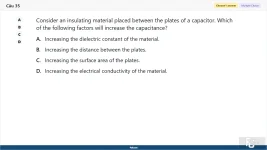
35. (Choose 1 answer)
Consider an insulating material placed between the plates of a capacitor. Which of the following factors will increase the capacitance?
A. Increasing the dielectric constant of the material.
B. Increasing the distance between the plates.
C. Increasing the surface area of the plates.
D. Increasing the electrical conductivity of the material.
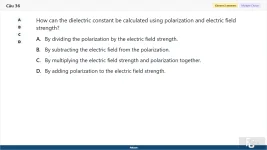
36. (Choose 2 answers)
How can the dielectric constant be calculated using polarization and electric field strength?
A. By dividing the polarization by the electric field strength.
B. By subtracting the electric field from the polarization.
C. By multiplying the electric field strength and polarization together.
D. By adding polarization to the electric field strength.
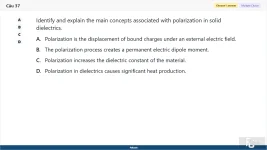
37. (Choose 1 answer)
Identify and explain the main concepts associated with polarization in solid dielectrics.
A. Polarization is the displacement of bound charges under an external electric field.
B. The polarization process creates a permanent electric dipole moment.
C. Polarization increases the dielectric constant of the material.
D. Polarization in dielectrics causes significant heat production.
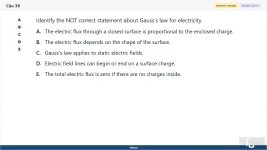
38. (Choose 1 answer)
Identify the NOT correct statement about Gauss's law for electricity.
A. The electric flux through a closed surface is proportional to the enclosed charge.
B. The electric flux depends on the shape of the surface.
C. Gauss's law applies to static electric fields.
D. Electric field lines can begin or end on a surface charge.
E. The total electric flux is zero if there are no charges inside.
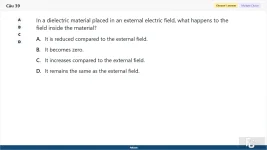
39. (Choose 1 answer)
In a dielectric material placed in an external electric field, what happens to the field inside the material?
A. It is reduced compared to the external field.
B. It becomes zero.
C. It increases compared to the external field.
D. It remains the same as the external field.
40. (Choose 2 answers)
Which of the following are conditions for mechanical equilibrium in electrostatic fields?
A. The net force on a charge is zero.
B. The electric potential is constant in the region.
C. The net electric field is uniform in the region.
D. The electric field is zero everywhere in the region.
41. (Choose 1 answer)
Analyze the forces acting between two charged plates in a capacitor setup. Assume the plates are parallel, charged equally and oppositely, and placed in vacuum. Which of the following statements is correct?
A. The electric field between the plates is uniform.
B. The force between the plates depends on the plate separation only.
C. The force between the plates does not depend on the medium between them.
D. The force is determined by the charge distribution.
42. (Choose 1 answer)
Identify the key concept discussed in the lecture that involves the calculation of electrostatic energy in a configuration of multiple charges.
A. Capacitance.
B. Electric potential.
C. Principle of superposition.
D. Resistance.
43. (Choose 2 answers)
What are the implications of performing a cross product operation on two vectors?
A. Produces a vector orthogonal to both original vectors
B. Produces a scalar value
C. Is commutative
D. Reversing vector order changes the direction of the result
44. (Choose 3 answers)
Which of the following statements are true about the del operator and its applications?
A. The del operator is used to calculate divergence, curl, and Laplacian of fields.
B. The del operator is primarily for scalar multiplication of fields.
C. The del operator is significant in electromagnetism and fluid dynamics.
D. The del operator is used to integrate fields over a surface.
E. The del operator is essential in Maxwell's equations.
45. (Choose 2 answers)
Which of the following equations are Maxwell's equations in free space?
A. Gauss Law
B. Faraday Law
C. Maxwell-Ampere Law
D. Gauss Law for Magnetism
46. (Choose 1 answer)
Which of the following units is used to measure electric field strength?
A. Volt (V)
B. Ampere (A)
C. Newton per coulomb (N/C)
D. Coulomb (C)
47. (Choose 2 answers)
Select all that are characteristics of electric field lines.
A. They originate from positive charges and terminate on negative charges.
B. They form closed loops.
C. They never cross each other.
D. They represent equipotential lines.
48. (Choose 1 answer)
What key concept is crucial in understanding neutron diffusion?
A. Fourier's law
B. Fick's second law
C. Gauss's law
D. Ohm's law
49. (Choose 1 answer)
How does the Biot-Savart Law help in electromagnetic theory?
A. Calculates the magnetic field produced by a current
B. Predicts electric potential in a region
C. Determines charge distribution in a conductor
D. Measures capacitance of a conductor
50. (Choose 1 answer)
What is the primary result of solving Maxwell's equations for a system with moving charges?
A. Determination of electric and magnetic fields
B. Calculation of gravitational fields
C. Prediction of thermal energy distribution
D. Estimation of nuclear forces
Đính kèm
-
 EMF301c SP26 FE RE_01.webp34.8 KB · Lượt xem: 2
 -
 EMF301c SP26 FE RE_02.webp35.7 KB · Lượt xem: 2
 -
 EMF301c SP26 FE RE_03.webp25.6 KB · Lượt xem: 0
 -
 EMF301c SP26 FE RE_04.webp56.5 KB · Lượt xem: 0
 -
 EMF301c SP26 FE RE_05.webp52.1 KB · Lượt xem: 0
 -
 EMF301c SP26 FE RE_06.webp37.1 KB · Lượt xem: 0
 -
 EMF301c SP26 FE RE_07.webp56.8 KB · Lượt xem: 0
 -
 EMF301c SP26 FE RE_08.webp49.2 KB · Lượt xem: 0
 -
 EMF301c SP26 FE RE_09.webp49 KB · Lượt xem: 0
 -
 EMF301c SP26 FE RE_10.webp21.6 KB · Lượt xem: 0
 -
 EMF301c SP26 FE RE_11.webp31.3 KB · Lượt xem: 0
 -
 EMF301c SP26 FE RE_12.webp49.5 KB · Lượt xem: 0
 -
 EMF301c SP26 FE RE_13.webp65.3 KB · Lượt xem: 0
 -
 EMF301c SP26 FE RE_14.webp31.4 KB · Lượt xem: 0
 -
 EMF301c SP26 FE RE_15.webp11 KB · Lượt xem: 0
 -
 EMF301c SP26 FE RE_16.webp24.5 KB · Lượt xem: 0
 -
 EMF301c SP26 FE RE_17.webp39.1 KB · Lượt xem: 0
 -
 EMF301c SP26 FE RE_18.webp31.4 KB · Lượt xem: 0
 -
 EMF301c SP26 FE RE_19.webp42.5 KB · Lượt xem: 0
 -
 EMF301c SP26 FE RE_20.webp49.9 KB · Lượt xem: 0
 -
 EMF301c SP26 FE RE_21.webp10.7 KB · Lượt xem: 0
 -
 EMF301c SP26 FE RE_22.webp62 KB · Lượt xem: 0
 -
 EMF301c SP26 FE RE_23.webp42.5 KB · Lượt xem: 0
 -
 EMF301c SP26 FE RE_24.webp26.4 KB · Lượt xem: 0
 -
 EMF301c SP26 FE RE_25.webp33 KB · Lượt xem: 0
 -
 EMF301c SP26 FE RE_26.webp50.1 KB · Lượt xem: 0
 -
 EMF301c SP26 FE RE_27.webp59.7 KB · Lượt xem: 0
 -
 EMF301c SP26 FE RE_28.webp40.3 KB · Lượt xem: 0
 -
 EMF301c SP26 FE RE_29.webp41.3 KB · Lượt xem: 0
 -
 EMF301c SP26 FE RE_30.webp44.7 KB · Lượt xem: 0
 -
 EMF301c SP26 FE RE_31.webp22.7 KB · Lượt xem: 0
 -
 EMF301c SP26 FE RE_32.webp44 KB · Lượt xem: 0
 -
 EMF301c SP26 FE RE_33.webp27.4 KB · Lượt xem: 0
 -
 EMF301c SP26 FE RE_34.webp10.9 KB · Lượt xem: 0
 -
 EMF301c SP26 FE RE_35.webp43.6 KB · Lượt xem: 0
 -
 EMF301c SP26 FE RE_36.webp43.5 KB · Lượt xem: 0
 -
 EMF301c SP26 FE RE_37.webp45.9 KB · Lượt xem: 0
 -
 EMF301c SP26 FE RE_38.webp42 KB · Lượt xem: 0
 -
 EMF301c SP26 FE RE_39.webp34.2 KB · Lượt xem: 0
 -
 EMF301c SP26 FE RE_40.webp34.7 KB · Lượt xem: 0
 -
 EMF301c SP26 FE RE_41.webp58.5 KB · Lượt xem: 0
 -
 EMF301c SP26 FE RE_42.webp31.2 KB · Lượt xem: 0
 -
 EMF301c SP26 FE RE_43.webp33.5 KB · Lượt xem: 0
 -
 EMF301c SP26 FE RE_44.webp51.8 KB · Lượt xem: 0
 -
 EMF301c SP26 FE RE_45.webp24.3 KB · Lượt xem: 0
 -
 EMF301c SP26 FE RE_46.webp22.2 KB · Lượt xem: 0
 -
 EMF301c SP26 FE RE_47.webp29.4 KB · Lượt xem: 0
 -
 EMF301c SP26 FE RE_48.webp21.2 KB · Lượt xem: 0
 -
 EMF301c SP26 FE RE_49.webp31.5 KB · Lượt xem: 0
 -
 EMF301c SP26 FE RE_50.webp35.2 KB · Lượt xem: 2