
- Học kỳ
- SP2026
- Thời Gian
- 3/5/26
- Loại tài liệu
- FE
DET101c SP26 FE RE
Câu 1: Multiple Choice
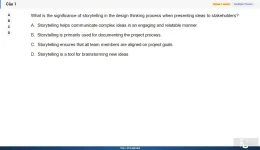
What is the significance of storytelling in the design thinking process when presenting ideas to stakeholders?
Câu 2: Multiple Choice
- A. Storytelling helps communicate complex ideas in an engaging and relatable manner
- B. Storytelling is primarily used for documenting the project process.
- C. Storytelling ensures that all team members are aligned on project goals
- D. Storytelling is a tool for brainstorming new ideas
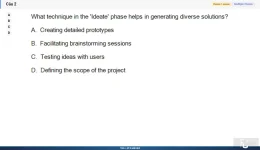
What technique in the 'Ideate' phase helps in generating diverse solutions?
Câu 3: Multiple Choice
- A. Creating detailed prototypes
- B. Facilitating brainstorming sessions
- C. Testing ideas with users
- D. Defining the scope of the project
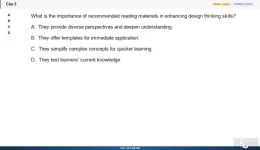
What is the importance of recommended reading materials in enhancing design thinking skills?
Câu 4: Multiple Choice
- A. They provide diverse perspectives and deepen understanding.
- B. They offer templates for immediate application.
- C. They simplify complex concepts for quicker learning.
- D. They test learners' current knowledge.
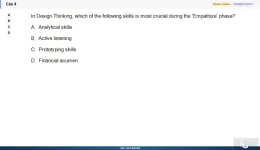
In Design Thinking, which of the following skills is most crucial during the 'Empathize' phase?
Câu 5: Multiple Choice
- A. Analytical skills
- B. Active listening
- C. Prototyping skills
- D. Financial acumen
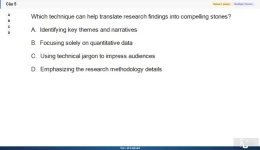
Which technique can help translate research findings into compelling stories?
Câu 6: Multiple Choice
- A. Identifying key themes and narratives
- B. Focusing solely on quantitative data
- C. Using technical jargon to impress audiences
- D. Emphasizing the research methodology details
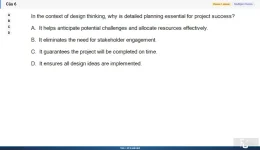
In the context of design thinking, why is detailed planning essential for project success?
Câu 7: Multiple Choice
- A. It helps anticipate potential challenges and allocate resources effectively.
- B. It eliminates the need for stakeholder engagement.
- C. It guarantees the project will be completed on time.
- D. It ensures all design ideas are implemented.
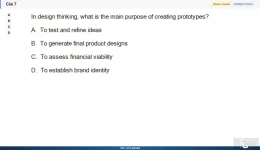
In design thinking, what is the main purpose of creating prototypes?
Câu 8: Multiple Choice
- A. To test and refine ideas
- B. To generate final product designs
- C. To assess financial viability
- D. To establish brand identity
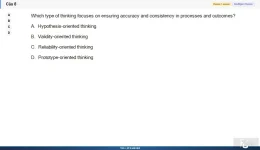
Which type of thinking focuses on ensuring accuracy and consistency in processes and outcomes?
Câu 9: Multiple Choice
- A. Hypothesis-oriented thinking
- B. Validity-oriented thinking
- C. Reliability-oriented thinking
- D. Prototype-oriented thinking
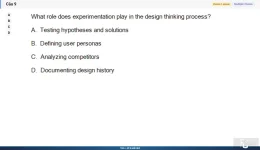
What role does experimentation play in the design thinking process?
Câu 10: Multiple Choice
- A. Testing hypotheses and solutions
- B. Defining user personas
- C. Analyzing competitors
- D. Documenting design history
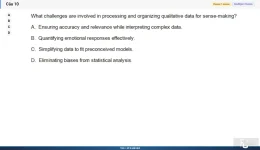
What challenges are involved in processing and organizing qualitative data for sense-making?
Câu 11: Multiple Choice
- A. Ensuring accuracy and relevance while interpreting complex data.
- B. Quantifying emotional responses effectively.
- C. Simplifying data to fit preconceived models.
- D. Eliminating biases from statistical analysis.
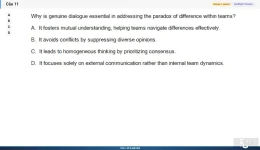
Why is genuine dialogue essential in addressing the paradox of difference within teams?
Câu 12: Multiple Choice
- A. It fosters mutual understanding, helping teams navigate differences effectively.
- B. It avoids conflicts by suppressing diverse opinions.
- C. It leads to homogeneous thinking by prioritizing consensus.
- D. It focuses solely on external communication rather than internal team dynamics.
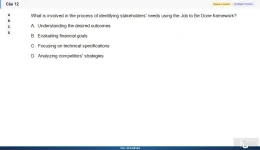
What is involved in the process of identifying stakeholders' needs using the Job to Be Done framework?
Câu 13: Multiple Choice
- A. Understanding the desired outcomes
- B. Evaluating financial goals
- C. Focusing on technical specifications
- D. Analyzing competitors' strategies
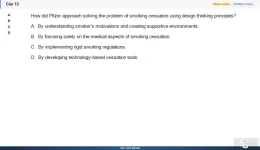
How did Pfizer approach solving the problem of smoking cessation using design thinking principles?
Câu 14: Multiple Choice
- A. By understanding smoker's motivations and creating supportive environments.
- B. By focusing solely on the medical aspects of smoking cessation.
- C. By implementing rigid smoking regulations.
- D. By developing technology-based cessation tools.
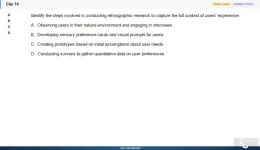
Identify the steps involved in conducting ethnographic research to capture the full context of users' experience.
Câu 15: Multiple Choice
- A. Observing users in their natural environment and engaging in interviews.
- B. Developing sensory preference cards and visual prompts for users.
- C. Creating prototypes based on initial assumptions about user needs.
- D. Conducting surveys to gather quantitative data on user preferences.
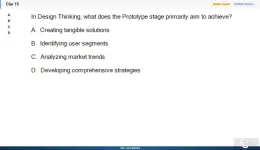
In Design Thinking, what does the Prototype stage primarily aim to achieve?
Câu 16: Multiple Choice
- A. Creating tangible solutions
- B. Identifying user segments
- C. Analyzing market trends
- D. Developing comprehensive strategies
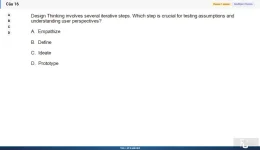
Design Thinking involves several iterative steps. Which step is crucial for testing assumptions and understanding user perspectives?
Câu 17: Multiple Choice
- A. Empathize
- B. Define
- C. Ideate
- D. Prototype
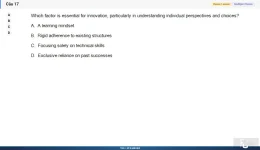
Which factor is essential for innovation, particularly in understanding individual perspectives and choices?
Câu 18: Multiple Choice
- A. A learning mindset
- B. Rigid adherence to existing structures
- C. Focusing solely on technical skills
- D. Exclusive reliance on past successes
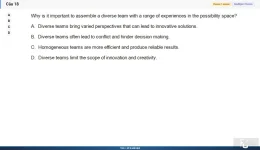
Why is it important to assemble a diverse team with a range of experiences in the possibility space?
Câu 19: Multiple Choice
- A. Diverse teams bring varied perspectives that can lead to innovative solutions.
- B. Diverse teams often lead to conflict and hinder decision making.
- C. Homogeneous teams are more efficient and produce reliable results.
- D. Diverse teams limit the scope of innovation and creativity.
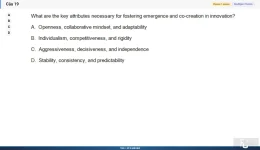
What are the key attributes necessary for fostering emergence and co-creation in innovation?
Câu 20: Multiple Choice
- A. Openness, collaborative mindset, and adaptability
- B. Individualism, competitiveness, and rigidity
- C. Aggressiveness, decisiveness, and independence
- D. Stability, consistency, and predictability
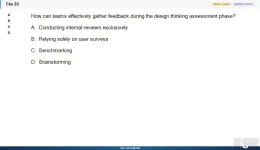
How can teams effectively gather feedback during the design thinking assessment phase?
Câu 21: Multiple Choice
- A. Conducting internal reviews exclusively
- B. Relying solely on user surveys
- C. Benchmarking
- D. Brainstorming
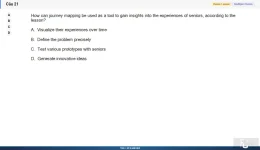
How can journey mapping be used as a tool to gain insights into the experiences of seniors, according to the lesson?
Câu 22: Multiple Choice
- A. Visualize their experiences over time
- B. Define the problem precisely
- C. Test various prototypes with seniors
- D. Generate innovative ideas
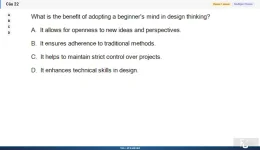
What is the benefit of adopting a beginner's mind in design thinking?
Câu 23: Multiple Choice
- A. It allows for openness to new ideas and perspectives.
- B. It ensures adherence to traditional methods.
- C. It helps to maintain strict control over projects.
- D. It enhances technical skills in design.
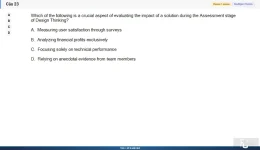
Which of the following is a crucial aspect of evaluating the impact of a solution during the Assessment stage of Design Thinking?
Câu 24: Multiple Choice
- A. Measuring user satisfaction through surveys
- B. Analyzing financial profits exclusively
- C. Focusing solely on technical performance
- D. Relying on anecdotal evidence from team members
Which method is commonly used during the Assessment phase to gather feedback from users?
Câu 25: Multiple Choice
- A. User interviews
- B. Brainstorming sessions
- C. Market analysis
- D. Sketching designs
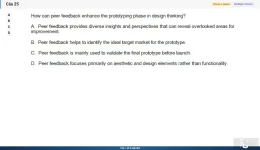
How can peer feedback enhance the prototyping phase in design thinking?
Câu 26: Multiple Choice
- A. Peer feedback provides diverse insights and perspectives that can reveal overlooked areas for improvement.
- B. Peer feedback helps to identify the ideal target market for the prototype.
- C. Peer feedback is mainly used to validate the final prototype before launch.
- D. Peer feedback focuses primarily on aesthetic and design elements rather than functionality.
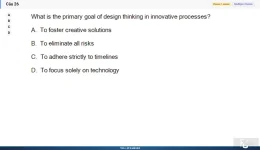
What is the primary goal of design thinking in innovative processes?
Câu 27: Multiple Choice
- A. To foster creative solutions
- B. To eliminate all risks
- C. To adhere strictly to timelines
- D. To focus solely on technology
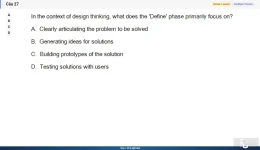
In the context of design thinking, what does the 'Define' phase primarily focus on?
Câu 28: Multiple Choice
- A. Clearly articulating the problem to be solved
- B. Generating ideas for solutions
- C. Building prototypes of the solution
- D. Testing solutions with users
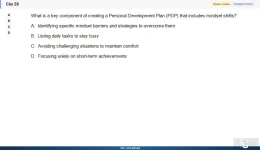
What is a key component of creating a Personal Development Plan (PDP) that includes mindset shifts?
Câu 29: Multiple Choice
- A. Identifying specific mindset barriers and strategies to overcome them
- B. Listing daily tasks to stay busy
- C. Avoiding challenging situations to maintain comfort
- D. Focusing solely on short-term achievements
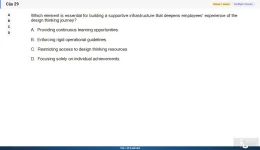
Which element is essential for building a supportive infrastructure that deepens employees' experience of the design thinking journey?
Câu 30: Multiple Choice
- A. Providing continuous learning opportunities.
- B. Enforcing rigid operational guidelines
- C. Restricting access to design thinking resources.
- D. Focusing solely on individual achievements.
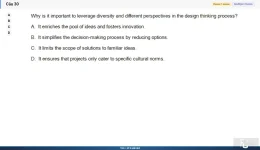
Why is it important to leverage diversity and different perspectives in the design thinking process?
Câu 31: Multiple Choice
- A. It enriches the pool of ideas and fosters innovation.
- B. It simplifies the decision-making process by reducing options.
- C. It limits the scope of solutions to familiar ideas.
- D. It ensures that projects only cater to specific cultural norms.
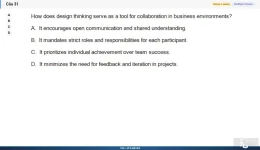
How does design thinking serve as a tool for collaboration in business environments?
Câu 32: Multiple Choice
- A. It encourages open communication and shared understanding.
- B. It mandates strict roles and responsibilities for each participant.
- C. It prioritizes individual achievement over team success.
- D. It minimizes the need for feedback and iteration in projects.
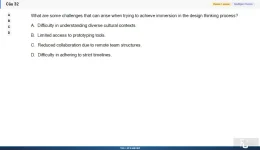
What are some challenges that can arise when trying to achieve immersion in the design thinking process?
Câu 33: Multiple Choice
- A. Difficulty in understanding diverse cultural contexts.
- B. Limited access to prototyping tools.
- C. Reduced collaboration due to remote team structures.
- D. Difficulty in adhering to strict timelines.
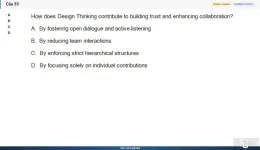
How does Design Thinking contribute to building trust and enhancing collaboration?
Câu 34: Multiple Choice
- A. By fostering open dialogue and active listening
- B. By reducing team interactions
- C. By enforcing strict hierarchical structures
- D. By focusing solely on individual contributions
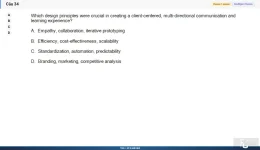
Which design principles were crucial in creating a client-centered, multi-directional communication and learning experience?
Câu 35: Multiple Choice
- A. Empathy, collaboration, iterative prototyping
- B. Efficiency, cost-effectiveness, scalability
- C. Standardization, automation, predictability
- D. Branding, marketing, competitive analysis
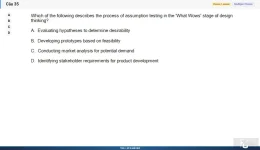
Which of the following describes the process of assumption testing in the 'What Wows' stage of design thinking?
Câu 36: Multiple Choice
- A. Evaluating hypotheses to determine desirability
- B. Developing prototypes based on feasibility
- C. Conducting market analysis for potential demand
- D. Identifying stakeholder requirements for product development
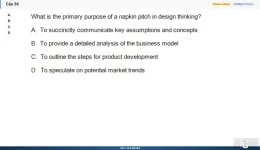
What is the primary purpose of a napkin pitch in design thinking?
Câu 37: Multiple Choice
- A. To succinctly communicate key assumptions and concepts
- B. To provide a detailed analysis of the business model
- C. To outline the steps for product development
- D. To speculate on potential market trends
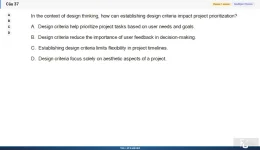
In the context of design thinking, how can establishing design criteria impact project prioritization?
Câu 38: Multiple Choice
- A. Design criteria help prioritize project tasks based on user needs and goals.
- B. Design criteria reduce the importance of user feedback in decision-making
- C. Establishing design criteria limits flexibility in project timelines.
- D. Design criteria focus solely on aesthetic aspects of a project.
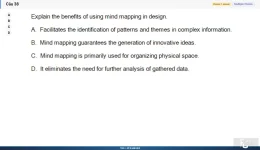
Explain the benefits of using mind mapping in design.
Câu 39: Multiple Choice
- A. Facilitates the identification of patterns and themes in complex information.
- B. Mind mapping guarantees the generation of innovative ideas.
- C. Mind mapping is primarily used for organizing physical space.
- D. It eliminates the need for further analysis of gathered data.
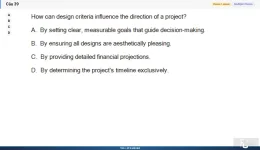
How can design criteria influence the direction of a project?
Câu 40: Multiple Choice
- A. By setting clear, measurable goals that guide decision-making.
- B. By ensuring all designs are aesthetically pleasing.
- C. By providing detailed financial projections.
- D. By determining the project's timeline exclusively.
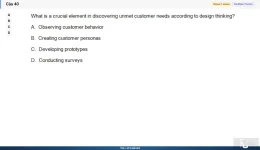
What is a crucial element in discovering unmet customer needs according to design thinking?
Câu 41: Multiple Choice
- A. Observing customer behavior
- B. Creating customer personas
- C. Developing prototypes
- D. Conducting surveys
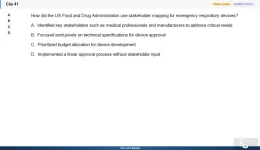
How did the US Food and Drug Administration use stakeholder mapping for emergency respiratory devices?
Câu 42: Multiple Choice
- A. Identified key stakeholders such as medical professionals and manufacturers to address critical needs
- B. Focused exclusively on technical specifications for device approval
- C. Prioritized budget allocation for device development
- D. Implemented a linear approval process without stakeholder input
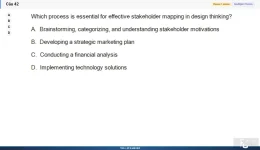
Which process is essential for effective stakeholder mapping in design thinking?
Câu 43: Multiple Choice
- A. Brainstorming, categorizing, and understanding stakeholder motivations
- B. Developing a strategic marketing plan
- C. Conducting a financial analysis
- D. Implementing technology solutions
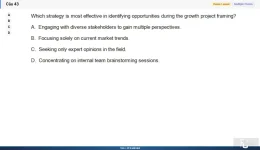
Which strategy is most effective in identifying opportunities during the growth project framing?
Câu 44: Multiple Choice
- A. Engaging with diverse stakeholders to gain multiple perspectives.
- B. Focusing solely on current market trends.
- C. Seeking only expert opinions in the field.
- D. Concentrating on internal team brainstorming sessions.
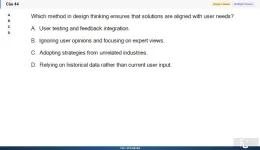
Which method in design thinking ensures that solutions are aligned with user needs?
Câu 45: Multiple Choice
- A. User testing and feedback integration.
- B. Ignoring user opinions and focusing on expert views.
- C. Adopting strategies from unrelated industries.
- D. Relying on historical data rather than current user input.
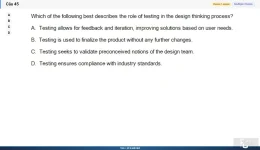
Which of the following best describes the role of testing in the design thinking process?
Câu 46: Multiple Choice
- A. Testing allows for feedback and iteration, improving solutions based on user needs.
- B. Testing is used to finalize the product without any further changes.
- C. Testing seeks to validate preconceived notions of the design team.
- D. Testing ensures compliance with industry standards.
What role does rapid prototyping play in the assumption testing process?
Câu 47: Multiple Choice
- A. It allows quick validation and iteration of ideas.
- B. It provides a detailed analysis of market trends.
- C. It guarantees final design approval by stakeholders.
- D. It limits creativity to ensure accurate designs.
Which technique is essential for gathering user feedback through card sorting?
Câu 48: Multiple Choice
- A. Organizing information in a way that reflects user mental models.
- B. Collecting data on user demographics.
- C. Creating a detailed project timeline based on card categories.
- D. Identifying competitors' product features.
What are the challenges associated with prototyping a complex product like the Eaton next generation meter?
Câu 49: Multiple Choice
- A. Balancing detail with flexibility to accommodate changes.
- B. Ensuring immediate market success without iterations.
- C. Using only high-fidelity models from the start.
- D. Ignoring user feedback to focus on technical specifications.
Which method can be used to enhance creativity during the ideation phase of design thinking?
Câu 50: Multiple Choice
- A. Mind mapping to generate and organize ideas visually.
- B. Strict adherence to conventional frameworks.
- C. Immediate selection of a single idea to develop.
- D. Focusing on technical feasibility from the start.
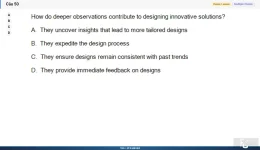
How do deeper observations contribute to designing innovative solutions?
- A. They uncover insights that lead to more tailored designs
- B. They expedite the design process
- C. They ensure designs remain consistent with past trends
- D. They provide immediate feedback on designs
Đính kèm
-
 DET101c SP26 FE RE_001.webp57.3 KB · Lượt xem: 1
 -
 DET101c SP26 FE RE_002.webp49.3 KB · Lượt xem: 1
 -
 DET101c SP26 FE RE_003.webp53.2 KB · Lượt xem: 0
 -
 DET101c SP26 FE RE_004.webp34.6 KB · Lượt xem: 0
 -
 DET101c SP26 FE RE_005.webp53.4 KB · Lượt xem: 0
 -
 DET101c SP26 FE RE_006.webp59.3 KB · Lượt xem: 0
 -
 DET101c SP26 FE RE_007.webp46.3 KB · Lượt xem: 0
 -
 DET101c SP26 FE RE_008.webp40 KB · Lượt xem: 0
 -
 DET101c SP26 FE RE_009.webp46 KB · Lượt xem: 0
 -
 DET101c SP26 FE RE_010.webp53.7 KB · Lượt xem: 0
 -
 DET101c SP26 FE RE_011.webp66.3 KB · Lượt xem: 0
 -
 DET101c SP26 FE RE_012.webp41.9 KB · Lượt xem: 0
 -
 DET101c SP26 FE RE_013.webp56.5 KB · Lượt xem: 0
 -
 DET101c SP26 FE RE_014.webp57.2 KB · Lượt xem: 0
 -
 DET101c SP26 FE RE_015.webp48.5 KB · Lượt xem: 0
 -
 DET101c SP26 FE RE_016.webp35.1 KB · Lượt xem: 0
 -
 DET101c SP26 FE RE_017.webp40.7 KB · Lượt xem: 0
 -
 DET101c SP26 FE RE_018.webp59.9 KB · Lượt xem: 0
 -
 DET101c SP26 FE RE_019.webp52.1 KB · Lượt xem: 0
 -
 DET101c SP26 FE RE_020.webp41.1 KB · Lượt xem: 0
 -
 DET101c SP26 FE RE_021.webp40.7 KB · Lượt xem: 0
 -
 DET101c SP26 FE RE_022.webp58.5 KB · Lượt xem: 0
 -
 DET101c SP26 FE RE_023.webp48 KB · Lượt xem: 0
 -
 DET101c SP26 FE RE_024.webp36.4 KB · Lượt xem: 0
 -
 DET101c SP26 FE RE_025.webp68.6 KB · Lượt xem: 0
 -
 DET101c SP26 FE RE_026.webp45.6 KB · Lượt xem: 0
 -
 DET101c SP26 FE RE_027.webp47.1 KB · Lượt xem: 0
 -
 DET101c SP26 FE RE_028.webp50.3 KB · Lượt xem: 0
 -
 DET101c SP26 FE RE_029.webp48.3 KB · Lượt xem: 0
 -
 DET101c SP26 FE RE_030.webp53.7 KB · Lượt xem: 0
 -
 DET101c SP26 FE RE_031.webp59.6 KB · Lượt xem: 0
 -
 DET101c SP26 FE RE_032.webp46.1 KB · Lượt xem: 0
 -
 DET101c SP26 FE RE_033.webp51 KB · Lượt xem: 0
 -
 DET101c SP26 FE RE_034.webp49.4 KB · Lượt xem: 0
 -
 DET101c SP26 FE RE_035.webp51.7 KB · Lượt xem: 0
 -
 DET101c SP26 FE RE_036.webp60.9 KB · Lượt xem: 0
 -
 DET101c SP26 FE RE_037.webp61.8 KB · Lượt xem: 0
 -
 DET101c SP26 FE RE_038.webp64.2 KB · Lượt xem: 0
 -
 DET101c SP26 FE RE_039.webp62.4 KB · Lượt xem: 0
 -
 DET101c SP26 FE RE_040.webp40.3 KB · Lượt xem: 0
 -
 DET101c SP26 FE RE_041.webp59.6 KB · Lượt xem: 0
 -
 DET101c SP26 FE RE_042.webp55.7 KB · Lượt xem: 0
 -
 DET101c SP26 FE RE_043.webp53.9 KB · Lượt xem: 0
 -
 DET101c SP26 FE RE_044.webp55.5 KB · Lượt xem: 0
 -
 DET101c SP26 FE RE_045.webp66.4 KB · Lượt xem: 0
 -
 DET101c SP26 FE RE_046.webp61.3 KB · Lượt xem: 0
 -
 DET101c SP26 FE RE_047.webp59.9 KB · Lượt xem: 0
 -
 DET101c SP26 FE RE_048.webp50.8 KB · Lượt xem: 0
 -
 DET101c SP26 FE RE_049.webp52.9 KB · Lượt xem: 0
 -
 DET101c SP26 FE RE_050.webp62.4 KB · Lượt xem: 1