
- Học kỳ
- SP2026
- Thời Gian
- 28/4/26
- Loại tài liệu
- FE
- Mã Đề
- CSD201_SP26_B5FE_920475
CSD201 SP26 B5 FE
CSD201_SP26_B5FE | Multiple Choice Question 1 (Choose 1 answer) Select the statement that is most correct.
A. There is no difference between a recursive method and a non-recursive method
B. For a recursive method to terminate there must be one or more steps,
C. For a recursive method to terminate there must be one or more limit conditions.
D. A recursive method is a method that invokes itself directly or indirectly. For a recursive method to terminate there must be one or more base cases.
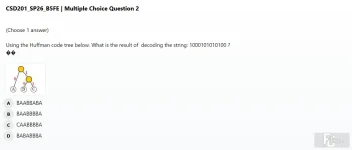
CSD201_SP26_B5FE | Multiple Choice Question 2 (Choose 1 answer) Using the Huffman code tree below. What is the result of decoding the string: 1000101010100?
A. BAABBABA
B. BAABBBBA
C. CAABBBBA
D. BABABBBA
CSD201_SP26_B5FE | Multiple Choice Question 3 (Choose 1 answer) In Huffman coding, both the sender and receiver must have a copy of the same code in order for the decoded file to match the encoded file
A. True
B. False
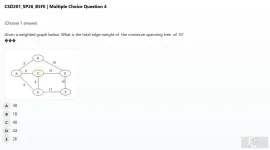
CSD201_SP26_B5FE | Multiple Choice Question 4 (Choose 1 answer) Given a weighted graph below. What is the total edge-weight of the minimum spanning tree of G?
A. 38
B. 18
C. 40
D. 24
E. 26
CSD201_SP26_B5FE | Multiple Choice Question 5 (Choose 1 answer) What is the result of the breadth first traverse of the binary search tree T, after inserting the following keys into the tree sequentially (suppose T is empty before insertion) 15, 7, 3, 0, 12, 20, 17
A. 15, 7, 20, 3, 12, 0, 17
B. 15, 7, 20, 3, 12, 17, 0
C. 15, 7, 20, 3, 17, 12, 0
D. 15, 7, 20, 3, 17, 0, 12
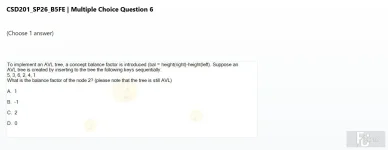
CSD201_SP26_B5FE | Multiple Choice Question 6 (Choose 1 answer) To implement an AVL tree, a concept balance factor is introduced (bal height(right)-height(left) Suppose an AVL tree is created by inserting to the tree the following keys sequentially 5 3 6 2 4 1 What is the balance factor of the node 2? (please note that the tree is still AVL)
A. 1
B. -1
C. 2
D. 0
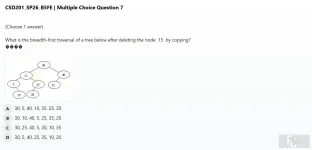
CSD201_SP26_B5FE | Multiple Choice Question 7 (Choose 1 answer) What is the breadth-first traversal of a tree below after deleting the node 15 by copying?
A. 30, 5, 40, 10, 35, 25, 20
B. 30, 10, 40, 5, 25, 35, 20
C. 30, 25, 40, 5, 20, 10, 35
D. 30, 5, 40, 25, 35, 10, 20
CSD201_SP26_B5FE | Multiple Choice Question 8 (Choose 1 answer) The function fis defined as below:
if n = 0 or r = 1 then f
if n > 1 then f
A. 22
B. 23
C. 24
D. 21
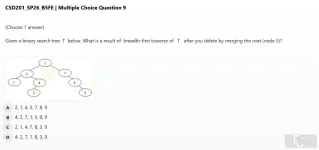
CSD201_SP26_B5FE | Multiple Choice Question 9 (Choose 1 answer) Given a binary search tree T below. What is a result of breadth-first traverse of T after you delete by merging the root (node 5)?
A. 2, 1, 4, 3, 7, 8, 9
B. 4, 2, 7, 1, 3, 8, 9
C. 2, 1, 4, 7, 8, 3, 9
D. 4, 2, 7, 1, 8, 3, 9
CSD201_SP26_B5FE | Multiple Choice Question 10 (Choose 1 answer) What is the correct definition of a hash function? (Select the best answer)
A. Hash function h(x) is a function which transforms a particular key x, be it a string, number, record, or the like, into non-negative integer
B. Hash function h(x) is a function which transforms a particular key x, be it a string, number, record, or the like, into an index i h(x) in the table T, where T is used for storing an item having key x or its address.
C. Hash function h(x) is a function which transforms a particular key x (string, or number) into an index = h(x) in the table T, where T is used for storing an item having key x or its address
D. Hash function h(x) is a function which transforms a particular key x, be it a string, number, record, or the like, into a positive integer
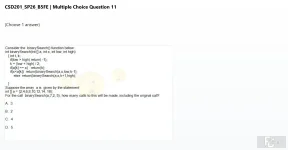
CSD201_SP26_B5FE | Multiple Choice Question 11 (Choose 1 answer) Consider the binarySearch() function below: int binarySearch(int[] a, int x, int low, int high) int t k if(low > high) return(-1); k=(low+high)/2; if(a[k]==x) return(k); if(x<a[k]) return(binarySearch(a,x,low,k-1)); else return(binarySearch(a,x,k+1,high)); Suppose the array a is given by the statement int [] a={2,4,6,8,10,12,14,16}; For the call binarySearch(a,7,2,5), how many calls to this will be made, including the original call?
A. 3
B. 2
C. 4
D. 5
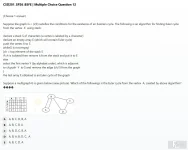
CSD201_SP26_B5FE | Multiple Choice Question 12 (Choose 1 answer) Suppose the graph G=(V,E) satisfies the conditions for the existence of an Eulerian cycle. The following is an algorithm for finding Euler cycle from the vertex X using stack. declare a stack S of characters (a vertex is labeled by a character) declare an empty array E (which will contain Euler cycle) push the vertex X to S while(S is not empty) ch = top element of the stack S if ch is isolated then remove it from the stack and put it to E else select the first vertex Y (by alphabet order), which is adjacent to ch,push Y to S and remove the edge (ch,Y) from the graph the last array E obtained is an Euler cycle of the graph Suppose a multigraph G is given below (view picture). Which of the followings is the Euler cycle from the vertex A created by above algorithm?
A. A, B, C, D, B, A
B. A, B, C, B, A
C. A, B, D, C, B, A
D. A, B, A, B, D, C, A
E. A, B, C, D, A
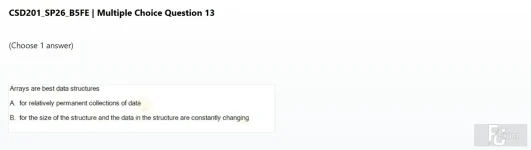
CSD201_SP26_B5FE | Multiple Choice Question 13 (Choose 1 answer) Arrays are best data structures
A. for relatively permanent collections of data
B. for the size of the structure and the data in the structure are constantly changing
CSD201_SP26_B5FE | Multiple Choice Question 14 (Choose 1 answer) The operation for removing and returning the top element of the stack is traditionally called:
A. delete
B. peek
C. pop
D. remove
CSD201_SP26_B5FE | Multiple Choice Question 15 (Choose 1 answer) Given a raw message XXXXXXUUUUxxxuuxXXXXXXxUU (without single quote). Run the run-length encoding algorithm for that message, what is the output?
A. 4X4U3X2U5X2U
B. X4U4X3U2X5UU2
C. 4X4U3X2U5X
D. 4X4U3X2U5X2UU
CSD201_SP26_B5FE | Multiple Choice Question 16 (Choose 1 answer) Suppose a doubly linked list of integers is given below and p is a reference to the node with value 29 in the list (e. p. info 29) (head) 17 11 6 4 3 29 8 2 (tail) What does the list look like after the following java code snippet is run? int x=5; Node p1, p2; p1 = new Node(x); p2 = p.next; p.next = p1; p1.prev = p; p1.next = p2; p2.prev = p1;
A. 17 11 6 4 3 29 8 2 5
B. 17 11 6 4 3 5 29 8 2
C. 17 11 6 4 3 29 5 8 2
D. 17 5 11 6 4 3 29 8 2
E. 5 17 11 6 4 3 29 8 2
CSD201_SP26_B5FE | Multiple Choice Question 17 (Choose 1 answer) Consider the following 2 definitions about graph An undirected graph is called connected when there is a path between any two vertices of the graph. If every node u in undirected graph G is adjacent to every other node v in G, A graph is said to be complete. Which of the following statements is correct:
A. The connected graph is always complete
B. The complete graph is always connected.
C. The complete graph is always connected and vise versa.
D. None of others
CSD201_SP26_B5FE | Multiple Choice Question 18 (Choose 1 answer) Given a weighted graph below and you are using the Dijkstra algorithm to find the shortest path from the vertex A to the vertex F. What are the correct order of vertices selected into the set S until the vertex F is selected? (Each step a vertex with minimal current distance is selected into S).
A. A, B, C, E, D, F
B. A, B, C, E, F
C. A, C, D, F
D. A, C, E, F
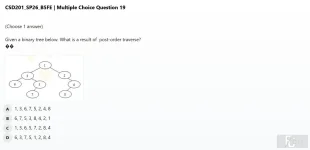
CSD201_SP26_B5FE | Multiple Choice Question 19 (Choose 1 answer) Given a binary tree below. What is a result of post-order traverse?
A. 1, 3, 6, 7, 5, 2, 4, 8
B. 6, 7, 5, 3, 8, 4, 2, 1
C. 1, 3, 6, 5, 7, 2, 8, 4
D. 6, 3, 7, 5, 1, 2, 8, 4
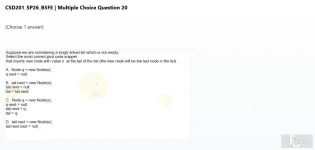
CSD201_SP26_B5FE | Multiple Choice Question 20 (Choose 1 answer) Suppose we are considering a singly linked list which is not empty Select the most correct java code snippet that inserts new node with value x at the tail of the list (the new node will be the last node in the list).
A. Node q = new Node(x); q.next = null;
B. tail.next = new Node(X); tail.next = null; tail = tail.next;
C. Node q = new Node(x); q.next = null; tail.next = q; tail = q;
D. tail.next = new Node(x); tail.next.next = null;
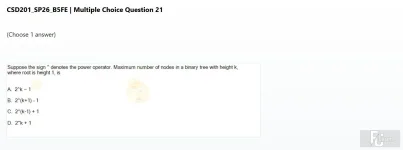
CSD201_SP26_B5FE | Multiple Choice Question 21 (Choose 1 answer) Suppose the sign denotes the power operator. Maximum number of nodes in a binary tree with height k where root is height 1, is
A. $2^n k-1$
B. $2^n(k+1)-1$
C. $2'(k-1)+1$
D. $2^\circ k+1$
CSD201_SP26_B5FE | Multiple Choice Question 22 (Choose 1 answer) The following is the main part of insertion sort pseudocode: for i = 1 to n-1 insert a into sorted sublist (a[0], ..., a[i-1]) so that the sortedness is still kept. end for Select the most correct solution: Consider the list of ten integers below: 17, 5, 3, 11, 10, 8, 13, 4, 8, 6 What is the list after the FIRST TWO steps of insertion sort? (sorting from smallest to largest).
A. 3, 4, 17, 11, 10, 8, 13, 5, 8, 6
B. 3, 4, 5, 11, 10, 8, 13, 17, 8, 6
C. 3, 5, 11, 10, 8, 13, 4, 8, 6, 17
D. 3, 5, 17, 11, 10, 8, 13, 4, 8, 6
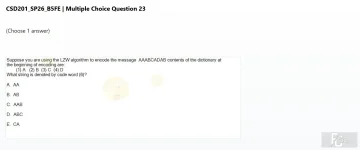
CSD201_SP26_B5FE | Multiple Choice Question 23 (Choose 1 answer) Suppose you are using the LZW algorithm to encode the message AAABCADAB contents of the dictionary at the beginning of encoding are (1) A (2) B (3) C (4) D What string is denoted by code word (6)?
A. AA
B. AB
C. AAB
D. ABC
E. CA
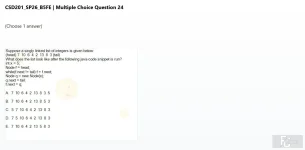
CSD201_SP26_B5FE | Multiple Choice Question 24 (Choose 1 answer) Suppose a singly linked list of integers is given below: (head) 7 10 6 4 2 13 8 3 (tail) What does the list look like after the following java code snippet is run? int x=5; Node f = head; while(f.next != tail) f=f.next; Node q = new Node(x); q.next = tail; f.next = q;
A. 7 10 6 4 2 13 8 3 5
B. 7 10 6 4 2 13 8 5 3
C. 5 7 10 6 4 2 13 8 3
D. 7 5 10 6 4 2 13 8 3
E. 7 10 6 4 2 13 5 8 3
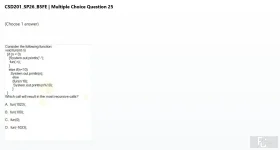
CSD201_SP26_B5FE | Multiple Choice Question 25 (Choose 1 answer) Consider the following function void fun(int n) { if (n<0) { System.out.println("-"); fun(-n); } else if(n<10) System.out.println
A. fun(1023)
B. fun(100)
C. fun(0)
D. fun(-1023)
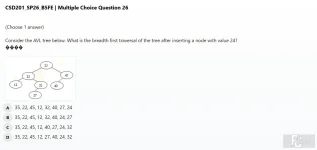
CSD201_SP26_B5FE | Multiple Choice Question 26 (Choose 1 answer) Consider the AVL tree below. What is the breadth first traversal of the tree after inserting a node with value 24?
A. 35, 22, 45, 12, 32, 40, 27, 24
B. 35, 22, 45, 12, 32, 40, 24, 27
C. 35, 22, 45, 12, 40, 27, 24, 32
D. 35, 22, 45, 12, 27, 40, 24, 32
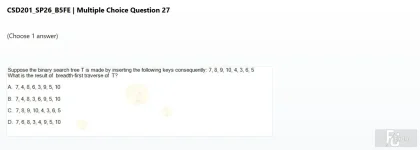
CSD201_SP26_B5FE | Multiple Choice Question 27 (Choose 1 answer) Suppose the binary search tree T is made by inserting the following keys consequently: 7, 8, 9, 10, 4, 3, 6, 5 What is the result of breadth-first traverse of T?
A. 7, 4, 8, 6, 3, 9, 5, 10
B. 7, 4, 8, 3, 6, 9, 5, 10
C. 7, 8, 9, 10, 4, 3, 6, 5
D. 7, 6, 8, 3, 4, 9, 5, 10
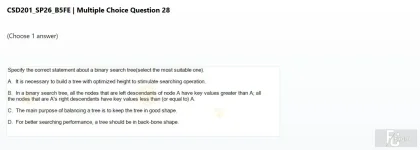
CSD201_SP26_B5FE | Multiple Choice Question 28 (Choose 1 answer) Specify the correct statement about a binary search tree(select the most suitable one).
A. It is necessary to build a tree with optimized height to stimulate searching operation.
B. In a binary search tree, all the nodes that are left descendants of node A have key values greater than A all the nodes that are A's right descendants have key values less than (or equal to) A
C. The main purpose of balancing a tree is to keep the tree in good shape
D. For better searching performance, a tree should be in back-bone shape
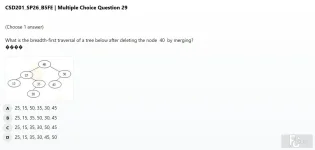
CSD201_SP26_B5FE | Multiple Choice Question 29 (Choose 1 answer) What is the breadth-first traversal of a tree below after deleting the node 40 by merging?
A. 25, 15, 50, 35, 30, 45
B. 25, 15, 35, 50, 30, 45
C. 25, 15, 35, 30, 50, 45
D. 25, 15, 35, 30, 45, 50
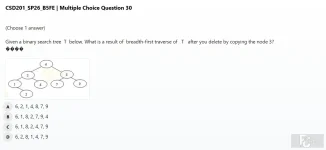
CSD201_SP26_B5FE | Multiple Choice Question 30 (Choose 1 answer) Given a binary search tree T below. What is a result of breadth-first traverse of T after you delete by copying the node 3?
A. 6, 2, 1, 4, 8, 7, 9
B. 6, 1, 8, 2, 7, 9, 4
C. 6, 1, 8, 2, 4, 7, 9
D. 6, 2, 8, 1, 4, 7, 9
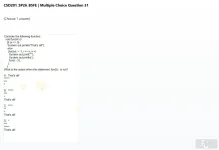
CSD201_SP26_B5FE | Multiple Choice Question 31 (Choose 1 answer) Consider the following function void fun(int n) { if (n<=0) System.out.println("That's alll"); else { for(int i=1; i<=n; i++) System.out.print("*"); System.out.println(); fun(n-2); } } What is the output when the statement fun(5); is run?
A. That's all
B. That's all!
C. That's all!
D. That's alll
CSD201_SP26_B5FE | Multiple Choice Question 32 (Choose 1 answer) Fill in blank to form a correct statement: "A recursive method is a method that invokes itself directly or indirectly For a recursive method to terminate there must be one or more ______"
A. base cases
B. steps
C. limit conditions
D. conditions
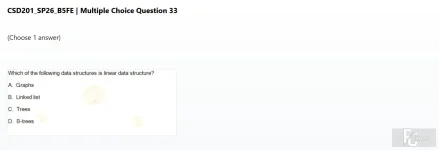
CSD201_SP26_B5FE | Multiple Choice Question 33 (Choose 1 answer) Which of the following data structures is linear data structure?
A. Graphs
B. Linked list
C. Trees
D. B-trees
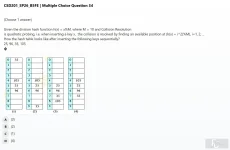
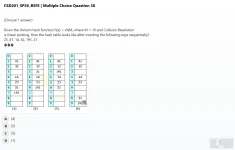
CSD201_SP26_B5FE | Multiple Choice Question 34 (Choose 1 answer) Given the division hash function $h(x)=x\%M,$ where $M=10$ and Collision Resolution is quadratic probing, i.e. when inserting a key x, the collision is resolved by finding an available position at $(h(x)+i^{\wedge}2)\%M$, $i=1,2,...$ How the hash table looks like after inserting the following keys sequentially? 25, 96, 35, 105
A. (3)
B. (2)
C. (1)
D. (4)
CSD201_SP26_B5FE | Multiple Choice Question 35 (Choose 1 answer) Linked lists are best suited
A. for relatively permanent collections of data
B. for the size of the structure and the data in the structure are constantly changing
CSD201_SP26_B5FE | Multiple Choice Question 36 (Choose 1 answer) In a linked list, the tail node is introduced for performance purpose only.
A. False
B. True
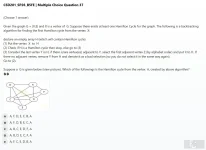
CSD201_SP26_B5FE | Multiple Choice Question 37 (Choose 1 answer) Given the graph $G=(V,E)$ and X is a vertex of G. Suppose there exists at least one Hamilton Cycle for the graph. The following is a backtracking algorithm for finding the first Hamilton cycle from the vertex X: declare an empty array H (which will contain Hamilton cycle) (1) Put the vertex X to H (2) Check if H is a Hamilton cycle then stop, else go to (3) (3) Consider the last vertex Y in H, if there is/are vertex(es) adjacent to Y, select the first adjacent vertex Z (by alphabet order) and put it to H. If there no adjacent vertex, remove Y from H and denote it as a bad selection (so you do not select it in the same way again). Go to (2). Suppose a G is given below (view picture). Which of the followings is the Hamilton cycle from the vertex A, created by above algorithm?
A. A, F, D, E, C, B, A
B. A, F, D, B, E, C, A
C. A, B, C, E, D, F, A
D. A, B, D, E, C, F, A
E. A, F, C, E, D, B, A
CSD201_SP26_B5FE | Multiple Choice Question 38 (Choose 1 answer) Given the division hash function $h(x)=x96M,$ where $M=10$ and Collision Resolution is linear probing. How the hash table looks like after inserting the following keys sequentially? 25, 41, 14, 32, 191, 21
A. (4)
B. (2)
C. (3)
D. (1)
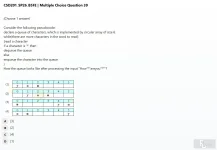
CSD201_SP26_B5FE | Multiple Choice Question 39 (Choose 1 answer) Consider the following pseudocode: declare a queue of characters, which is implemented by circular array of size 6. while(there are more characters in the word to read) { read a character if a character is '' then dequeue the queue else enqueue the character into the queue } How the queue looks like after processing the input "Howareyou*"?
A. (3)
B. (2)
C. (4)
D. (1)
CSD201_SP26_B5FE | Multiple Choice Question 40 (Choose 1 answer) Consider the following pseudocode declare a stack of characters while(there are more characters in the word to read) { read a character if a character is then pop and write the poped character to the screen else push the character into the stack } What is written to the screen for the input "Good Morning Sir"?
A. donico
B. doringi
C. donnoG
D. donriMG
E. GooMorni
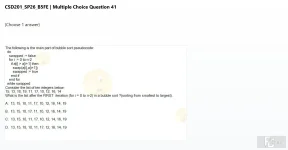
CSD201_SP26_B5FE | Multiple Choice Question 41 (Choose 1 answer) The following is the main part of bubble sort pseudocode: do { swapped = false; for i = 0 to n-2 if a > a[i+1] then swap(a,a[i+1]); swapped = true; end if end for } while swapped Consider the list of ten integers below; 15, 13, 18, 19, 11, 17, 10, 12, 16, 14 What is the list after the FIRST iteration (for 10 to n-2) in a bubble sort?(sorting from smallest to largest)
A. 13, 15, 18, 11, 17, 10, 12, 16, 14, 19
B. 13, 15, 18, 17, 11, 10, 12, 16, 14, 19
C. 13, 15, 18, 11, 17, 10, 12, 14, 16, 19
D. 13, 15, 18, 10, 11, 17, 12, 16, 14, 19
CSD201_SP26_B5FE | Multiple Choice Question 42 (Choose 1 answer) The operation for removing and returning the front element of the queue is traditionally called
A. delete
B. peek
C. dequeue
D. remove
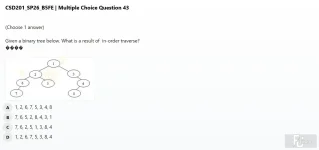
CSD201_SP26_B5FE | Multiple Choice Question 43 (Choose 1 answer) Given a binary tree below. What is a result of in-order traverse?
A. 1, 2, 6, 7, 5, 3, 4, 8
B. 7, 6, 5, 2, 8, 4, 3, 1
C. 7, 6, 2, 5, 1, 3, 8, 4
D. 1, 2, 6, 7, 5, 3, 8, 4
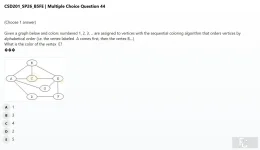
CSD201_SP26_B5FE | Multiple Choice Question 44 (Choose 1 answer) Given a graph below and colors numbered 1, 2, 3, ... are assigned to vertices with the sequential coloring algorithm that orders vertices by alphabetical order (ie. the vertex labeled A comes first, then the vertex B...) What is the color of the vertex E?
A. 1
B. 3
C. 4
D. 2
E. 5
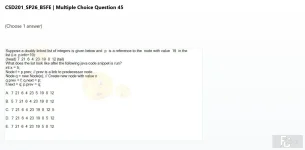
CSD201_SP26_B5FE | Multiple Choice Question 45 (Choose 1 answer) Suppose a doubly linked list of integers is given below and p is a reference to the node with value 19 in the list (Le.You do not have permission to view link Đăng nhập hoặc Đăng ký.19) (head) 7 21 6 4 23 19 8. 12 (tail) What does the list look like after the following java code snippet is run? int x=5; Node f = p.prev; // prev is a link to predecessor node Node q = new Node(x); // Create new node with value x q.prev = f; q.next = p; f.next = q; p.prev = q;
A. 7 21 6 4 23 5 19 8 12
B. 5 7 21 6 4 23 19 8 12
C. 7 21 6 4 23 19 8 12 5.
D. 7 21 6 4 23 19 8 5 12
E. 7 21 8 4 23 19 5 8 12
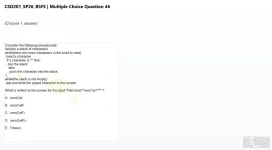
CSD201_SP26_B5FE | Multiple Choice Question 46 (Choose 1 answer) Consider the following pseudocode declare a stack of characters while(there are more characters in the word to read) { read a character if a character is then 1 pop the stack else push the character into the stack while(the stack is not empty) pop and write the poped character to the screen } What is written to the screen for the input "FileCompression***"?
A. seroCeli
B. seroCellF
C. seroCelFi
D. seroCelin
E. Filreion
CSD201_SP26_B5FE | Multiple Choice Question 47 (Choose 1 answer) Suppose a singly linked list of integers is given below and p is a reference to the node with value 9 in the list (e. pinfo-9) (head) 7 11 6 4 3 9 8 21 (tail) What does the list look like after the following java code snippet is run? int x=19; Node f = head; while(f.next != p) f=f.next; Node q = new Node(x); q.next = p; f.next = q;
A. 7 11 6 4 3 9 8 21 13
B. 7 11 6 4 3 13 9 8 21
C. 7 11 6 4 3 9 13 8 21
D. 7 13 11 6 4 3 9 8 21
E. 13 7 11 6 4 3 9 8 21
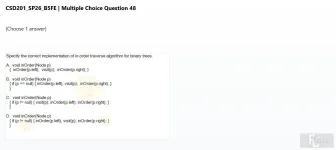
CSD201_SP26_B5FE | Multiple Choice Question 48 (Choose 1 answer) Specify the correct implementation of in-order traverse algorithm for binary trees
A. void inOrder(Node p) { inOrder(p.left); visit(p); inOrder(p.right); }
B. void inOrder(Node p) { if(p==null) { inOrder(p.left); visit(p); inOrder(p.right); } }
C. void inOrder(Node p) { if (p!= null) { visit(p); inOrder(p.left); inOrder(p.right); } }
D. void inOrder(Node p) { if(p!=null) { inOrder(p.left); visit(p); inOrder(p.right); } }
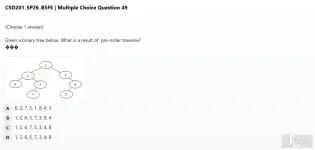
CSD201_SP26_B5FE | Multiple Choice Question 49 (Choose 1 answer) Given a binary tree below. What is a result of pre-order traverse?
A. 6, 2, 7, 5, 1, 8, 4, 3
B. 1, 2, 6, 5, 7, 3, 8, 4
C. 1, 2, 6, 7, 5, 3, 4, 8
D. 1, 2, 6, 5, 7, 3, 4, 8
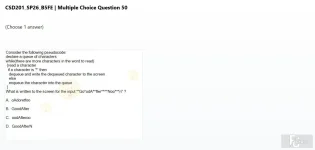
CSD201_SP26_B5FE | Multiple Choice Question 50 (Choose 1 answer) Consider the following pseudocode declare a queue of characters while(there are more characters in the word to read) { read a character if a character is then 1 dequeue and write the dequeued character to the screen else enqueue the character into the queue } What is written to the screen for the input "GoodAfter Noon"?
A. Adoretfoo
B. GoodAfter
C. oodAfteroo
D. GoodAfterN
Đính kèm
-
 CSD201 SP26 B5 FE_001.webp33.9 KB · Lượt xem: 23
 -
 CSD201 SP26 B5 FE_002.webp34.5 KB · Lượt xem: 27
 -
 CSD201 SP26 B5 FE_003.webp33.5 KB · Lượt xem: 22
 -
 CSD201 SP26 B5 FE_004.webp24.9 KB · Lượt xem: 22
 -
 CSD201 SP26 B5 FE_005.webp31.8 KB · Lượt xem: 16
 -
 CSD201 SP26 B5 FE_006.webp33.3 KB · Lượt xem: 11
 -
 CSD201 SP26 B5 FE_007.webp23.2 KB · Lượt xem: 10
 -
 CSD201 SP26 B5 FE_008.webp17.2 KB · Lượt xem: 11
 -
 CSD201 SP26 B5 FE_009.webp24.8 KB · Lượt xem: 9
 -
 CSD201 SP26 B5 FE_010.webp24.3 KB · Lượt xem: 9
 -
 CSD201 SP26 B5 FE_011.webp25.7 KB · Lượt xem: 11
 -
 CSD201 SP26 B5 FE_012.webp29.7 KB · Lượt xem: 13
 -
 CSD201 SP26 B5 FE_013.webp17.2 KB · Lượt xem: 11
 -
 CSD201 SP26 B5 FE_014.webp27.5 KB · Lượt xem: 9
 -
 CSD201 SP26 B5 FE_015.webp51.3 KB · Lượt xem: 10
 -
 CSD201 SP26 B5 FE_016.webp35.3 KB · Lượt xem: 12
 -
 CSD201 SP26 B5 FE_017.webp82.1 KB · Lượt xem: 10
 -
 CSD201 SP26 B5 FE_018.webp17.8 KB · Lượt xem: 11
 -
 CSD201 SP26 B5 FE_019.webp16.5 KB · Lượt xem: 12
 -
 CSD201 SP26 B5 FE_020.webp23.4 KB · Lượt xem: 12
 -
 CSD201 SP26 B5 FE_021.webp35.3 KB · Lượt xem: 9
 -
 CSD201 SP26 B5 FE_022.webp35.2 KB · Lượt xem: 9
 -
 CSD201 SP26 B5 FE_023.webp41.8 KB · Lượt xem: 11
 -
 CSD201 SP26 B5 FE_024.webp24.6 KB · Lượt xem: 12
 -
 CSD201 SP26 B5 FE_025.webp32.3 KB · Lượt xem: 9
 -
 CSD201 SP26 B5 FE_026.webp18.9 KB · Lượt xem: 11
 -
 CSD201 SP26 B5 FE_027.webp36.1 KB · Lượt xem: 13
 -
 CSD201 SP26 B5 FE_028.webp23.4 KB · Lượt xem: 14
 -
 CSD201 SP26 B5 FE_029.webp29.7 KB · Lượt xem: 14
 -
 CSD201 SP26 B5 FE_030.webp25.3 KB · Lượt xem: 11
 -
 CSD201 SP26 B5 FE_031.webp31.9 KB · Lượt xem: 8
 -
 CSD201 SP26 B5 FE_032.webp22.6 KB · Lượt xem: 12
 -
 CSD201 SP26 B5 FE_033.webp37.8 KB · Lượt xem: 10
 -
 CSD201 SP26 B5 FE_034.webp28.5 KB · Lượt xem: 10
 -
 CSD201 SP26 B5 FE_035.webp28.1 KB · Lượt xem: 10
 -
 CSD201 SP26 B5 FE_036.webp27.8 KB · Lượt xem: 13
 -
 CSD201 SP26 B5 FE_037.webp22.1 KB · Lượt xem: 12
 -
 CSD201 SP26 B5 FE_038.webp15.4 KB · Lượt xem: 9
 -
 CSD201 SP26 B5 FE_039.webp50.3 KB · Lượt xem: 11
 -
 CSD201 SP26 B5 FE_040.webp17.7 KB · Lượt xem: 11
 -
 CSD201 SP26 B5 FE_041.webp13.8 KB · Lượt xem: 9
 -
 CSD201 SP26 B5 FE_042.webp79.1 KB · Lượt xem: 11
 -
 CSD201 SP26 B5 FE_043.webp43.6 KB · Lượt xem: 14
 -
 CSD201 SP26 B5 FE_044.webp46.1 KB · Lượt xem: 12
 -
 CSD201 SP26 B5 FE_045.webp30.8 KB · Lượt xem: 12
 -
 CSD201 SP26 B5 FE_046.webp38.1 KB · Lượt xem: 13
 -
 CSD201 SP26 B5 FE_047.webp17 KB · Lượt xem: 14
 -
 CSD201 SP26 B5 FE_048.webp24.8 KB · Lượt xem: 13
 -
 CSD201 SP26 B5 FE_049.webp34.9 KB · Lượt xem: 16
 -
 CSD201 SP26 B5 FE_050.webp38.5 KB · Lượt xem: 29
Sửa lần cuối: