
- Học kỳ
- SP2026
- Thời Gian
- 4/5/26
- Loại tài liệu
- FE
- Mã Đề
- CRY303c_SP26_RE_126800
CRY303c SP26 FE RE
1. (Choose 1 answer)
Diffie-Hellman is not vulnerable to man-in-the-middle attack
A. True
B. False
2. (Choose 1 answer)
Which of the followings does Diffie-Hellman Key Exchange support: encryption/decryption, digital signatures, key exchange?
A. Key exchange
B. Encryption/Decryption
C. Digital signature
D. All the other choices
3. (Choose 1 answer)
Alice and Bob use Diffie-Hellman Key Exchange to share a key with a common prime p=11 and a primitive root a=2. If Alice has a public key Y_A=9, what is her private key X_A?
A. 2
B. 4
C. 6
D. 8
E. 10
4. (Choose 1 answer)
With a prime number p, _____ is a number whose power successively generate all the elements mod p, except for zero.
A. primitive root
B. public exponent
C. private exponent
D. modulus
5. (Choose 1 answer)
Which of the followings is the most temporary by design?
A. Session key
B. Master key
C. Nonce
D. Public-key certificate
E. A user's public-private key pair
6. (Choose 1 answer)
One of the requirements for an asymmetric cipher is that it should be computationally infeasible for an attacker knowing the public key to determine the private key.
A. True
B. False
7. (Choose 1 answer)
Alice and Bob use Diffie-Hellman Key Exchange to share a key with a common prime p=157 and a primitive root a=5. If Alice has a public key X_A=22, what is her private key Y_A?
A. 48
B. 32
C. 24
D. 62
8. (Choose 1 answer)
Which of the following statements are true?
1. Given a large modulus n, the exponential operation mod n is computationally difficult.
2. Given a large modulus n, the discrete logarithm problem is computationally difficult.
3. The discrete logarithm mod p always exists and is unique if p is a prime number.
4. Using the primitive roots of a prime modulus p yields the maximum p-1 possible outcome values for the discrete logarithm, which is desired for cryptography.
A. 1 & 2
B. 1 & 3
C. 1 & 4
D. 2 & 3
E. 2 & 4
F. 3 & 4
9. (Choose 1 answer)
Asymmetric cryptography needs to ensure that it is computationally infeasible, difficult to derive the private key from the public key
A. True
B. False
10. (Choose 1 answer)
Decryption is the process of converting plaintext to ciphertext.
A. True
B. False
11. (Choose 1 answer)
One-time pad is popularly used for systems that require secure data protection.
A. True
B. False
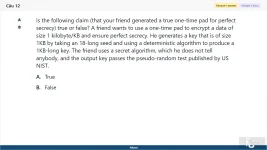
12. (Choose 1 answer)
Is the following claim (that your friend generated a true one-time pad for perfect secrecy) true or false? A friend wants to use a one-time pad to encrypt a data of size 1 kilobyte/KB and ensure perfect secrecy. He generates a key that is of size 1KB by taking an 18-long seed and using a deterministic algorithm to produce a 1KB-long key. The friend uses a secret algorithm, which he does not tell anybody, and the output key passes the pseudo-random test published by US NIST.
A. True
B. False
13. (Choose 1 answer)
The key is 64-bits long, how long does it take in days for an attacker to brute-force search/attack for the key on average? The attacker can perform 10 trillion (10^13) decryptions per second, given the attacker processor and the encryption/decryption algorithm.
A. 42.701
B. 4.971
C. 21.350
D. 10.675
14. (Choose 1 answer)
One-time pad is proven to achieve perfect secrecy
A. True
B. False
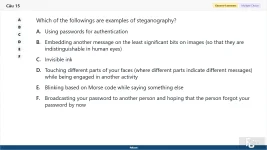
15. (Choose 4 answers)
Which of the followings are examples of steganography?
A. Using passwords for authentication
B. Embedding another message on the least significant bits on images (so that they are indistinguishable in human eyes)
C. Invisible ink
D. Touching different parts of your faces (where different parts indicate different messages) while being engaged in another activity
E. Blinking based on Morse code while saying something else
F. Broadcasting your password to another person and hoping that the person forgot your password by now
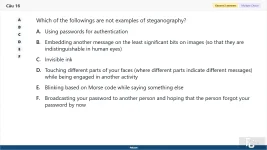
16. (Choose 2 answers)
Which of the followings are not examples of steganography?
A. Using passwords for authentication
B. Embedding another message on the least significant bits on images (so that they are indistinguishable in human eyes)
C. Invisible ink
D. Touching different parts of your faces (where different parts indicate different messages) while being engaged in another activity
E. Blinking based on Morse code while saying something else
F. Broadcasting your password to another person and hoping that the person forgot your password by now
17. (Choose 1 answer)
An original intelligible message fed into the algorithm as input is known as ____ while the coded message produced as output is called the ____.
A. Plaintext, ciphertext
B. Ciphertext, plaintext
C. Plaintext, secret key
D. Ciphertext, secret key
18. (Choose 1 answer)
Which of the following statements are false for hash functions?
A. Across varying inputs, the output of the hash function needs to be uniformly distributed.
B. The output size is fixed.
C. Given an input, a hash function can produce multiple outputs.
D. The input size can vary.
19. (Choose 3 answers)
Which of the following terms are used to describe the output of the hash function?
A. Digest
B. Message
C. Cache
D. Hash value
E. Fingerprint
20. (Choose 1 answer)
Which of the following states that for any given input, it is computationally infeasible to find to generate the input given the hash output?
A. Weak collision resistance
B. Pre-image resistance
C. Strong collision resistance
21. (Choose 1 answer)
Which of the followings states that for any given input, it is computationally infeasible to find any pair that results in the same hash?
A. Weak collision resistance
B. One-way property
C. Pre-image resistance
D. Strong collision resistance
22. (Choose 1 answer)
For a hash tree that covers 128 data blocks, how many hash checks do you need to perform to localize the error? Assume that error occurred on two blocks.
A. 11
B. 15
C. 19
D. 23
23. (Choose 1 answer)
Symmetric encryption/decryption can provide message authentication
A. True
B. False
24. (Choose 1 answer)
Which of the following statements are false about digital signature?
A. Digital signature is based on asymmetric/public-key cryptography
B. Digital signature is typically smaller than the data size.
C. Digital signature protects the confidentiality of the data
D. Digital signature tends to require more computational resources than message authentication
25. (Choose 1 answer)
A hash chain is a successive application of a cryptographic hash function h to a string x.
A. True
B. False
26. (Choose 1 answer)
Hash Functions take an input whose size can vary and generate size output based on input size.
A. True
B. False
27. (Choose 1 answer)
Informally, a message authentication code system consists how many algorithms?
A. 1
B. 2
C. 3
D. 4
E. 5
28. (Choose 1 answer)
Your friend proposes an update in the key and suggests a new key, k=532. How many cyclic shifts do you need to perform using the new key? You want to minimize the number of cyclic shifts on the letters.
A. 3
B. 5
C. 7
D. 9
29. (Choose 1 answer)
When the key is 8-bits long, how many decryptions do the brute-force attacker try on average?
A. 128
B. 16
C. 32
D. 64
30. (Choose 1 answer)
In DES algorithm, the block size, the key size, and the number of rounds is ___, ___ and ___
A. 64/56/16
B. 64/64/16
C. 64/56/10
D. 64/64/10
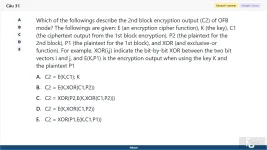
31. (Choose 1 answer)
Which of the followings describe the 2nd block encryption output (C2) of OFB mode? The followings are given: E (an encryption cipher function), K (the key), C1 (the ciphertext output from the 1st block encryption), P2 (the plaintext for the 2nd block), P1 (the plaintext for the 1st block), and XOR (and exclusive-or function). For example, XOR(i,j) indicate the bit-by-bit XOR between the two bit vectors i and j, and E(K,P1) is the encryption output when using the key K and the plaintext P1
A. C2 = E(K,C1); K
B. C2 = E(K,XOR(C1,P2))
C. C2 = XOR(P2,E(K,XOR(C1,P2)))
D. C2 = E(K,XOR(C1,P2))
E. C2 = XOR(P1,E(K,C1,P1))
32. (Choose 1 answer)
If the block cipher supports input/output bits of length 2 (i.e., n=2), what is the number of possible keys for the ideal block cipher?
A. 6
B. 24
C. 720
D. 40320
33. (Choose 3 answers)
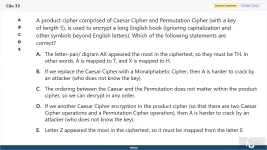
A product cipher comprised of Caesar Cipher and Permutation Cipher (with a key of length 5), is used to encrypt a long English book (ignoring capitalization and other symbols beyond English letters). Which of the following statements are correct?
A. The letter-pair/ digram AX appeared the most in the ciphertext, so they must be TH. In other words, A is mapped to T, and X is mapped to H.
B. If we replace the Caesar Cipher with a Monalphabetic Cipher, then A is harder to crack by an attacker (who does not know the key).
C. The ordering between the Caesar and the Permutation does not matter within the product cipher, so we can decrypt in any order.
D. If we another Caesar Cipher encryption in the product cipher (so that there are two Caesar Cipher operations and a Permutation Cipher operation), then A is harder to crack by an attacker (who does not know the key).
E. Letter Z appeared the most in the ciphertext, so it must be mapped from the latter E.
34. (Choose 1 answer)
A _____ is an encryption/decryption scheme in which a block of plaintext is treated as a whole and used to produce a ciphertext block of equal length.
A. Stream cipher
B. Block cipher
C. Asymmetric cipher
D. Symmetric cipher
35. (Choose 1 answer)
You are given a stream cipher and a block cipher with a block size of 64 bits. The data input is 32 bits. How many bits do you need to pad before processing the data input using a stream cipher?
A. 0
B. 16
C. 32
D. 64
36. (Choose 1 answer)
____ provide ways to handle plaintext that is longer than a block in a secure manner
A. Symmetric cipher
B. Asymmetric cipher
C. Block cipher operation modes
D. Classical cipher
37. (Choose 1 answer)
You are given a block cipher with a block size of 64 bits. Given a data input of 32 bits, how many bits do you need to pad if the using the CFB operation mode
A. 0
B. 16
C. 32
D. 64
38. (Choose 3 answers)
Which of the following operation modes do not require padding (if the data does not fill the block)?
A. CBC
B. ECB
C. OFB
D. CFB
E. CTR
39. (Choose 1 answer)
Alice and Bob are not synchronized in time, and their clock frequency is different. Which of the block cipher operation modes would be affected by such lack of synchronization?
A. CTR
B. OFB
C. CBC
D. CFB
E. ECB
40. (Choose 1 answer)
Which of the following AES transformation functions use the key?
A. SubBytes
B. ShiftRows
C. MixColumns
D. AddRoundKey
41. (Choose 2 answers)
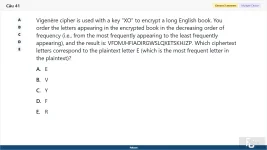
Vigenère cipher is used with a key "XO" to encrypt a long English book. You order the letters appearing in the encrypted book in the decreasing order of frequency (i.e., from the most frequently appearing to the least frequently appearing), and the result is: VFDMJHFIAOIRGWSLQXETSKHJZP. Which ciphertext letters correspond to the plaintext letter E (which is the most frequent letter in the plaintext)?
A. E
B. V
C. Y
D. F
E. R
42. (Choose 1 answer)
Vigenère cipher is used with a key "XO" to encrypt a long English book, comprised of English alphabet letters and ignoring capitalization and other symbols. The key length is fixed, i.e., the key is 2 alphabets long. What is the number of possible distinct keys?
A. 26
B. 52
C. 676
D. 1352
43. (Choose 1 answer)
____ a non-linear substitution step where each byte is replaced with another according to a lookup table.
A. SubBytes
B. ShiftRows
C. MixColumns
D. AddRoundKey
44. (Choose 1 answer)
Known-plaintext attack is a stronger threat than ciphertext-only attack because the attacker uses the known plaintext-ciphertext pairs to more efficiently find the key that is being used by Alice and Bob
A. True
B. False
45. (Choose 2 answers)
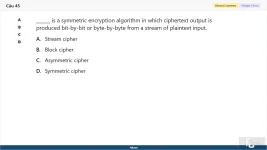
______ is a symmetric encryption algorithm in which ciphertext output is produced bit-by-bit or byte-by-byte from a stream of plaintext input.
A. Stream cipher
B. Block cipher
C. Asymmetric cipher
D. Symmetric cipher
46. (Choose 1 answer)
Which of the following can be the block size, key size and number of rounds in AES?
A. 128/128/10
B. 128/128/12
C. 128/128/14
D. 128/256/10
47. (Choose 1 answer)
AES is not based on Feistel cipher.
A. True
B. False
Đính kèm
-
 CRY303c SP26 FE RE_01.webp14.6 KB · Lượt xem: 2
 -
 CRY303c SP26 FE RE_02.webp31.1 KB · Lượt xem: 2
 -
 CRY303c SP26 FE RE_03.webp28.5 KB · Lượt xem: 0
 -
 CRY303c SP26 FE RE_04.webp27 KB · Lượt xem: 0
 -
 CRY303c SP26 FE RE_05.webp23.4 KB · Lượt xem: 0
 -
 CRY303c SP26 FE RE_06.webp26.8 KB · Lượt xem: 0
 -
 CRY303c SP26 FE RE_07.webp28.8 KB · Lượt xem: 0
 -
 CRY303c SP26 FE RE_08.webp60.1 KB · Lượt xem: 0
 -
 CRY303c SP26 FE RE_09.webp23.4 KB · Lượt xem: 0
 -
 CRY303c SP26 FE RE_10.webp15.4 KB · Lượt xem: 0
 -
 CRY303c SP26 FE RE_11.webp17.9 KB · Lượt xem: 0
 -
 CRY303c SP26 FE RE_12.webp60 KB · Lượt xem: 0
 -
 CRY303c SP26 FE RE_13.webp39.2 KB · Lượt xem: 0
 -
 CRY303c SP26 FE RE_14.webp14 KB · Lượt xem: 0
 -
 CRY303c SP26 FE RE_15.webp57.1 KB · Lượt xem: 0
 -
 CRY303c SP26 FE RE_16.webp57.6 KB · Lượt xem: 0
 -
 CRY303c SP26 FE RE_17.webp33.1 KB · Lượt xem: 0
 -
 CRY303c SP26 FE RE_18.webp31.4 KB · Lượt xem: 0
 -
 CRY303c SP26 FE RE_19.webp22.9 KB · Lượt xem: 0
 -
 CRY303c SP26 FE RE_20.webp31.8 KB · Lượt xem: 0
 -
 CRY303c SP26 FE RE_21.webp33.2 KB · Lượt xem: 0
 -
 CRY303c SP26 FE RE_22.webp26.8 KB · Lượt xem: 0
 -
 CRY303c SP26 FE RE_23.webp17.4 KB · Lượt xem: 0
 -
 CRY303c SP26 FE RE_24.webp41.2 KB · Lượt xem: 0
 -
 CRY303c SP26 FE RE_25.webp18.2 KB · Lượt xem: 0
 -
 CRY303c SP26 FE RE_26.webp19.9 KB · Lượt xem: 0
 -
 CRY303c SP26 FE RE_27.webp19.7 KB · Lượt xem: 0
 -
 CRY303c SP26 FE RE_28.webp31 KB · Lượt xem: 0
 -
 CRY303c SP26 FE RE_29.webp21.2 KB · Lượt xem: 0
 -
 CRY303c SP26 FE RE_30.webp22.5 KB · Lượt xem: 0
 -
 CRY303c SP26 FE RE_31.webp71.1 KB · Lượt xem: 0
 -
 CRY303c SP26 FE RE_32.webp25.1 KB · Lượt xem: 0
 -
 CRY303c SP26 FE RE_33.webp96.7 KB · Lượt xem: 0
 -
 CRY303c SP26 FE RE_34.webp31.5 KB · Lượt xem: 0
 -
 CRY303c SP26 FE RE_35.webp30.8 KB · Lượt xem: 0
 -
 CRY303c SP26 FE RE_36.webp26.2 KB · Lượt xem: 0
 -
 CRY303c SP26 FE RE_37.webp27.1 KB · Lượt xem: 0
 -
 CRY303c SP26 FE RE_38.webp22.9 KB · Lượt xem: 0
 -
 CRY303c SP26 FE RE_39.webp30.9 KB · Lượt xem: 0
 -
 CRY303c SP26 FE RE_40.webp20.2 KB · Lượt xem: 0
 -
 CRY303c SP26 FE RE_41.webp53.7 KB · Lượt xem: 0
 -
 CRY303c SP26 FE RE_42.webp38.4 KB · Lượt xem: 0
 -
 CRY303c SP26 FE RE_43.webp25 KB · Lượt xem: 0
 -
 CRY303c SP26 FE RE_44.webp31.3 KB · Lượt xem: 0
 -
 CRY303c SP26 FE RE_45.webp30.2 KB · Lượt xem: 0
 -
 CRY303c SP26 FE RE_46.webp24.1 KB · Lượt xem: 0
 -
 CRY303c SP26 FE RE_47.webp12.2 KB · Lượt xem: 2