
- Học kỳ
- SP2026
- Thời Gian
- 3/5/26
- Loại tài liệu
- FE
WDU203c SP26 FE
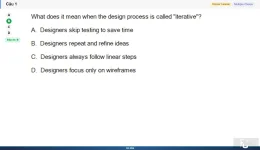
Câu 1 (Chọn 1 đáp án)
What does it mean when the design process is called "iterative"?
A. Designers skip testing to save time
B. Designers repeat and refine ideas
C. Designers always follow linear steps
D. Designers focus only on wireframes
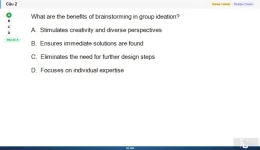
Câu 2 (Chọn 1 đáp án)
What are the benefits of brainstorming in group ideation?
A. Stimulates creativity and diverse perspectives
B. Ensures immediate solutions are found
C. Eliminates the need for further design steps
D. Focuses on individual expertise
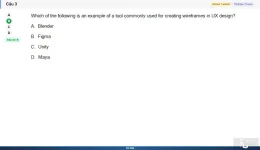
Câu 3 (Chọn 1 đáp án)
Which of the following is an example of a tool commonly used for creating wireframes in UX design?
A. Blender
B. Figma
C. Unity
D. Maya
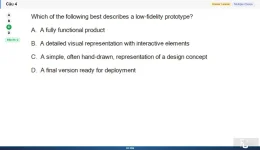
Câu 4 (Chọn 1 đáp án)
Which of the following best describes a low-fidelity prototype?
A. A fully functional product
B. A detailed visual representation with interactive elements
C. A simple, often hand-drawn, representation of a design concept
D. A final version ready for deployment
Câu 5 (Chọn 1 đáp án)
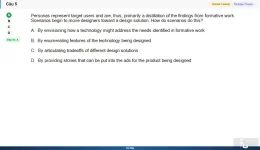
Personas represent target users and are, thus, primarily a distillation of the findings from formative work. Scenarios begin to move designers toward a design solution. How do scenarios do this?
A. By envisioning how a technology might address the needs identified in formative work
B. By enumerating features of the technology being designed
C. By articulating tradeoffs of different design solutions
D. By providing stories that can be put into the ads for the product being designed
Câu 6 (Chọn 1 đáp án)
Sketching is used both for generating and for communicating ideas.
A. True
B. False
Câu 7 (Chọn 1 đáp án)
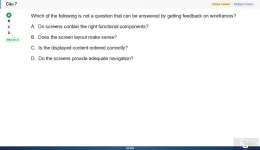
Which of the following is not a question that can be answered by getting feedback on wireframes?
A. Do screens contain the right functional components?
B. Does the screen layout make sense?
C. Is the displayed content ordered correctly?
D. Do the screens provide adequate navigation?
Câu 8 (Chọn 1 đáp án)
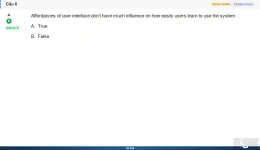
Affordances of user interface don't have much influence on how easily users learn to use the system.
A. True
B. False
Câu 9 (Chọn 1 đáp án)
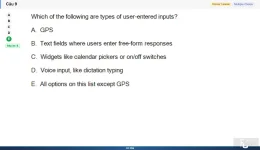
Which of the following are types of user-entered inputs?
A. GPS
B. Text fields where users enter free-form responses
C. Widgets like calendar pickers or on/off switches
D. Voice input, like dictation typing
E. All options on this list except GPS
Câu 10 (Chọn 1 đáp án)
What is a key criterion when evaluating low-fidelity prototypes?
A. Ability to test core user tasks
B. Visual style and branding
C. Use of advanced interaction patterns
D. Detailed animations
Câu 11 (Chọn 1 đáp án)
What principle helps ensure that users can discover how to use a system?
A. Signifiers
B. Constraints
C. Affordances
D. Feedback
Câu 12 (Chọn 1 đáp án)
What is the first step in conducting a Heuristic Evaluation?
A. Create a prioritized list of issues
B. Choose specific screens or interactions to focus on
C. Conduct user interviews
D. Test the system's speed
Câu 13 (Chọn 1 đáp án)
What does the Gulf of Execution refer to?
A. The gap when users interpret the results of their actions
B. The difficulty in understanding the actions required to achieve a goal
C. The gap when the goal is too complex to reach
D. The failure of actions when feedback is not provided
Câu 14 (Chọn 1 đáp án)
What is the primary purpose of conducting user interviews in UX research?
A. To test the final product
B. To gather quantitative data
C. To understand user needs and behaviors
D. To train new designers
Câu 15 (Chọn 1 đáp án)
What is the purpose of sketching in UX design?
A. To finalize the design
B. To reflect, explore, and communicate design concepts
C. To create perfect visuals
D. To avoid feedback from users
Câu 16 (Chọn 1 đáp án)
What is the primary focus of Heuristic Evaluation?
A. To analyze system speed and performance
B. To review a UI using Nielsen's 10 heuristics
C. To conduct focus groups with real users
D. To test the visual appeal of the design
Câu 17 (Chọn nhiều đáp án)
Select all the benefits of conducting usability testing early in the UX design process.
A. Identify potential design flaws
B. Guarantees project success
C. Improves user satisfaction
D. Ensures compliance with industry standards
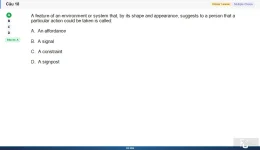
Câu 18 (Chọn 1 đáp án)
A feature of an environment or system that, by its shape and appearance, suggests to a person that a particular action could be taken is called:
A. An affordance
B. A signal
C. A constraint
D. A signpost
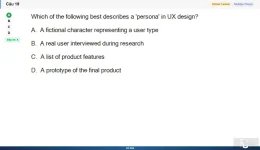
Câu 19 (Chọn 1 đáp án)
Which of the following best describes a 'persona' in UX design?
A. A fictional character representing a user type
B. A real user interviewed during research
C. A list of product features
D. A prototype of the final product
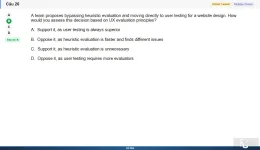
Câu 20 (Chọn 1 đáp án)
A team proposes bypassing heuristic evaluation and moving directly to user testing for a website design. How would you assess this decision based on UX evaluation principles?
A. Support it, as user testing is always superior
B. Oppose it, as heuristic evaluation is faster and finds different issues
C. Support it, as heuristic evaluation is unnecessary
D. Oppose it, as user testing requires more evaluators
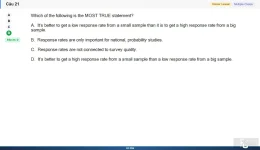
Câu 21 (Chọn 1 đáp án)
Which of the following is the MOST TRUE statement?
A. It's better to get a low response rate from a small sample than it is to get a high response rate from a big sample
B. Response rates are only important for national, probability studies
C. Response rates are not connected to survey quality
D. It's better to get a high response rate from a small sample than a low response rate from a big sample
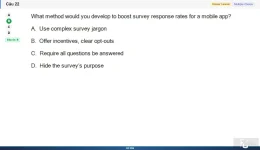
Câu 22 (Chọn 1 đáp án)
What method would you develop to boost survey response rates for a mobile app?
A. Use complex survey jargon
B. Offer incentives, clear opt-outs
C. Require all questions be answered
D. Hide the survey's purpose
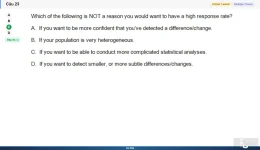
Câu 23 (Chọn 1 đáp án)
Which of the following is NOT a reason you would want to have a high response rate?
A. If you want to be more confident that you've detected a difference/change
B. If your population is very heterogeneous
C. If you want to be able to conduct more complicated statistical analyses
D. If you want to detect smaller, or more subtle differences/changes
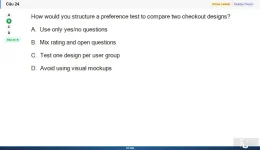
Câu 24 (Chọn 1 đáp án)
How would you structure a preference test to compare two checkout designs?
A. Use only yes/no questions
B. Mix rating and open questions
C. Test one design per user group
D. Avoid using visual mockups
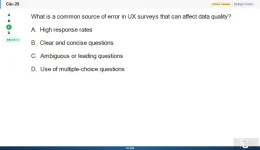
Câu 25 (Chọn 1 đáp án)
What is a common source of error in UX surveys that can affect data quality?
A. High response rates
B. Clear and concise questions
C. Ambiguous or leading questions
D. Use of multiple-choice questions
Câu 26 (Chọn 1 đáp án)
Besides usability testing, what is another research method that can be conducted remotely?
A. Product assembly
B. Diary studies
C. Server maintenance
D. Eye-tracking in physical stores
Câu 27 (Chọn 1 đáp án)
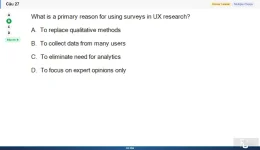
What is a primary reason for using surveys in UX research?
A. To replace qualitative methods
B. To collect data from many users
C. To eliminate need for analytics
D. To focus on expert opinions only
Câu 28 (Chọn 1 đáp án)
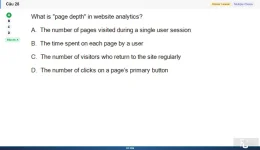
What is "page depth" in website analytics?
A. The number of pages visited during a single user session
B. The time spent on each page by a user
C. The number of visitors who return to the site regularly
D. The number of clicks on a page's primary button
Câu 29 (Chọn 1 đáp án)
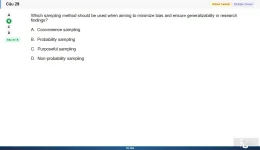
Which sampling method should be used when aiming to minimize bias and ensure generalizability in research findings?
A. Convenience sampling
B. Probability sampling
C. Purposeful sampling
D. Non-probability sampling
Câu 30 (Chọn 1 đáp án)
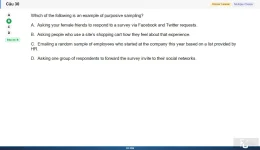
Which of the following is an example of purposive sampling?
A. Asking your female friends to respond to a survey via Facebook and Twitter requests
B. Asking people who use a site's shopping cart how they feel about that experience
C. Emailing a random sample of employees who started at the company this year based on a list provided by HR
D. Asking one group of respondents to forward the survey invite to their social networks
Câu 31 (Chọn 1 đáp án)
How should affinity clusters be labeled?
A. With specific, precise titles that capture the essence of the common theme
B. With random titles for easier identification
C. With labels that focus solely on the user demographics
D. With vague, general titles to avoid bias
Câu 32 (Chọn 1 đáp án)
Which of the following best describes the correct approach to note-taking?
A. Writing down only the main ideas using brief phrases and key details
B. Recording only the information that won't be captured by audio or video
C. Accepting that there isn't a single correct method for taking notes
D. Noting only the follow-up questions you plan to ask later in the conversation
Câu 33 (Chọn 1 đáp án)
How are personas useful in user needs assessments?
A. They help summarize quantitative data collected through surveys
B. They provide archetypes that represent different subsets of users, helping design teams understand user motivations
C. They offer insights into market trends
D. They analyze the effectiveness of product features
Câu 34 (Chọn 1 đáp án)
In-situ observation is particularly useful for:
A. Understanding user behavior in their natural environment
B. Testing the technical performance of a product
C. Conducting large-scale surveys
D. Gathering statistical data on user preferences
Câu 35 (Chọn 1 đáp án)
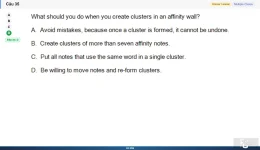
What should you do when you create clusters in an affinity wall?
A. Avoid mistakes, because once a cluster is formed, it cannot be undone
B. Create clusters of more than seven affinity notes
C. Put all notes that use the same word in a single cluster
D. Be willing to move notes and re-form clusters
Câu 36 (Chọn nhiều đáp án)
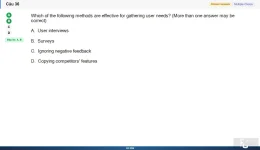
Which of the following methods are effective for gathering user needs?
A. User interviews
B. Surveys
C. Ignoring negative feedback
D. Copying competitors' features
Câu 37 (Chọn 1 đáp án)
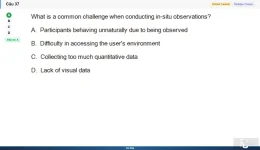
What is a common challenge when conducting in-situ observations?
A. Participants behaving unnaturally due to being observed
B. Difficulty in accessing the user's environment
C. Collecting too much quantitative data
D. Lack of visual data
Câu 38 (Chọn 1 đáp án)
Which of the following is NOT another name for the kind of qualitative research methodology you learned in this specialization?
A. Ethnographic research
B. Contextual inquiry
C. User needs assessment
D. Socio-technical extraction
Câu 39 (Chọn 1 đáp án)
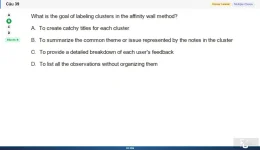
What is the goal of labeling clusters in the affinity wall method?
A. To create catchy titles for each cluster
B. To summarize the common theme or issue represented by the notes in the cluster
C. To provide a detailed breakdown of each user's feedback
D. To list all the observations without organizing them
Câu 40 (Chọn 1 đáp án)
How does qualitative research differ from quantitative research?
A. Qualitative research focuses on understanding in-depth user behavior and experiences, while quantitative research focuses on numerical data
B. Qualitative research provides statistical data, while quantitative research focuses on user behavior
C. Quantitative research is more subjective than qualitative research
D. Qualitative research involves automated data analysis
Câu 41 (Chọn 1 đáp án)
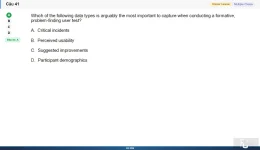
Which of the following data types is arguably the most important to capture when conducting a formative, problem-finding user test?
A. Critical incidents
B. Perceived usability
C. Suggested improvements
D. Participant demographics
Câu 42 (Chọn 1 đáp án)
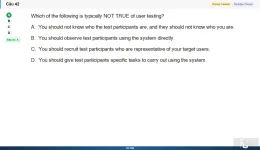
Which of the following is typically NOT TRUE of user testing?
A. You should not know who the test participants are, and they should not know who you are
B. You should observe test participants using the system directly
C. You should recruit test participants who are representative of your target users
D. You should give test participants specific tasks to carry out using the system
Câu 43 (Chọn 1 đáp án)
What type of user testing is designed to verify if the system meets performance goals like task completion time or error rate?
A. Formative Testing
B. Benchmark Testing
C. Problem Identification Testing
D. Comparative Testing
Câu 44 (Chọn 1 đáp án)
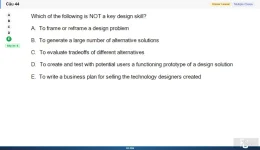
Which of the following is NOT a key design skill?
A. To frame or reframe a design problem
B. To generate a large number of alternative solutions
C. To evaluate tradeoffs of different alternatives
D. To create and test with potential users a functioning prototype of a design solution
E. To write a business plan for selling the technology designers created
Câu 45 (Chọn 1 đáp án)
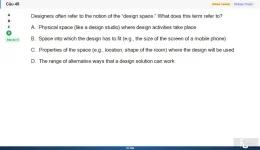
Designers often refer to the notion of the "design space." What does this term refer to?
A. Physical space (like a design studio) where design activities take place
B. Space into which the design has to fit (e.g., the size of the screen of a mobile phone)
C. Properties of the space (e.g., location, shape of the room) where the design will be used
D. The range of alternative ways that a design solution can work
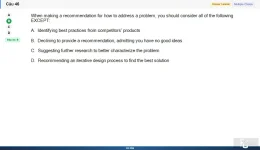
Câu 46 (Chọn 1 đáp án)
When making a recommendation for how to address a problem, you should consider all of the following EXCEPT:
A. Identifying best practices from competitors' products
B. Declining to provide a recommendation, admitting you have no good ideas
C. Suggesting further research to better characterize the problem
D. Recommending an iterative design process to find the best solution
Câu 47 (Chọn 1 đáp án)
A test task uses the term "Shopping Cart" which appears in the UI. What should you do instead?
A. Leave it as is
B. Add more technical jargon
C. Reword it to avoid interface-specific terms
D. Ask users to guess the meaning
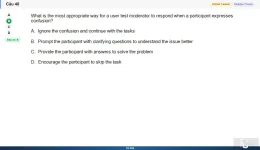
Câu 48 (Chọn 1 đáp án)
What is the most appropriate way for a user test moderator to respond when a participant expresses confusion?
A. Ignore the confusion and continue with the tasks
B. Prompt the participant with clarifying questions to understand the issue better
C. Provide the participant with answers to solve the problem
D. Encourage the participant to skip the task
Câu 49 (Chọn 1 đáp án)
Which type of recruiting criteria would the following question screen for?
"In the past week, how many hours did you spend completing coursework on edX? 0, 1-2, 3-5, or more than 5"
A. Expertise
B. Behavioral
C. Characteristic
D. Attitudinal
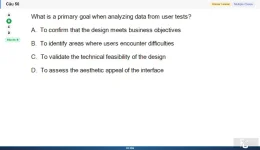
Câu 50 (Chọn 1 đáp án)
What is a primary goal when analyzing data from user tests?
A. To confirm that the design meets business objectives
B. To identify areas where users encounter difficulties
C. To validate the technical feasibility of the design
D. To assess the aesthetic appeal of the interface
Đính kèm
-
 WDU203c SP26 FE_001.webp52.5 KB · Lượt xem: 105
 -
 WDU203c SP26 FE_002.webp54 KB · Lượt xem: 89
 -
 WDU203c SP26 FE_003.webp29.9 KB · Lượt xem: 54
 -
 WDU203c SP26 FE_004.webp59.3 KB · Lượt xem: 54
 -
 WDU203c SP26 FE_005.webp68.8 KB · Lượt xem: 48
 -
 WDU203c SP26 FE_006.webp27.1 KB · Lượt xem: 52
 -
 WDU203c SP26 FE_007.webp50.2 KB · Lượt xem: 52
 -
 WDU203c SP26 FE_008.webp26.4 KB · Lượt xem: 54
 -
 WDU203c SP26 FE_009.webp56.5 KB · Lượt xem: 46
 -
 WDU203c SP26 FE_010.webp46.6 KB · Lượt xem: 45
 -
 WDU203c SP26 FE_011.webp36.7 KB · Lượt xem: 47
 -
 WDU203c SP26 FE_012.webp49.7 KB · Lượt xem: 52
 -
 WDU203c SP26 FE_013.webp62 KB · Lượt xem: 50
 -
 WDU203c SP26 FE_014.webp48.5 KB · Lượt xem: 46
 -
 WDU203c SP26 FE_015.webp47.5 KB · Lượt xem: 49
 -
 WDU203c SP26 FE_016.webp53 KB · Lượt xem: 44
 -
 WDU203c SP26 FE_017.webp43.6 KB · Lượt xem: 45
 -
 WDU203c SP26 FE_018.webp37.5 KB · Lượt xem: 48
 -
 WDU203c SP26 FE_019.webp52.7 KB · Lượt xem: 45
 -
 WDU203c SP26 FE_020.webp58.1 KB · Lượt xem: 41
 -
 WDU203c SP26 FE_021.webp58.4 KB · Lượt xem: 45
 -
 WDU203c SP26 FE_022.webp46.8 KB · Lượt xem: 45
 -
 WDU203c SP26 FE_023.webp64.4 KB · Lượt xem: 43
 -
 WDU203c SP26 FE_024.webp46.7 KB · Lượt xem: 44
 -
 WDU203c SP26 FE_025.webp46.3 KB · Lượt xem: 45
 -
 WDU203c SP26 FE_026.webp39.1 KB · Lượt xem: 45
 -
 WDU203c SP26 FE_027.webp47.8 KB · Lượt xem: 46
 -
 WDU203c SP26 FE_028.webp58.1 KB · Lượt xem: 48
 -
 WDU203c SP26 FE_029.webp37.5 KB · Lượt xem: 42
 -
 WDU203c SP26 FE_030.webp61.6 KB · Lượt xem: 40
 -
 WDU203c SP26 FE_031.webp57.3 KB · Lượt xem: 38
 -
 WDU203c SP26 FE_032.webp72.4 KB · Lượt xem: 38
 -
 WDU203c SP26 FE_033.webp52.2 KB · Lượt xem: 36
 -
 WDU203c SP26 FE_034.webp55.2 KB · Lượt xem: 37
 -
 WDU203c SP26 FE_035.webp65 KB · Lượt xem: 35
 -
 WDU203c SP26 FE_036.webp38 KB · Lượt xem: 33
 -
 WDU203c SP26 FE_037.webp56.8 KB · Lượt xem: 32
 -
 WDU203c SP26 FE_038.webp39.4 KB · Lượt xem: 34
 -
 WDU203c SP26 FE_039.webp56.5 KB · Lượt xem: 31
 -
 WDU203c SP26 FE_040.webp64.2 KB · Lượt xem: 33
 -
 WDU203c SP26 FE_041.webp39.6 KB · Lượt xem: 32
 -
 WDU203c SP26 FE_042.webp64.1 KB · Lượt xem: 34
 -
 WDU203c SP26 FE_043.webp38.9 KB · Lượt xem: 36
 -
 WDU203c SP26 FE_044.webp64.3 KB · Lượt xem: 33
 -
 WDU203c SP26 FE_045.webp68 KB · Lượt xem: 34
 -
 WDU203c SP26 FE_046.webp57.8 KB · Lượt xem: 33
 -
 WDU203c SP26 FE_047.webp42 KB · Lượt xem: 34
 -
 WDU203c SP26 FE_048.webp56.3 KB · Lượt xem: 34
 -
 WDU203c SP26 FE_049.webp39.5 KB · Lượt xem: 33
 -
 WDU203c SP26 FE_050.webp62 KB · Lượt xem: 98

