
- Học kỳ
- SP2026
- Thời Gian
- 5/5/26
- Loại tài liệu
- FE
SWD392 SP26 B5 FE RE
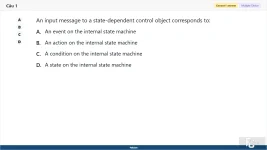
1. (Choose 1 answer)
An input message to a state-dependent control object corresponds to:
A. An event on the internal state machine
B. An action on the internal state machine
C. A condition on the internal state machine
D. A state on the internal state machine
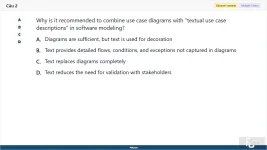
2. (Choose 1 answer)
Why is it recommended to combine use case diagrams with "textual use case descriptions" in software modeling?
A. Diagrams are sufficient, but text is used for decoration
B. Text provides detailed flows, conditions, and exceptions not captured in diagrams
C. Text replaces diagrams completely
D. Text reduces the need for validation with stakeholders
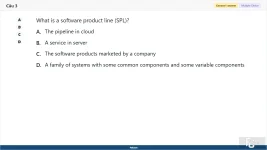
3. (Choose 1 answer)
What is a software product line (SPL)?
A. The pipeline in cloud
B. A service in server
C. The software products marketed by a company
D. A family of systems with some common components and some variable components
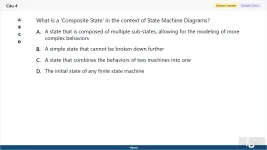
4. (Choose 1 answer)
What is a 'Composite State' in the context of State Machine Diagrams?
A. A state that is composed of multiple sub-states, allowing for the modeling of more complex behaviors
B. A simple state that cannot be broken down further
C. A state that combines the behaviors of two machines into one
D. The initial state of any finite state machine
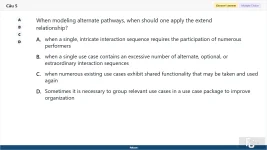
5. (Choose 1 answer)
When modeling alternate pathways, when should one apply the extend relationship?
A. when a single, intricate interaction sequence requires the participation of numerous performers
B. when a single use case contains an excessive number of alternate, optional, or extraordinary interaction sequences
C. when numerous existing use cases exhibit shared functionality that may be taken and used again
D. Sometimes it is necessary to group relevant use cases in a use case package to improve organization
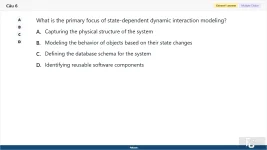
6. (Choose 1 answer)
What is the primary focus of state-dependent dynamic interaction modeling?
A. Capturing the physical structure of the system
B. Modeling the behavior of objects based on their state changes
C. Defining the database schema for the system
D. Identifying reusable software components
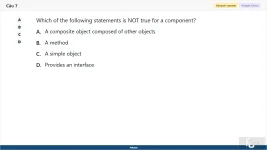
7. (Choose 1 answer)
Which of the following statements is NOT true for a component?
A. A composite object composed of other objects
B. A method
C. A simple object
D. Provides an interface
8. (Choose 1 answer)
What is a software life cycle?
A. The life of the software
B. A cyclic approach to developing software
C. A phased approach to developing software
D. The life of software developed in cycles
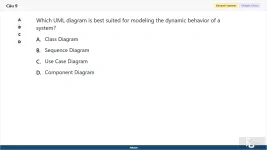
9. (Choose 1 answer)
Which UML diagram is best suited for modeling the dynamic behavior of a system?
A. Class Diagram
B. Sequence Diagram
C. Use Case Diagram
D. Component Diagram
10. (Choose 1 answer)
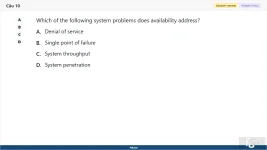
Which of the following system problems does availability address?
A. Denial of service
B. Single point of failure
C. System throughput
D. System penetration
11. (Choose 1 answer)
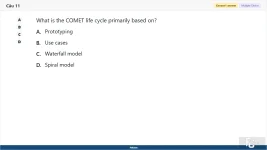
What is the COMET life cycle primarily based on?
A. Prototyping
B. Use cases
C. Waterfall model
D. Spiral model
12. (Choose 1 answer)
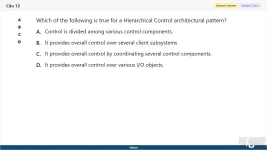
Which of the following is true for a Hierarchical Control architectural pattern?
A. Control is divided among various control components.
B. It provides overall control over several client subsystems
C. It provides overall control by coordinating several control components.
D. It provides overall control over various I/O objects.
13. (Choose 1 answer)
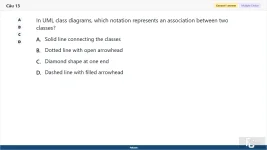
In UML class diagrams, which notation represents an association between two classes?
A. Solid line connecting the classes
B. Dotted line with open arrowhead
C. Diamond shape at one end
D. Dashed line with filled arrowhead
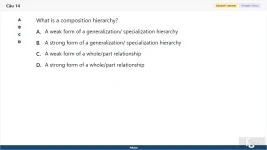
14. (Choose 1 answer)
What is a composition hierarchy?
A. A weak form of a generalization/ specialization hierarchy
B. A strong form of a generalization/ specialization hierarchy
C. A weak form of a whole/part relationship
D. A strong form of a whole/part relationship
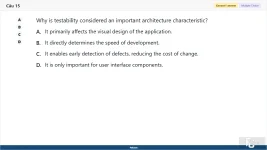
15. (Choose 1 answer)
Why is testability considered an important architecture characteristic?
A. It primarily affects the visual design of the application.
B. It directly determines the speed of development.
C. It enables early detection of defects, reducing the cost of change.
D. It is only important for user interface components.
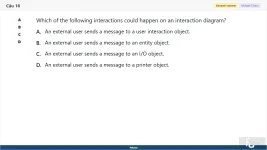
16. (Choose 1 answer)
Which of the following interactions could happen on an interaction diagram?
A. An external user sends a message to a user interaction object.
B. An external user sends a message to an entity object.
C. An external user sends a message to an I/O object.
D. An external user sends a message to a printer object.
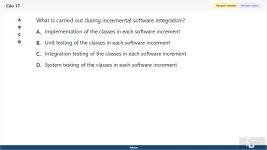
17. (Choose 1 answer)
What is carried out during incremental software integration?
A. Implementation of the classes in each software increment
B. Unit testing of the classes in each software increment
C. Integration testing of the classes in each software increment
D. System testing of the classes in each software increment
18. (Choose 1 answer)
How does COMET compare the life cycle with the Unified Software Development Process?
A. Identifies them as identical with no differences
B. Does not acknowledge the Unified Software Development Process
C. Highlights key differences and similarities between them
D. Suggests that the Unified Software Development Process is outdated
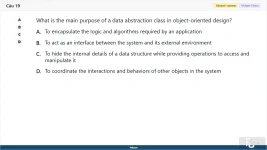
19. (Choose 1 answer)
What is the main purpose of a data abstraction class in object-oriented design?
A. To encapsulate the logic and algorithms required by an application
B. To act as an interface between the system and its external environment
C. To hide the internal details of a data structure while providing operations to access and manipulate it
D. To coordinate the interactions and behaviors of other objects in the system
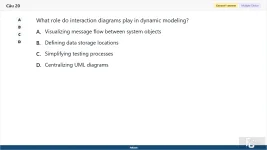
20. (Choose 1 answer)
What role do interaction diagrams play in dynamic modeling?
A. Visualizing message flow between system objects
B. Defining data storage locations
C. Simplifying testing processes
D. Centralizing UML diagrams
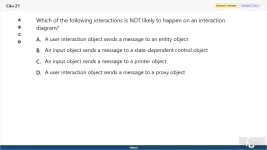
21. (Choose 1 answer)
Which of the following interactions is NOT likely to happen on an interaction diagram?
A. A user interaction object sends a message to an entity object
B. An input object sends a message to a state-dependent control object
C. An input object sends a message to a printer object
D. A user interaction object sends a message to a proxy object
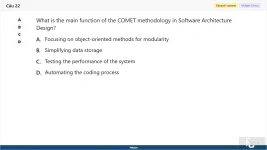
22. (Choose 1 answer)
What is the main function of the COMET methodology in Software Architecture Design?
A. Focusing on object-oriented methods for modularity
B. Simplifying data storage
C. Testing the performance of the system
D. Automating the coding process
23. (Choose 1 answer)
What is a secondary actor?
A. The actor who goes on stage second
B. The actor that starts the use case
C. An actor that participates in the use case
D. An object inside the system
24. (Choose 1 answer)
What is the primary goal of designing client/server software architectures?
A. To enable distributed processing across multiple systems
B. To centralize data storage on a single server
C. To reduce the number of clients in a system
D. To eliminate middleware usage
25. (Choose 1 answer)
A subsystem provides a larger-grained information-hiding solution than an object. Objects that realize the same use case have higher coupling because they communicate with each other (as depicted on the use case-based interaction diagram) and have lower (or no) coupling with objects in other use cases.
A. True
B. False
26. (Choose 1 answer)
What is a kernel class in a SPL?
A. An entity class in the SPL
B. A SPL class that stores essential data
C. A class that is required by all members of the SPL
D. An external class to the SPL
27. (Choose 1 answer)
In SOA, services are typically:
A. Tightly coupled
B. Loosely coupled
C. Hardcoded to specific clients
D. Bound to a single technology stack
28. (Choose 1 answer)
In COMET, which diagram integrates static and dynamic models for software design?
A. Statechart diagram
B. Interaction diagram
C. Composite class interaction diagram
D. Package diagram
29. (Choose 1 answer)
What is the primary purpose of the integrated communication diagram in the software design process?
A. To depict the static structure of subsystems and their relationships.
B. To merge all use case-based communication diagrams into a single diagram, showing all message interactions between objects.
C. To visualize the geographical distribution of subsystems.
D. To show the sequence of operations for a single use case only.
30. (Choose 1 answer)
What is a kernel system in a SPL?
A. A member of the SPL only composed of kernel classes
B. A member of the SPL composed of kernel classes and possibly some default classes
C. A member of the SPL composed of kernel classes and possibly some optional classes
D. A member of the SPL composed of kernel classes and possibly some entity classes
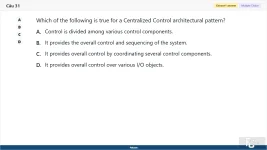
31. (Choose 1 answer)
Which of the following is true for a Centralized Control architectural pattern?
A. Control is divided among various control components.
B. It provides the overall control and sequencing of the system.
C. It provides overall control by coordinating several control components.
D. It provides overall control over various I/O objects.
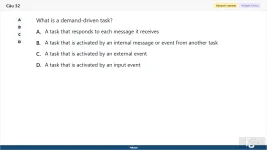
32. (Choose 1 answer)
What is a demand-driven task?
A. A task that responds to each message it receives
B. A task that is activated by an internal message or event from another task
C. A task that is activated by an external event
D. A task that is activated by an input event
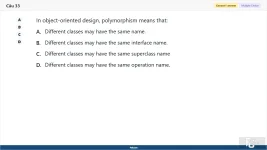
33. (Choose 1 answer)
In object-oriented design, polymorphism means that:
A. Different classes may have the same name.
B. Different classes may have the same interface name.
C. Different classes may have the same superclass name
D. Different classes may have the same operation name.
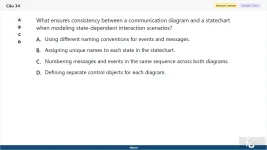
34. (Choose 1 answer)
What ensures consistency between a communication diagram and a statechart when modeling state-dependent interaction scenarios?
A. Using different naming conventions for events and messages.
B. Assigning unique names to each state in the statechart.
C. Numbering messages and events in the same sequence across both diagrams.
D. Defining separate control objects for each diagram.
35. (Choose 1 answer)
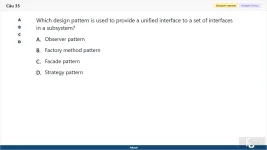
Which design pattern is used to provide a unified interface to a set of interfaces in a subsystem?
A. Observer pattern
B. Factory method pattern
C. Facade pattern
D. Strategy pattern
36. (Choose 1 answer)
Which of the following is not addressed by a secure system?
A. System penetration
B. Denial of service
C. System scalability
D. System authorization
37. (Choose 1 answer)
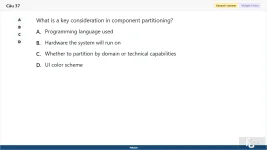
What is a key consideration in component partitioning?
A. Programming language used
B. Hardware the system will run on
C. Whether to partition by domain or technical capabilities
D. UI color scheme
38. (Choose 1 answer)
What type of object coordinates behavior among multiple objects?
A. Entity object
B. Boundary object
C. Control object
D. Interface object
39. (Choose 1 answer)
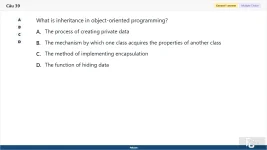
What is inheritance in object-oriented programming?
A. The process of creating private data
B. The mechanism by which one class acquires the properties of another class
C. The method of implementing encapsulation
D. The function of hiding data
40. (Choose 1 answer)
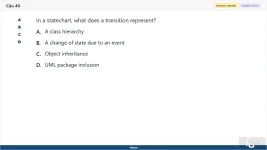
In a statechart, what does a transition represent?
A. A class hierarchy
B. A change of state due to an event
C. Object inheritance
D. UML package inclusion
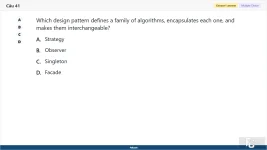
41. (Choose 1 answer)
Which design pattern defines a family of algorithms, encapsulates each one, and makes them interchangeable?
A. Strategy
B. Observer
C. Singleton
D. Facade
42. (Choose 1 answer)
What is a key characteristic of SOA?
A. Services are dependent on each other
B. Services are autonomous
C. Services are not reusable
D. Services are tightly integrated
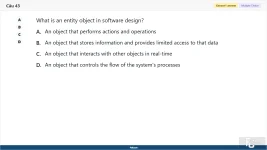
43. (Choose 1 answer)
What is an entity object in software design?
A. An object that performs actions and operations
B. An object that stores information and provides limited access to that data
C. An object that interacts with other objects in real-time
D. An object that controls the flow of the system's processes
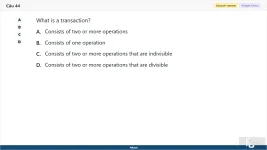
44. (Choose 1 answer)
What is a transaction?
A. Consists of two or more operations
B. Consists of one operation
C. Consists of two or more operations that are indivisible
D. Consists of two or more operations that are divisible
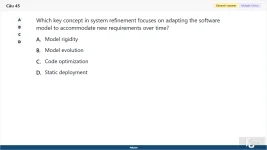
45. (Choose 1 answer)
Which key concept in system refinement focuses on adapting the software model to accommodate new requirements over time?
A. Model rigidity
B. Model evolution
C. Code optimization
D. Static deployment
46. (Choose 1 answer)
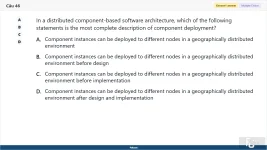
In a distributed component-based software architecture, which of the following statements is the most complete description of component deployment?
A. Component instances can be deployed to different nodes in a geographically distributed environment
B. Component instances can be deployed to different nodes in a geographically distributed environment before design
C. Component instances can be deployed to different nodes in a geographically distributed environment before implementation
D. Component instances can be deployed to different nodes in a geographically distributed environment after design and implementation
47. (Choose 1 answer)
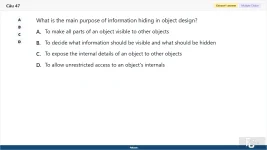
What is the main purpose of information hiding in object design?
A. To make all parts of an object visible to other objects
B. To decide what information should be visible and what should be hidden
C. To expose the internal details of an object to other objects
D. To allow unrestricted access to an object's internals
48. (Choose 1 answer)
What is the primary role of architecture characteristics in software architecture?
A. To define the functionality of the system.
B. To specify the rules for how the system should be constructed.
C. To define the success criteria of the system, orthogonal to its functionality.
D. To provide guidelines for the development teams
49. (Choose 1 answer)
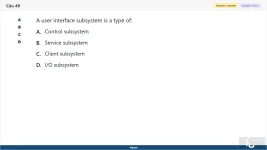
A user interface subsystem is a type of:
A. Control subsystem
B. Service subsystem
C. Client subsystem
D. I/O subsystem
50. (Choose 1 answer)
In the context of a use case, a control object is most similar to:
A. A conductor of an orchestra
B. A composer writing music
C. An audience member
D. A musician in the orchestra
51. (Choose 1 answer)
Which of the following best describes UML (Unified Modeling Language)?
A. A programming language for object-oriented systems
B. A standardized modeling language used to specify, visualize, and document software systems
C. A database schema language
D. A user interface markup language
52. (Choose 1 answer)
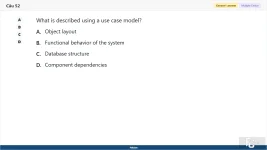
What is described using a use case model?
A. Object layout
B. Functional behavior of the system
C. Database structure
D. Component dependencies
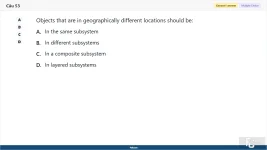
53. (Choose 1 answer)
Objects that are in geographically different locations should be:
A. In the same subsystem
B. In different subsystems
C. In a composite subsystem
D. In layered subsystems
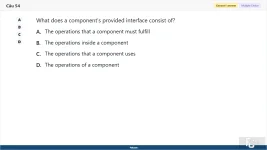
54. (Choose 1 answer)
What does a component's provided interface consist of?
A. The operations that a component must fulfill
B. The operations inside a component
C. The operations that a component uses
D. The operations of a component
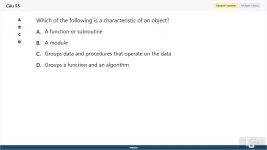
55. (Choose 1 answer)
Which of the following is a characteristic of an object?
A. A function or subroutine
B. A module
C. Groups data and procedures that operate on the data
D. Groups a function and an algorithm
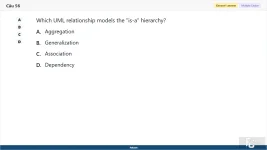
56. (Choose 1 answer)
Which UML relationship models the "is-a" hierarchy?
A. Aggregation
B. Generalization
C. Association
D. Dependency
57. (Choose 1 answer)
In a sequential service design, how are client transactions processed?
A. Multiple transactions are processed concurrently
B. Transactions are processed in random order
C. Each transaction is processed to completion before the next starts
D. Only withdrawal transactions are processed sequentially
58. (Choose 1 answer)
What is a software design strategy?
A. A graphical or textual description of the software.
B. A fundamental idea that can be applied to designing a system.
C. A systematic approach for producing a design.
D. An overall plan and direction for developing a design.
59. (Choose 1 answer)
What is an entity class?
A. A class on an entity/relationship diagram
B. A class that stores data
C. A class that interfaces to an external entity
D. An external class
60. (Choose 1 answer)
Which COMET step focuses on identifying system use cases and actors?
A. Architectural design
B. Analysis modeling
C. Requirements capture
D. Testing
Đính kèm
-
 SWD392 SP26 B5 FE RE_01.webp31.4 KB · Lượt xem: 12
 -
 SWD392 SP26 B5 FE RE_02.webp44.7 KB · Lượt xem: 12
 -
 SWD392 SP26 B5 FE RE_03.webp29 KB · Lượt xem: 6
 -
 SWD392 SP26 B5 FE RE_04.webp41.2 KB · Lượt xem: 6
 -
 SWD392 SP26 B5 FE RE_05.webp63.9 KB · Lượt xem: 7
 -
 SWD392 SP26 B5 FE RE_06.webp37.4 KB · Lượt xem: 4
 -
 SWD392 SP26 B5 FE RE_07.webp25.1 KB · Lượt xem: 4
 -
 SWD392 SP26 B5 FE RE_08.webp27.2 KB · Lượt xem: 3
 -
 SWD392 SP26 B5 FE RE_09.webp25.8 KB · Lượt xem: 3
 -
 SWD392 SP26 B5 FE RE_10.webp24.6 KB · Lượt xem: 3
 -
 SWD392 SP26 B5 FE RE_11.webp19.7 KB · Lượt xem: 3
 -
 SWD392 SP26 B5 FE RE_12.webp39.6 KB · Lượt xem: 3
 -
 SWD392 SP26 B5 FE RE_13.webp31.9 KB · Lượt xem: 3
 -
 SWD392 SP26 B5 FE RE_14.webp32.4 KB · Lượt xem: 3
 -
 SWD392 SP26 B5 FE RE_15.webp38 KB · Lượt xem: 3
 -
 SWD392 SP26 B5 FE RE_16.webp39.3 KB · Lượt xem: 3
 -
 SWD392 SP26 B5 FE RE_17.webp37.8 KB · Lượt xem: 3
 -
 SWD392 SP26 B5 FE RE_18.webp44.2 KB · Lượt xem: 3
 -
 SWD392 SP26 B5 FE RE_19.webp49.8 KB · Lượt xem: 3
 -
 SWD392 SP26 B5 FE RE_20.webp30.2 KB · Lượt xem: 3
 -
 SWD392 SP26 B5 FE RE_21.webp43.6 KB · Lượt xem: 4
 -
 SWD392 SP26 B5 FE RE_22.webp34.7 KB · Lượt xem: 3
 -
 SWD392 SP26 B5 FE RE_23.webp25.9 KB · Lượt xem: 3
 -
 SWD392 SP26 B5 FE RE_24.webp34.6 KB · Lượt xem: 3
 -
 SWD392 SP26 B5 FE RE_25.webp42 KB · Lượt xem: 3
 -
 SWD392 SP26 B5 FE RE_26.webp26 KB · Lượt xem: 3
 -
 SWD392 SP26 B5 FE RE_27.webp22 KB · Lượt xem: 3
 -
 SWD392 SP26 B5 FE RE_28.webp29.3 KB · Lượt xem: 3
 -
 SWD392 SP26 B5 FE RE_29.webp50.9 KB · Lượt xem: 3
 -
 SWD392 SP26 B5 FE RE_30.webp42.4 KB · Lượt xem: 3
 -
 SWD392 SP26 B5 FE RE_31.webp40.1 KB · Lượt xem: 3
 -
 SWD392 SP26 B5 FE RE_32.webp33.4 KB · Lượt xem: 3
 -
 SWD392 SP26 B5 FE RE_33.webp34.6 KB · Lượt xem: 3
 -
 SWD392 SP26 B5 FE RE_34.webp50.3 KB · Lượt xem: 3
 -
 SWD392 SP26 B5 FE RE_35.webp27.6 KB · Lượt xem: 4
 -
 SWD392 SP26 B5 FE RE_36.webp23.5 KB · Lượt xem: 5
 -
 SWD392 SP26 B5 FE RE_37.webp28.8 KB · Lượt xem: 4
 -
 SWD392 SP26 B5 FE RE_38.webp22.8 KB · Lượt xem: 3
 -
 SWD392 SP26 B5 FE RE_39.webp33.1 KB · Lượt xem: 3
 -
 SWD392 SP26 B5 FE RE_40.webp23.6 KB · Lượt xem: 3
 -
 SWD392 SP26 B5 FE RE_41.webp25.6 KB · Lượt xem: 4
 -
 SWD392 SP26 B5 FE RE_42.webp25.1 KB · Lượt xem: 3
 -
 SWD392 SP26 B5 FE RE_43.webp37.2 KB · Lượt xem: 3
 -
 SWD392 SP26 B5 FE RE_44.webp27.9 KB · Lượt xem: 3
 -
 SWD392 SP26 B5 FE RE_45.webp30.5 KB · Lượt xem: 3
 -
 SWD392 SP26 B5 FE RE_46.webp80.8 KB · Lượt xem: 4
 -
 SWD392 SP26 B5 FE RE_47.webp39 KB · Lượt xem: 3
 -
 SWD392 SP26 B5 FE RE_48.webp40.1 KB · Lượt xem: 3
 -
 SWD392 SP26 B5 FE RE_49.webp20.9 KB · Lượt xem: 3
 -
 SWD392 SP26 B5 FE RE_50.webp25.4 KB · Lượt xem: 3
 -
 SWD392 SP26 B5 FE RE_51.webp39.8 KB · Lượt xem: 3
 -
 SWD392 SP26 B5 FE RE_52.webp23.6 KB · Lượt xem: 3
 -
 SWD392 SP26 B5 FE RE_53.webp25.7 KB · Lượt xem: 3
 -
 SWD392 SP26 B5 FE RE_54.webp29.7 KB · Lượt xem: 3
 -
 SWD392 SP26 B5 FE RE_55.webp26.7 KB · Lượt xem: 3
 -
 SWD392 SP26 B5 FE RE_56.webp20.5 KB · Lượt xem: 4
 -
 SWD392 SP26 B5 FE RE_57.webp37.8 KB · Lượt xem: 3
 -
 SWD392 SP26 B5 FE RE_58.webp34.3 KB · Lượt xem: 3
 -
 SWD392 SP26 B5 FE RE_59.webp24.4 KB · Lượt xem: 4
 -
 SWD392 SP26 B5 FE RE_60.webp24.5 KB · Lượt xem: 13