
- Học kỳ
- SP2026
- Thời Gian
- 11/4/26
- Loại tài liệu
- FE
OSG202 SP26 FE RE
1. (Choose 1 answer)
The Process Control Block (PCB) does NOT store which of the following?
A. Process state
B. CPU registers
C. I/O status
D. Scheduling information
E. Source code
2. (Choose 1 answer)
Which of the following is shared among threads of the same process?
A. Stack memory and program counter for each thread
B. File descriptors, heap, and global variables
C. CPU registers and instruction pointer
D. Cache and clock speed of the CPU
3. (Choose 1 answer)
Select the correct statement from the following options.
A. Mouse is unique tool to interface between user and computer
B. Windows operating system does not provide a work in network environment.
C. The Windows operating system is viewed as an object that performs tasks.
D. The Windows operating system has a graphical interface.
4. (Choose 1 answer)
Which file access method is often used to optimize access to large files in a file system?
A. Sequential access
B. Direct access
C. Indexed access
D. Linked access
5. (Choose 1 answer)
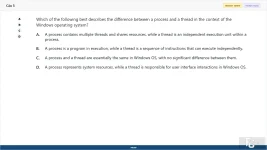
Which of the following best describes the difference between a process and a thread in the context of the Windows operating system?
A. A process contains multiple threads and shares resources, while a thread is an independent execution unit within a process.
B. A process is a program in execution, while a thread is a sequence of instructions that can execute independently.
C. A process and a thread are essentially the same in Windows OS, with no significant difference between them.
D. A process represents system resources, while a thread is responsible for user interface interactions in Windows OS.
6. (Choose 1 answer)
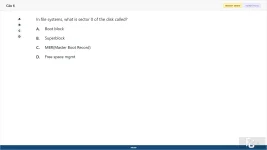
In file systems, what is sector 0 of the disk called?
A. Boot block
B. Superblock
C. MBR(Master Boot Record)
D. Free space mgmt
7. (Choose 1 answer)
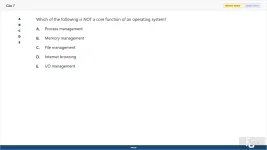
Which of the following is NOT a core function of an operating system?
A. Process management
B. Memory management
C. File management
D. Internet browsing
E. I/O management
8. (Choose 1 answer)
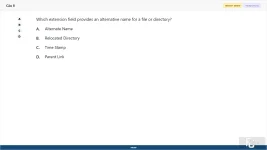
Which extension field provides an alternative name for a file or directory?
A. Alternate Name
B. Relocated Directory
C. Time Stamp
D. Parent Link
9. (Choose 1 answer)
What is the benefit of using paging in virtual memory systems?
A. Enhanced CPU performance
B. Improved disk storage management
C. Efficient memory utilization
D. Faster network communication
10. (Choose 1 answer)
Which resource allocation strategy is most likely to prevent deadlock while still allowing high resource utilization?
A. Granting requests based on the order they arrive
B. Preempting resources whenever a higher-priority process arrives
C. Allowing processes to hold resources indefinitely until they complete
D. Allocating resources based on a resource hierarchy
11. (Choose 1 answer)
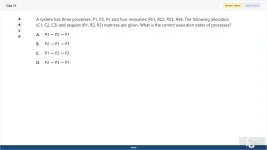
A system has three processes: P1, P2, P3 and four resources: RS1, RS2, RS3, RS4. The following allocation (C1, C2, C3) and request (R1, R2, R3) matrices are given. What is the correct execution order of processes?
A. P3 → P2 → P1
B. P2 → P1 → P3
C. P1 → P2 → P3
D. P2 → P3 → P1
12. (Choose 1 answer)
The hardware mechanism that allows a device to notify the CPU is called.........
A. interrupt
B. polling
C. driver
D. controlling
13. (Choose 1 answer)
What is the primary goal of the "working set model" in page replacement algorithms?
A. To minimize internal fragmentation by using small page sizes.
B. To ensure that processes always run with a fixed number of pages in memory.
C. To prepage all pages a process might ever need into memory before execution.
D. To greatly reduce the page fault rate by keeping a process's active pages in memory.
14. (Choose 1 answer)
What is the purpose of the spindle in a hard disk drive?
A. To store data temporarily
B. To read and write data to the platters
C. To control the movement of the read/write head
D. To provide power to the disk
E. To cool the disk during operation
15. (Choose 1 answer)
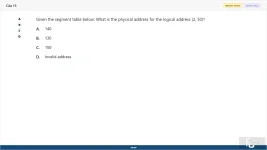
Given the segment table below: What is the physical address for the logical address (2, 50)?
A. 140
B. 130
C. 150
D. Invalid address
16. (Choose 1 answer)
What does the Banker's Algorithm check before granting a resource request?
A. If granting the request will lead to a safe state.
B. If the request is within the current needs of the process.
C. If there are enough resources available.
D. If the requesting process has priority.
17. (Choose 1 answer)
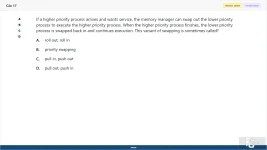
If a higher priority process arrives and wants service, the memory manager can swap out the lower priority process to execute the higher priority process. When the higher priority process finishes, the lower priority process is swapped back in and continues execution. This variant of swapping is sometimes called?
A. roll out, roll in
B. priority swapping
C. pull in, push out
D. pull out, push in
18. (Choose 1 answer)
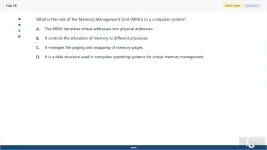
What is the role of the Memory Management Unit (MMU) in a computer system?
A. The MMU translates virtual addresses into physical addresses
B. It controls the allocation of memory to different processes.
C. It manages the paging and swapping of memory pages.
D. It is a data structure used in computer operating systems for virtual memory management
19. (Choose 1 answer)
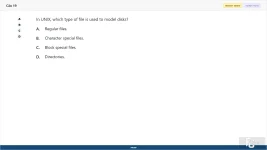
In UNIX, which type of file is used to model disks?
A. Regular files.
B. Character special files.
C. Block special files.
D. Directories.
20. (Choose 1 answer)
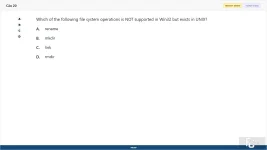
Which of the following file system operations is NOT supported in Win32 but exists in UNIX?
A. rename
B. mkdir
C. link
D. rmdir
21. (Choose 1 answer)
Which of the following techniques attacks the "No Preemption" condition for preventing deadlocks?
A. Requiring processes to request all resources at once.
B. Allowing only one process to use a resource at a time.
C. Spooling printer output to disk to allow the printer daemon exclusive access.
D. Ordering resources numerically and requiring processes to request them in increasing order.
22. (Choose 1 answer)
What is a cache hit in CPU cache memory?
A. When the requested data is found in the cache, avoiding access to main memory.
B. When the CPU fails to locate data in the cache and retrieves it from RAM.
C. When a new cache line is added to the cache memory and collides with previously stored data.
D. When all cache levels are fully utilized by the CPU
23. (Choose 1 answer)
The simplest form of directory system is having one directory containing all the files. it is called the ____
A. Root directory
B. User directory
C. Parent directory
D. Current directory
24. (Choose 1 answer)
Which of the following actions does the operating system take to execute a new process?
A. Provide immediate CPU for process.
B. Delivery the resources must be process.
C. Create immediate PCB blocks for process.
D. Provide immediate Register for process.
25. (Choose 1 answer)
Most virtual memory systems use a technique called________?
A. Page Fault
B. Page Frames
C. Page Table
D. Paging
26. (Choose 1 answer)
In a system with limited resources, which deadlock handling strategy is most appropriate for safety-critical applications?
A. Ostrich algorithm
B. Deadlock detection and recovery
C. Deadlock avoidance using Banker's algorithm
D. Terminating all active tasks and reinitializing the system to recover from potential deadlock
27. (Choose 1 answer)
A computer is reading a file using single-threaded file server. It takes 12ms to get a request for work, dispatch and do the rest of the necessary processing. If disk operation is additionally required 75ms which is one-third of the total time. How many requests per second can the server can handle?
A. 30
B. 37
C. 35
D. 28
28. (Choose 1 answer)
In data communication and I/O (Input/Output) operations, besides converting the serial bit stream into a block of bytes, what else does the controller's job do?
A. Perform any error correction necessary
B. Perform convert the sequence bit stream into a block of bytes
C. Perform connecting I/O devices
D. Perform read and write serial bit stream into a block of bytes
29. (Choose 1 answer)
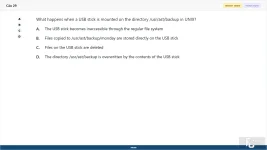
What happens when a USB stick is mounted on the directory /usr/ast/backup in UNIX?
A. The USB stick becomes inaccessible through the regular file system
B. Files copied to /usr/ast/backup/monday are stored directly on the USB stick
C. Files on the USB stick are deleted
D. The directory /usr/ast/backup is overwritten by the contents of the USB stick
30. (Choose 1 answer)
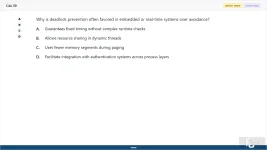
Why is deadlock prevention often favored in embedded or real-time systems over avoidance?
A. Guarantees fixed timing without complex runtime checks
B. Allows resource sharing in dynamic threads
C. Uses fewer memory segments during paging
D. Facilitate integration with authentication systems across process layers
31. (Choose 1 answer)
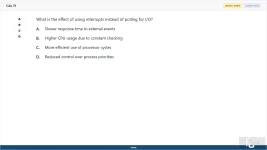
What is the effect of using interrupts instead of polling for I/O?
A. Slower response time to external events
B. Higher CPU usage due to constant checking
C. More efficient use of processor cycles
D. Reduced control over process priorities
32. (Choose 1 answer)
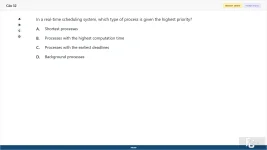
In a real-time scheduling system, which type of process is given the highest priority?
A. Shortest processes
B. Processes with the highest computation time
C. Processes with the earliest deadlines
D. Background processes
33. (Choose 1 answer)
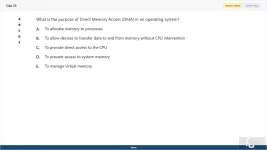
What is the purpose of Direct Memory Access (DMA) in an operating system?
A. To allocate memory to processes
B. To allow devices to transfer data to and from memory without CPU intervention
C. To provide direct access to the CPU
D. To prevent access to system memory
E. To manage virtual memory
34. (Choose 1 answer)
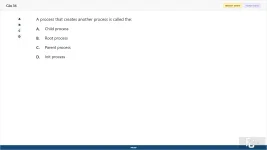
A process that creates another process is called the:
A. Child process
B. Root process
C. Parent process
D. Init process
35. (Choose 1 answer)
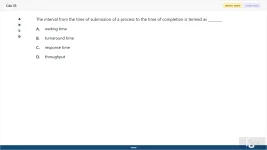
The interval from the time of submission of a process to the time of completion is termed as ________
A. waiting time
B. turnaround time
C. response time
D. throughput
36. (Choose 1 answer)
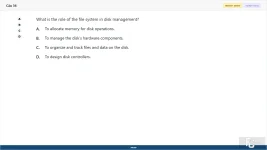
What is the role of the file system in disk management?
A. To allocate memory for disk operations.
B. To manage the disk's hardware components.
C. To organize and track files and data on the disk.
D. To design disk controllers.
37. (Choose 1 answer)
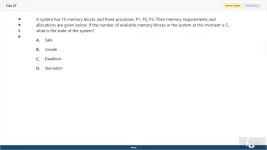
A system has 15 memory blocks and three processes: P1, P2, P3. Their memory requirements and allocations are given below: If the number of available memory blocks in the system at this moment is 5, what is the state of the system?
A. Safe
B. Unsafe
C. Deadlock
D. Starvation
38. (Choose 1 answer)
In 1965, Dijkstra posed and then solved a synchronization problem he called ____.
A. the dining philosophers problem
B. the ostrich algorithm
C. the banker's algorithm
D. the allocation algorithm
39. (Choose 1 answer)
In the evolution of operating systems, which fundamental shift was the most critical in enabling modern multitasking and time-sharing capabilities?
A. The introduction of graphical user interfaces (GUIs) in the 1980s
B. The transition from batch processing to interactive computing in the 1960s
C. The development of single-user operating systems for personal computers in the 1970s
D. The adoption of cloud-based virtualization in the 2000s
40. (Choose 1 answer)
In the Classical IPC Problems, specifically the Readers-Writers problem, what condition may lead to writer starvation?
A. A continuous stream of incoming readers
B. A reader exits too early
C. The mutex semaphore remains locked
D. Too many writers writing at the same time
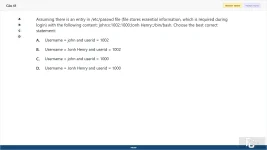
41. (Choose 1 answer)
Assuming there is an entry in /etc/passwd file (file stores essential information, which is required during login) with the following content: john:x:1002:1000:Jonh Henry::/bin/bash. Choose the best correct statement:
A. Username = john and userid = 1002
B. Username = Jonh Henry and userid = 1002
C. Username = john and userid = 1000
D. Username = Jonh Henry and userid = 1000
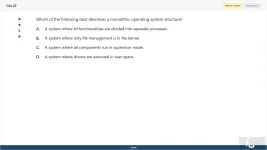
42. (Choose 1 answer)
Which of the following best describes a monolithic operating system structure?
A. A system where all functionalities are divided into separate processes.
B. A system where only file management is in the kernel.
C. A system where all components run in supervisor mode.
D. A system where drivers are executed in user space.
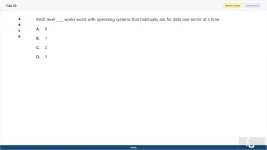
43. (Choose 1 answer)
RAID level ____ works worst with operating systems that habitually ask for data one sector at a time
A. 0
B. 1
C. 2
D. 3
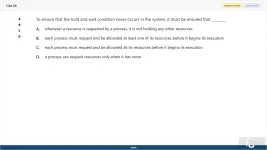
44. (Choose 3 answers)
To ensure that the hold and wait condition never occurs in the system, it must be ensured that ________
A. whenever a resource is requested by a process, it is not holding any other resources
B. each process must request and be allocated at least one of its resources before it begins its execution
C. each process must request and be allocated all its resources before it begins its execution
D. a process can request resources only when it has none
45. (Choose 1 answer)
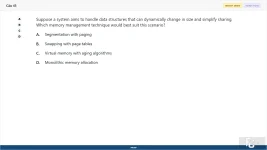
Suppose a system aims to handle data structures that can dynamically change in size and simplify sharing. Which memory management technique would best suit this scenario?
A. Segmentation with paging
B. Swapping with page tables
C. Virtual memory with aging algorithms
D. Monolithic memory allocation
46. (Choose 1 answer)
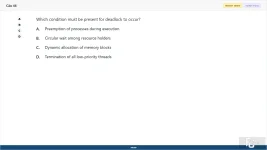
Which condition must be present for deadlock to occur?
A. Preemption of processes during execution
B. Circular wait among resource holders
C. Dynamic allocation of memory blocks
D. Termination of all low-priority threads
47. (Choose 1 answer)
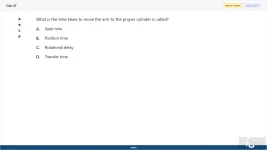
What is the time takes to move the arm to the proper cylinder is called?
A. Seek time
B. Position time
C. Rotational delay
D. Transfer time
48. (Choose 1 answer)
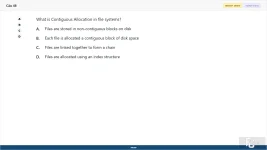
What is Contiguous Allocation in file systems?
A. Files are stored in non-contiguous blocks on disk
B. Each file is allocated a contiguous block of disk space
C. Files are linked together to form a chain
D. Files are allocated using an index structure
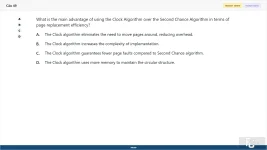
49. (Choose 1 answer)
What is the main advantage of using the Clock Algorithm over the Second Chance Algorithm in terms of page replacement efficiency?
A. The Clock algorithm eliminates the need to move pages around, reducing overhead.
B. The Clock algorithm increases the complexity of implementation.
C. The Clock algorithm guarantees fewer page faults compared to Second Chance algorithm.
D. The Clock algorithm uses more memory to maintain the circular structure.
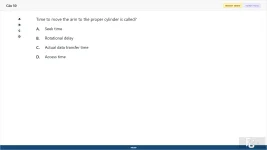
50. (Choose 1 answer)
Time to move the arm to the proper cylinder is called?
A. Seek time
B. Rotational delay
C. Actual data transfer time
D. Access time
Đính kèm
-
 OSG202 SP26 FE RE_01.webp19.1 KB · Lượt xem: 0
 -
 OSG202 SP26 FE RE_02.webp25.6 KB · Lượt xem: 0
 -
 OSG202 SP26 FE RE_03.webp32.6 KB · Lượt xem: 0
 -
 OSG202 SP26 FE RE_04.webp19.1 KB · Lượt xem: 0
 -
 OSG202 SP26 FE RE_05.webp52.9 KB · Lượt xem: 0
 -
 OSG202 SP26 FE RE_06.webp16.8 KB · Lượt xem: 0
 -
 OSG202 SP26 FE RE_07.webp20.6 KB · Lượt xem: 0
 -
 OSG202 SP26 FE RE_08.webp17.8 KB · Lượt xem: 0
 -
 OSG202 SP26 FE RE_09.webp21.8 KB · Lượt xem: 0
 -
 OSG202 SP26 FE RE_10.webp34 KB · Lượt xem: 0
 -
 OSG202 SP26 FE RE_11.webp26.7 KB · Lượt xem: 0
 -
 OSG202 SP26 FE RE_12.webp15.9 KB · Lượt xem: 0
 -
 OSG202 SP26 FE RE_13.webp36.8 KB · Lượt xem: 0
 -
 OSG202 SP26 FE RE_14.webp25.2 KB · Lượt xem: 0
 -
 OSG202 SP26 FE RE_15.webp17 KB · Lượt xem: 0
 -
 OSG202 SP26 FE RE_16.webp27 KB · Lượt xem: 0
 -
 OSG202 SP26 FE RE_17.webp35.6 KB · Lượt xem: 0
 -
 OSG202 SP26 FE RE_18.webp33.9 KB · Lượt xem: 0
 -
 OSG202 SP26 FE RE_19.webp16.6 KB · Lượt xem: 0
 -
 OSG202 SP26 FE RE_20.webp16.7 KB · Lượt xem: 0
 -
 OSG202 SP26 FE RE_21.webp35.8 KB · Lượt xem: 0
 -
 OSG202 SP26 FE RE_22.webp33.3 KB · Lượt xem: 0
 -
 OSG202 SP26 FE RE_23.webp19.7 KB · Lượt xem: 0
 -
 OSG202 SP26 FE RE_24.webp26.6 KB · Lượt xem: 0
 -
 OSG202 SP26 FE RE_25.webp15.2 KB · Lượt xem: 0
 -
 OSG202 SP26 FE RE_26.webp31.5 KB · Lượt xem: 0
 -
 OSG202 SP26 FE RE_27.webp30.8 KB · Lượt xem: 0
 -
 OSG202 SP26 FE RE_28.webp33.9 KB · Lượt xem: 0
 -
 OSG202 SP26 FE RE_29.webp33.3 KB · Lượt xem: 0
 -
 OSG202 SP26 FE RE_30.webp31.4 KB · Lượt xem: 0
 -
 OSG202 SP26 FE RE_31.webp24.9 KB · Lượt xem: 0
 -
 OSG202 SP26 FE RE_32.webp23.8 KB · Lượt xem: 0
 -
 OSG202 SP26 FE RE_33.webp29.5 KB · Lượt xem: 0
 -
 OSG202 SP26 FE RE_34.webp16 KB · Lượt xem: 0
 -
 OSG202 SP26 FE RE_35.webp18.9 KB · Lượt xem: 0
 -
 OSG202 SP26 FE RE_36.webp24 KB · Lượt xem: 0
 -
 OSG202 SP26 FE RE_37.webp27.3 KB · Lượt xem: 0
 -
 OSG202 SP26 FE RE_38.webp21.5 KB · Lượt xem: 0
 -
 OSG202 SP26 FE RE_39.webp40.1 KB · Lượt xem: 0
 -
 OSG202 SP26 FE RE_40.webp27.4 KB · Lượt xem: 0
 -
 OSG202 SP26 FE RE_41.webp35 KB · Lượt xem: 0
 -
 OSG202 SP26 FE RE_42.webp31.1 KB · Lượt xem: 0
 -
 OSG202 SP26 FE RE_43.webp15.5 KB · Lượt xem: 0
 -
 OSG202 SP26 FE RE_44.webp39.2 KB · Lượt xem: 0
 -
 OSG202 SP26 FE RE_45.webp30.5 KB · Lượt xem: 0
 -
 OSG202 SP26 FE RE_46.webp23.8 KB · Lượt xem: 0
 -
 OSG202 SP26 FE RE_47.webp17.1 KB · Lượt xem: 0
 -
 OSG202 SP26 FE RE_48.webp25.4 KB · Lượt xem: 0
 -
 OSG202 SP26 FE RE_49.webp41.1 KB · Lượt xem: 0
 -
 OSG202 SP26 FE RE_50.webp16.8 KB · Lượt xem: 0
Sửa lần cuối: