
- Học kỳ
- SP2026
- Thời Gian
- 3/5/26
- Loại tài liệu
- FE
OBE102c SP26 FE RE
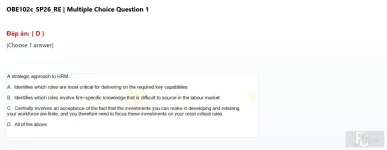
Question 1
(Choose 1 answer)
A strategic approach to HRM..
A. Identifies which roles are most critical for delivering on the required key capabilities
B. Identifies which roles involve firm-specific knowledge that is difficult to source in the labour market
C. Centrally involves an acceptance of the fact that the investments you can make in developing and retaining your workforce are finite, and you therefore need to focus these investments on your most critical roles
D. All of the above
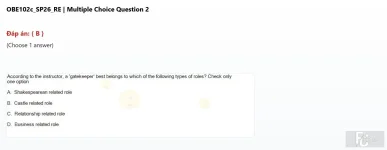
Question 2
(Choose 1 answer)
According to the instructor, a "gatekeeper best belongs to which of the following types of roles? Check only one option
A. A Shakespearean related role
B. Castle related role
C. Relationship related role
D. Business related role
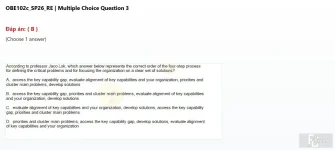
Question 3
(Choose 1 answer)
According to professor Jaco Lok, which answer below represents the correct order of the four-step process for defining the critical problems and for focusing the organization on a clear set of solutions?
A. access the key capability gap, evaluate alignment of key capabilities and your organization, priorities and cluster main problems, develop solutions
B. access the key capability gap, priorities and cluster main problems, evaluate alignment of key capabilities and your organization, develop solutions
C. evaluate alignment of key capabilities and your organization, develop solutions, access the key capability gap, priorities and cluster main problems
D. priorities and cluster main problems, access the key capability gap, develop solutions, evaluate alignment of key capabilities and your organization
Question 4
(Choose 1 answer)
What is suggested to build a learning zone in your organization?
A. Recognising ambiguity and interdependence
B. Fostering questioning, learning from failure, and challenging convention
C. Reframing as problem opening
D. All of these
Question 5
(Choose 1 answer)
What are the three drives of self-determination theory?
A. Autonomy, competence, relatedness
B. Autonomy, comprehensive improvement
C. Self-awareness, self-disciplined competence
D. Unity, balance, competence
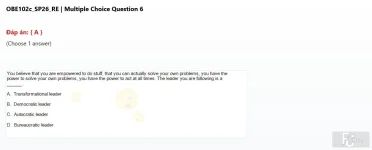
Question 6
(Choose 1 answer)
You believe that you are empowered to do stuff, that you can actually solve your own problems, you have the power to solve your own problems, you have the power to act at all times. The leader you are following is a
A. Transformational leader
B. Democratic leader
C. Autocratic leader
D. Bureaucratic leader
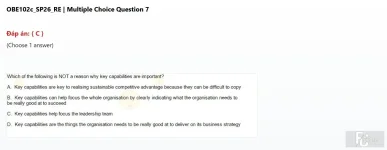
Question 7
(Choose 1 answer)
Which of the following is NOT a reason why key capabilities are important?
A. Key capabilities are key to realising sustainable competitive advantage because they can be difficult to copy
B. Key capabilities can help focus the whole organisation by clearly indicating what the organisation needs to be really good at to succeed
C. Key capabilities help focus the leadership team
D. Key capabilities are the things the organisation needs to be really good at to deliver on its business strategy
Question 8
(Choose 1 answer)
What are the two biggest fear reflected in negative thoughts of a person?
A. Being not good enough and then being rejected
B. Being not smart enough and not beautiful enough
C. Being good enough but still being rejected
D. Being not loveable enough and then being isolated
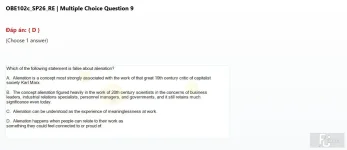
Question 9
(Choose 1 answer)
Which of the following statement is false about alienation?
A. Alienation is a concept most strongly associated with the work of that great 19th century critic of capitalist society Karl Marx
B. The concept alienation figured heavily in the work of 20th century scientists in the concerns of business leaders, industrial relations specialists, personnel managers, and governments, and it still retains much significance even today.
C. Alienation can be understood as the experience of meaninglessness at work.
D. Alienation happens when people can relate to their work as something they could feel connected to or proud of.
Question 10
(Choose 1 answer)
How many leadership styles did the GLOBE project identify?
A. 134
B. 123
C. 6
D. 2
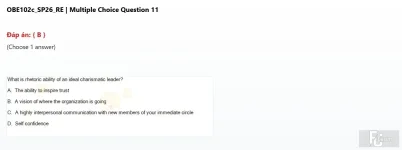
Question 11
(Choose 1 answer)
What is rhetoric ability of an ideal charismatic leader?
A. The ability to inspire trust
B. A vision of where the organization is going
C. A highly interpersonal communication with new members of your immediate circle
D. Self confidence
Question 12
(Choose 1 answer)
Why shouldn't a manager always override an employee's better judgement?
A. Because it will always lead to bullying
B. This makes an employee's work feel meaningless because the employee always knows best
C. Because it wastes valuable time
D. This makes an employee's work feel meaningless because it removes their sense of autonomy
Question 13
(Choose 1 answer)
Social identity framing happens in three stages in an organization, what are they?
A. Unfreezing-moving social identity-refreezing
B. Beginning-moving-ending
C. Forming team-creating social movement-performing
D. Planning-changing-reviewing
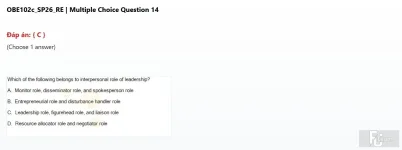
Question 14
(Choose 1 answer)
Which of the following belongs to interpersonal role of leadership?
A. Monitor role, disseminator role, and spokesperson role
B. Entrepreneurial role and disturbance handler role
C. Leadership role, figurehead role, and liaison role
D. Resource allocator role and negotiator role
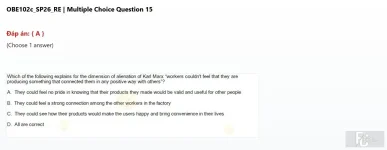
Question 15
(Choose 1 answer)
Which of the following explains for the dimension of alienation of Karl Marx "workers couldn't feel that they are producing something that connected them in any positive way with others"?
A. They could feel no pride in knowing that their products they made would be valid and useful for other people
B. They could feel a strong connection among the other workers in the factory
C. They could see how their products would make the users happy and bring convenience in their lives
D. All are correct
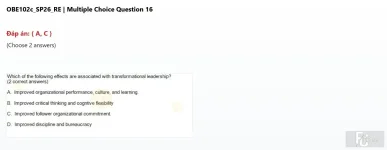
Question 16
(Choose 2 answers)
Which of the following effects are associated with transformational leadership?
A. Improved organizational performance, culture, and learning
B. Improved critical thinking and cogntive flexibility
C. Improved follower organizational commitment
D. Improved discipline and bureaucracy
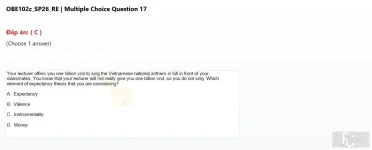
Question 17
(Choose 1 answer)
Your lecturer offers you one billion vnd to sing the Vietnamese national anthem in full in front of your classmates You know that your lecturer will not really give you one billion vid, so you do not sing. Which element of expectancy theory that you are considering?
A. Expectancy
B. Valence
C. Instrumentality
D. Money
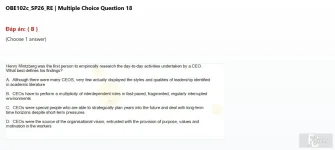
Question 18
(Choose 1 answer)
Henry Mintzberg was the first person to empirically research the day-to-day activities undertaken by a CEO. What best defines his findings?
A. Although there were many CEOS, very few actually displayed the styles and qualities of leadership identified in academic literature
B. CEOs have to perform a multiplicity of interdependent roles in fast-paced, fragmented, regularly interrupted environments
C. CEOs were special people who are able to strategically plan years into the future and deal with long-term time horizons despite short-term pressures
D. CEOs were the source of the organisational vision, entrusted with the provision of purpose, values and motivation in the workers
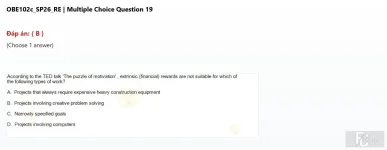
Question 19
(Choose 1 answer)
According to the TED talk The puzzle of motivation', extrinsic (financial) rewards are not suitable for which of the following types of work?
A. Projects that always require expensive heavy construction equipment
B. Projects involving creative problem solving
C. Narrowly specified goals
D. Projects involving computers
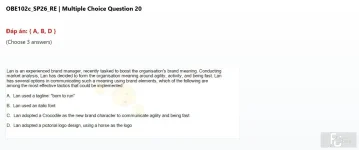
Question 20
(Choose 3 answers)
Lan is an experienced brand manager, recently tasked to boost the organisation's brand meaning. Conducting market analysis, Lan has decided to form the organisation meaning around agility, activity, and being fast. Lan has several options in communicating such a meaning using brand elements, which of the following are among the most effective tactics that could be implemented
A. Lan used a tagline "born to run"
B. Lan used an italic font
C. Lan adopted a Crocodile as the new brand character to communicate agility and being fast
D. Lan adopted a pictorial logo design, using a horse as the logo
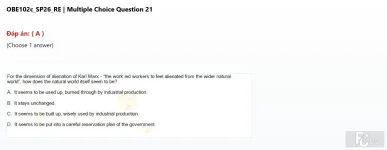
Question 21
(Choose 1 answer)
For the dimension of alienation of Karl Marx "the work led workers to feel alienated from the wider natural world how does the natural world itself seem to be?
A. It seems to be used up, burned through by industrial production
B. It stays unchanged.
C. It seems to be built up, wisely used by industrial production.
D. It seems to be put into a careful reservation plan of the government.
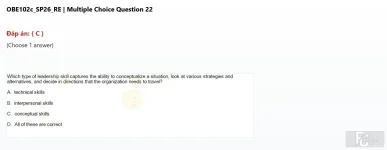
Question 22
(Choose 1 answer)
Which type of leadership skill captures the ability to conceptualize a situation, look at various strategies and alternatives, and decide in directions that the organization needs to travel?
A. technical skills
B. interpersonal skills
C. conceptual skills
D. All of these are correct
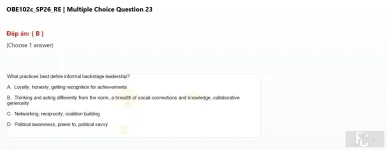
Question 23
(Choose 1 answer)
What practices best define informal backstage leadership?
A. Loyalty, honesty, getting recognition for achievements
B. Thinking and acting differently from the nom, a breadth of social connections and knowledge, collaborative generosity
C. Networking, reciprocity, coalition building
D. Political awareness, power to, political savvy
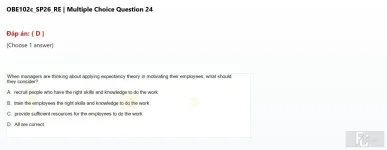
Question 24
(Choose 1 answer)
When managers are thinking about applying expectancy theory in motivating their employees, what should they consider?
A. recruit people who have the right skills and knowledge to do the work
B. train the employees the nght skills and knowledge to do the work
C. provide sufficient resources for the employees to do the work
D. All are correct
Question 25
(Choose 1 answer)
If you were to design a perfect leader, what qualities would they have?
A. There are too many contradictory models of leadership qualities to be able to pursue such a task
B. A high need for power, a moderate need for achievement and a low need for affiliation
C. High cognitive ability and deep integrity
D. High extraversion, moderate agreeableness, openness to experience and conscientiousness
Question 26
(Choose 1 answer)
What best characterises the femininity dimension of culture?
A. An emphasis on developing and nurturing personal relationships and a high quality of life
B. A state of mind wherein the values and goals of the group-whether extended family, ethnic group, company, or community-are primary
C. A concem for maintaining personal happiness and for living for the present.
D. An emphasis on assertiveness and a competitive drive for money and maternal objects
Question 27
(Choose 1 answer)
The brand vision can be classified into three layers include,
A. core, extended, and higher purpose.
B. core, extended, and lower purpose.
C. Internal, external and higher purpose
D. Internal, external, and lower purpose.
Question 28
(Choose 1 answer)
Which of the following best describes the logo design of brands like Unilever, Westinghouse, and Tesla
A. Abstract Design
B. Letter Marks
C. Word Marks
D. Pictorial Design
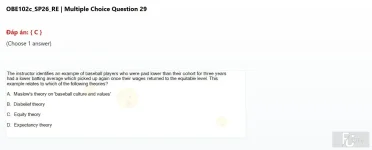
Question 29
(Choose 1 answer)
The instructor identifies an example of baseball players who were paid lower than their cohort for three years had a lower batting average which picked up again once their wages returned to the equitable level. This example relates to which of the following theories?
A. Maslow's theory on "baseball culture and values"
B. Disbelief theory
C. Equity theory
D. Expectancy theory
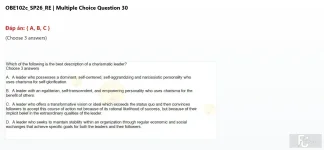
Question 30
(Choose 3 answers)
Which of the following is the best description of a charismatic leader?
A. A leader who possesses a dominant, self-centered, self-aggrandizing and narcissistic personality who uses charisma for self-glorification
B. A leader with an egalitarian, self-transcendent, and empowering personality who uses charisma for the benefit of others.
C. A leader who offers a transformative vision or ideal which exceeds the status quo and then convinces followers to accept this course of action not because of its rational likelihood of success, but because of their implicit belief in the extraordinary qualities of the leader.
D. A leader who seeks to maintain stability within an organization through regular economic and social exchanges that achieve specific goals for both the leaders and their followers
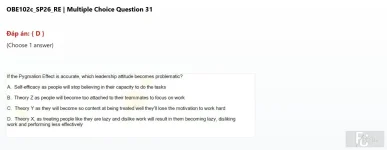
Question 31
(Choose 1 answer)
If the Pygmalion Effect is accurate, which leadership attitude becomes problematic?
A. Self-efficacy as people will stop believing in their capacity to do the tasks
B. Theory Z as people will become too attached to their teammates to focus on work
C. Theory Y as they will become so content at being treated well they'll lose the motivation to work hard
D. Theory X, as treating people like they are lazy and dislike work will result in them becoming lazy, disliking work and performing less effectively
Question 32
(Choose 1 answer)
Which of the following is NOT one of the key problems that have emerged around HRM?
A. A universal HRM approach that focuses on maximising the development potential of every employee can become disconnected from business strategy
B. HRM has generally failed to secure a seat at the top management table
C. The general empowerment focus in HRM that is based on McGregor's theory Y tends to be North American-centric
D. The rhetorical promise of HRM tends to be quite different from the actual reality of HRM
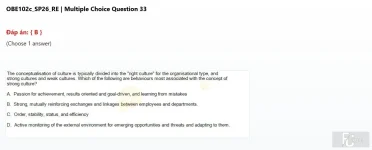
Question 33
(Choose 1 answer)
The conceptualisation of culture is typically divided into the "right culture" for the organisational type, and strong cultures and weak cultures. Which of the following are behaviours most associated with the concept of strong culture?
A. Passion for achievement, results orierited and goal-driven, and learning from mistakes
B. Strong, mutually reinforcing exchanges and linkages between employees and departments
C. Order, stability, status, and efficiency
D. Active monitoring of the external environment for emerging opportunities and threats and adapting to them.
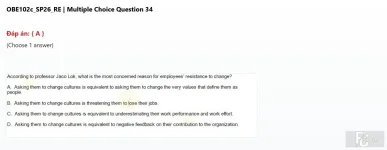
Question 34
(Choose 1 answer)
According to professor Jaco Lok, what is the most concerned reason for employees' resistance to change?
A. Asking them to change cultures is equivalent to asking them to change the very values that define them as people.
B. Asking them to change cultures is threatening them to lose their jobs.
C. Asking them to change cultures is equivalent to underestimating their work performance and work effort
D. Asking them to change cultures is equivalent to negative feedback on their contribution to the organization
Question 35
(Choose 1 answer)
According to professor Jaco Lok, why is organizational culture difficult to change?
A. Because it involves asking people to change part of who they feel they are, their identity
B. Because organizational culture is invisible
C. Because it takes time and is very expensive for any organization
D. Because the managers and employees do not see the necessity of organizational change
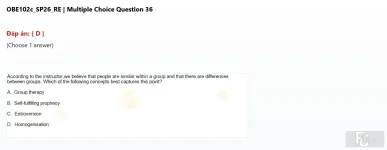
Question 36
(Choose 1 answer)
According to the instructor, we believe that people are similar within a group and that there are differences between groups. Which of the following concepts best captures this point?
A. Group therapy
B. Self-fulfiling prophecy
C. Extroversion
D. Homogenisation
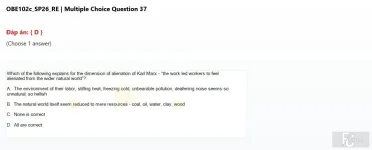
Question 37
(Choose 1 answer)
Which of the following explains for the dimension of alienation of Karl Marx "the work led workers to feel alienated from the wider natural world?
A. The environment of their labor, stifling heat, freezing cold, unbearable pollution, deafening noise seems so unnatural, so hellish
B. The natural world itself seem reduced to mere resources-coal, oil, water, clay, wood
C. None is correct
D. All are correct
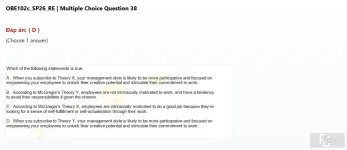
Question 38
(Choose 1 answer)
Which of the following statements is true:
A. When you subscribe to Theory X, your management style is likely to be more participative and focused on empowering your employees to unlock their creative potential and stimulate their commitment to work.
B. According to McGregor's Theory Y, employees are not intrinsically motivated to work, and have a tendency to avoid their responsibilities if given the chance
C. According to McGregor's Theory X, employees are intrinsically motivated to do a good job because they're looking for a sense of self-fulfillment or self-actualisation through their work.
D. When you subscribe to Theory Y your management style is likely to be more participative and focused on empowering your employees to unlock their creative potential and stimulate their commitment to work.
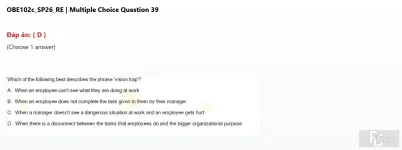
Question 39
(Choose 1 answer)
Which of the following best describes the phrase 'vision trap?
A. When an employee can't see what they are doing at work
B. When an employee does not complete the task given to them by their manager
C. When a manager doesn't see a dangerous situation at work and an employee gets hurt
D. When there is a disconnect between the tasks that employees do and the bigger organizational purpose
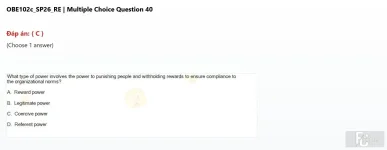
Question 40
(Choose 1 answer)
What type of power involves the power to punishing people and withholding rewards to ensure compliance to the organizational norms?
A. Reward power
B. Legitimate power
C. Coercive power
D. Referent power
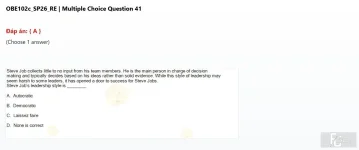
Question 41
(Choose 1 answer)
Steve Job collects little to no input from his team members. He is the main person in charge of decision making and typically decides based on his ideas rather than solid evidence. Steve Job's leadership style is
A. Autocratic
B. Democratic
C. Laissez faire
D. None is correct
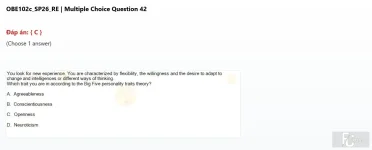
Question 42
(Choose 1 answer)
You look for new experience. You are characterized by flexibility, the willingness and the desire to adapt to change and intelligerices or different ways of thinking. Which trait you are in according to the Big Five personality traits theory?
A. Agreeableness
B. Conscientiousness
C. Openness
D. Neuroticism
Question 43
(Choose 1 answer)
What should leaders focus on when designing goals?
A. Visionary & emotionally appealing
B. Leader's emotion
C. How to follow the law
D. Blusiness partners' emotional reaction
Question 44
(Choose 1 answer)
What has alienation at work driven managers and academics to search hard for all except?
A. how to cut cost on production
B. a raft of motivation theories
C. human relations theory
D. corporate culture
Question 45
(Choose 1 answer)
According to Maslow hierarchy of needs, at which level of need that you meet your fullest potential?
A. Safety
B. Love and belonging
C. Esteem
D. Self-actualizationi
Question 46
(Choose 1 answer)
Our social identity reflects how we define ourselves in terms of a social group and our emotional attachment to that group. For university students, the types of social groups that might be important maybe not include
A. your local gym
B. your university
C. your research group
D. your assignment group
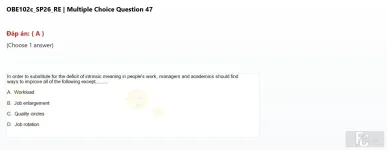
Question 47
(Choose 1 answer)
In order to substitute for the deficit of intrinsic meaning in people's work, managers and academics should find ways to improve all of the following except.
A. Workload
B. Job enlargement
C. Quality circles
D. Job rotation
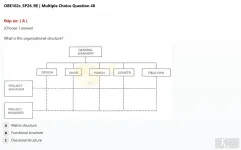
Question 48
(Choose 1 answer)
What is this organizational structure? (Based on diagram showing General Manager leading Design, Engr, Purch, Constr, Field Ops, intersected by Project Managers)
A. Matrix structure
B. Functional structure
C. Divisional structure
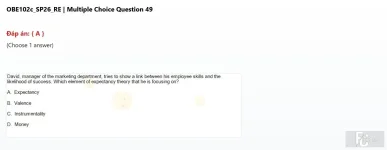
Question 49
(Choose 1 answer)
David, manager of the marketing department, tries to show a link between his employee skills and the likelihood of success. Which element of expectancy theory that he is focusing on?
A. Expectancy
B. Valence
C. Instrumentality
D. Money
Question 50
(Choose 1 answer)
Which of the following statement is false about people with high openness?
A. Highly open people are more creative and can be good leaders
B. Highly open people are very cunous about the outside world.
C. Highly open people are flexible in employing different working methods
D. Highly open people are down-to-earth leaders
Đính kèm
-
 OBE102c SP26 FE RE_001.webp34.3 KB · Lượt xem: 3
 -
 OBE102c SP26 FE RE_002.webp23.1 KB · Lượt xem: 3
 -
 OBE102c SP26 FE RE_003.webp54.2 KB · Lượt xem: 0
 -
 OBE102c SP26 FE RE_004.webp23.3 KB · Lượt xem: 0
 -
 OBE102c SP26 FE RE_005.webp22.3 KB · Lượt xem: 0
 -
 OBE102c SP26 FE RE_006.webp27.4 KB · Lượt xem: 0
 -
 OBE102c SP26 FE RE_007.webp37.1 KB · Lượt xem: 0
 -
 OBE102c SP26 FE RE_008.webp25.8 KB · Lượt xem: 0
 -
 OBE102c SP26 FE RE_009.webp44 KB · Lượt xem: 0
 -
 OBE102c SP26 FE RE_010.webp15.3 KB · Lượt xem: 0
 -
 OBE102c SP26 FE RE_011.webp23 KB · Lượt xem: 0
 -
 OBE102c SP26 FE RE_012.webp29.7 KB · Lượt xem: 0
 -
 OBE102c SP26 FE RE_013.webp24.2 KB · Lượt xem: 0
 -
 OBE102c SP26 FE RE_014.webp25.4 KB · Lượt xem: 0
 -
 OBE102c SP26 FE RE_015.webp37.1 KB · Lượt xem: 0
 -
 OBE102c SP26 FE RE_016.webp27.4 KB · Lượt xem: 0
 -
 OBE102c SP26 FE RE_017.webp27.4 KB · Lượt xem: 0
 -
 OBE102c SP26 FE RE_018.webp47.8 KB · Lượt xem: 0
 -
 OBE102c SP26 FE RE_019.webp28.1 KB · Lượt xem: 0
 -
 OBE102c SP26 FE RE_020.webp43.8 KB · Lượt xem: 0
 -
 OBE102c SP26 FE RE_021.webp30.7 KB · Lượt xem: 0
 -
 OBE102c SP26 FE RE_022.webp25.4 KB · Lượt xem: 0
 -
 OBE102c SP26 FE RE_023.webp28.8 KB · Lượt xem: 0
 -
 OBE102c SP26 FE RE_024.webp29.4 KB · Lượt xem: 0
 -
 OBE102c SP26 FE RE_025.webp32 KB · Lượt xem: 0
 -
 OBE102c SP26 FE RE_026.webp35 KB · Lượt xem: 0
 -
 OBE102c SP26 FE RE_027.webp22.2 KB · Lượt xem: 0
 -
 OBE102c SP26 FE RE_028.webp20.6 KB · Lượt xem: 0
 -
 OBE102c SP26 FE RE_029.webp30.8 KB · Lượt xem: 0
 -
 OBE102c SP26 FE RE_030.webp56.3 KB · Lượt xem: 0
 -
 OBE102c SP26 FE RE_031.webp36.8 KB · Lượt xem: 0
 -
 OBE102c SP26 FE RE_032.webp39.8 KB · Lượt xem: 0
 -
 OBE102c SP26 FE RE_033.webp41.5 KB · Lượt xem: 0
 -
 OBE102c SP26 FE RE_034.webp38.3 KB · Lượt xem: 0
 -
 OBE102c SP26 FE RE_035.webp31.3 KB · Lượt xem: 0
 -
 OBE102c SP26 FE RE_036.webp25.2 KB · Lượt xem: 0
 -
 OBE102c SP26 FE RE_037.webp32 KB · Lượt xem: 0
 -
 OBE102c SP26 FE RE_038.webp55 KB · Lượt xem: 0
 -
 OBE102c SP26 FE RE_039.webp32.5 KB · Lượt xem: 0
 -
 OBE102c SP26 FE RE_040.webp22.2 KB · Lượt xem: 0
 -
 OBE102c SP26 FE RE_041.webp31.6 KB · Lượt xem: 0
 -
 OBE102c SP26 FE RE_042.webp27.3 KB · Lượt xem: 0
 -
 OBE102c SP26 FE RE_043.webp20.6 KB · Lượt xem: 0
 -
 OBE102c SP26 FE RE_044.webp21.5 KB · Lượt xem: 0
 -
 OBE102c SP26 FE RE_045.webp19.9 KB · Lượt xem: 0
 -
 OBE102c SP26 FE RE_046.webp27.5 KB · Lượt xem: 0
 -
 OBE102c SP26 FE RE_047.webp22.9 KB · Lượt xem: 0
 -
 OBE102c SP26 FE RE_048.webp36.9 KB · Lượt xem: 0
 -
 OBE102c SP26 FE RE_049.webp23.8 KB · Lượt xem: 0
 -
 OBE102c SP26 FE RE_050.webp28.4 KB · Lượt xem: 3