
- Học kỳ
- SP2026
- Thời Gian
- 4/5/26
- Loại tài liệu
- FE
- Mã Đề
- LAW201c_SP26_RE_403252
LAW201c SP26 FE RE
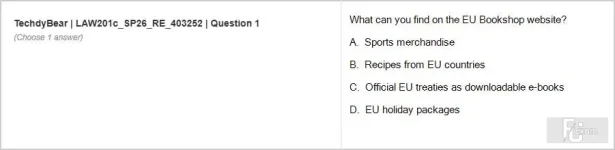
Question 1 (Choose 1 answer): What can you find on the EU Bookshop website?
A. Sports merchandise
B. Recipes from EU countries
C. Official EU treaties as downloadable e-books
D. EU holiday packages
Question 2 (Choose 1 answer): In what practical way does the Committee of the Regions support EU policy-making?
A. It enforces regional EU laws.
B. It provides advice on regional and local issues.
C. It supervises the European Parliament.
D. It administers regional EU budgets directly.
Question 3 (Choose 1 answer): Which of the following best describes the current state of the EU's external energy policy?
A. It is fully comprehensive and unified.
B. It is fragmented with unclear roles for institutions.
C. It is only about nuclear energy.
D. It has no connection to internal EU policies.
Question 4 (Choose 1 answer): Which employment practice is specifically emphasized by the EU to ensure fairness?
A. Maximum working hours
B. Minimum wage standards
C. Equal pay for equal work between men and women
D. Mandatory vacation days
Question 5 (Choose 1 answer): Pursuant to the Brussels I Regulation, a person domiciled within an EU Member State (MS) can be sued in matters relating to tort in the MS where the harmful event occurred.
A. True
B. False
Question 6 (Choose 1 answer): Pursuant to the Brussels I Regulation, where can a person domiciled within an EU Member State (MS) be sued in matters relating to tort?
A. Either in the Member State where the harmful event occurred or the Member State where he/she is domiciled, at the choice of the plaintiff.
B. A person must be sued in the Member State where he/she is domiciled.
C. A person must be sued in the Member State where the harmful event occurred.
Question 7 (Choose 1 answer): Judge the balance achieved by the EU between facilitating the free movement of goods and adequately addressing diverse national consumer protection standards.
A. EU standards always reduce consumer protection significantly.
B. EU rules largely harmonize standards effectively, but challenges remain in specific national contexts.
C. EU consumer standards completely eliminate national differences.
D. EU rules consistently fail to address consumer protection issues.
Question 8 (Choose 1 answer): What obligation arises from the primacy principle even if a provision does not have direct effect?
A. Obligation to amend the constitution immediately
B. Obligation to ignore EU law entirely
C. Obligation to interpret national law in conformity with EU law
D. Obligation to hold a public referendum
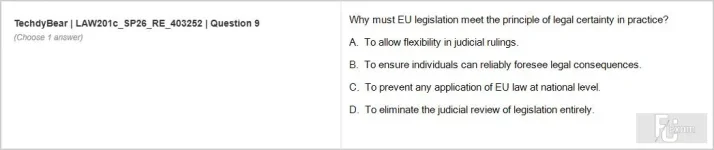
Question 9 (Choose 1 answer): Why must EU legislation meet the principle of legal certainty in practice?
A. To allow flexibility in judicial rulings.
B. To ensure individuals can reliably foresee legal consequences.
C. To prevent any application of EU law at national level.
D. To eliminate the judicial review of legislation entirely.
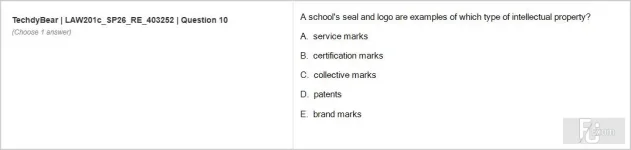
Question 10 (Choose 1 answer): A school's seal and logo are examples of which type of intellectual property?
A. service marks
B. certification marks
C. collective marks
D. patents
E. brand marks
Question 11 (Choose 1 answer): A judgment given in an EU Member State must be recognized by the other Member States even when they find it manifestly contrary to their public policy.
A. False
B. True
Question 12 (Select all that apply): What is not defined as an 'undertaking' in Article 107(1) TFEU?
A. Companies registered in an EU Member State
B. An entity engaging in economic activity regardless of its legal status or how it is financed
C. Registered companies, regardless of where they are registered
D. Privately owned limited companies
Question 13 (Select all that apply / Choose 2 answers): The benefits of competition that consumers may receive is...
A. More products with cheaper price
B. Increase a monopoly and outcomes of the companies
C. Wider ranges of products in the market
D. More promotions between competitors will benefit consumers
Question 14 (Choose 1 answer): Which of the following can typically be found at the start of a competition law investigation in the EU?
A. A decision by the European Commission.
B. A decision by a national competition authority.
C. A decision by an EU court.
D. A decision by a national court.
Question 15 (Choose 1 answer): Is consignment note the name of the document that is commonly used in international sea carriage of goods?
A. Yes, it is.
B. No, it should be the bill of lading.
C. No, it should be transportation documents.
D. No, it should be the seaway bill.
Question 16 (Choose 1 answer): How does the principle of homogeneity affect judicial decision-making in EFTA states?
A. It allows EFTA states to apply their own law independently.
B. It ensures EFTA states apply EU law uniformly with EU member states.
C. It removes all judicial functions from EFTA courts.
D. It makes judicial decisions entirely optional.
Question 17 (Choose 1 answer): The value of trademarks is increasing in today's globalization.
A. True
B. False
Question 18 (Choose 1 answer): Can the German patentee prevent patented product sold by his licensee in Spain from being imported into Germany?
A. Yes
B. No
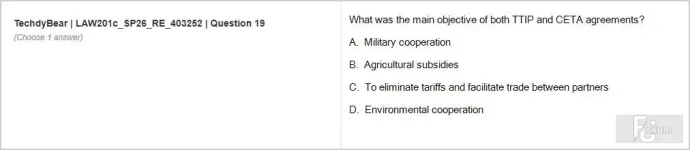
Question 19 (Choose 1 answer): What was the main objective of both TTIP and CETA agreements?
A. Military cooperation
B. Agricultural subsidies
C. To eliminate tariffs and facilitate trade between partners
D. Environmental cooperation
Question 20 (Choose 1 answer): What does the "comply or explain" code entail?
A. Laissez-faire for all legal requirements.
B. Adapt to the rules.
C. It allows companies to depart from particular recommendations of the applicable code, provided they explain the reasons for doing so.
Question 21 (Choose 1 answer): A judgment given in an EU Member State may not be recognized by the other Member States when they find it manifestly contrary to their public policy.
A. False
B. True
Question 22 (Choose 1 answer): How can businesses practically benefit from the EU's freedom of establishment when setting up operations abroad?
A. By focusing exclusively on domestic sales.
B. By restricting access to foreign workers.
C. By easily opening branches or subsidiaries in other EU countries without facing unnecessary restrictions.
D. By always having to relocate entirely to another country.
Question 23 (Choose 1 answer): In the following IPR-related exercises, which one that vigilance by a dominant company is required?
A. Resale price maintenance (RPM-establishing licensee's sales price) in licensing relations.
B. Territorial allocation for its distributors.
C. Refusal to license essential facility.
D. All answers are correct.
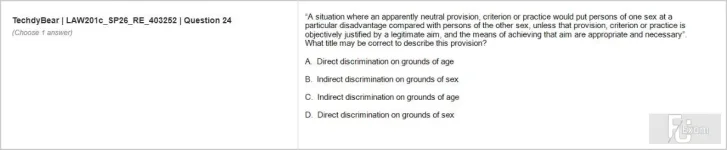
Question 24 (Choose 1 answer): "A situation where an apparently neutral provision, criterion or practice would put persons of one sex at a particular disadvantage compared with persons of the other sex, unless that provision, criterion or practice is objectively justified by a legitimate aim, and the means of achieving that aim are appropriate and necessary." What title may be correct to describe this provision?
A. Direct discrimination on grounds of age
B. Indirect discrimination on grounds of sex
C. Indirect discrimination on grounds of age
D. Direct discrimination on grounds of sex
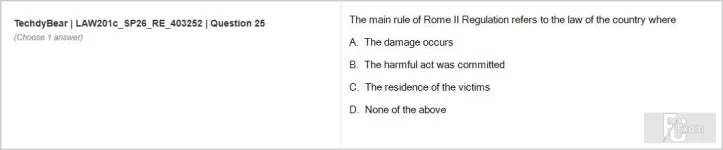
Question 25 (Choose 1 answer): The main rule of Rome II Regulation refers to the law of the country where:
A. The damage occurs
B. The harmful act was committed
C. The residence of the victims
D. None of the above
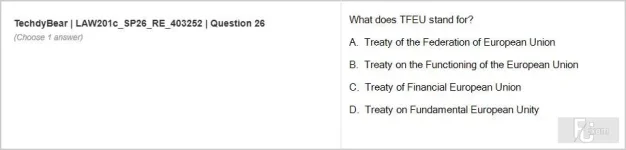
Question 26 (Choose 1 answer): What does TFEU stand for?
A. Treaty of the Federation of European Union
B. Treaty on the Functioning of the European Union
C. Treaty of Financial European Union
D. Treaty on Fundamental European Unity
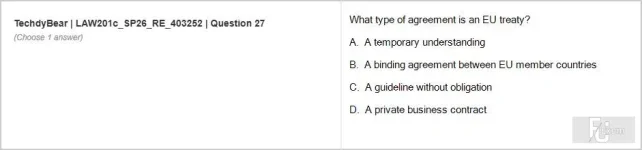
Question 27 (Choose 1 answer): What type of agreement is an EU treaty?
A. A temporary understanding
B. A binding agreement between EU member countries
C. A guideline without obligation
D. A private business contract
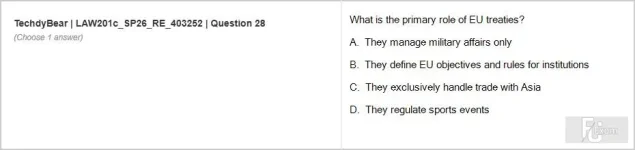
Question 28 (Choose 1 answer): What is the primary role of EU treaties?
A. They manage military affairs only.
B. They define EU objectives and rules for institutions.
C. They exclusively handle trade with Asia.
D. They regulate sports events.
Question 29 (Choose 1 answer): Which law regulates the Commission's enforcement procedure in competition proceedings relating in particular to cartel and abuse of dominance investigations?
A. The European Merger Regulation (only relevant regarding mergers).
B. Council Regulation 1/2003.
C. Article 101 and 102 TFEU (does not regulate the procedure but contains the substantive prohibitions).
D. All are correct.
Question 30 (Choose 1 answer): Should the European Union develop judicial cooperation in civil matters?
A. Yes. Since this is defined in Article 81 of the treaty on the functioning of the European Union.
B. No. This totally depends on goodwill of the member states.
Question 31 (Choose 1 answer): How might rules ensuring equal treatment of workers from other EU states impact national employment practices?
A. They reduce all job opportunities within member states.
B. They require employers to treat foreign and national workers equally, eliminating nationality-based discrimination.
C. They exclusively benefit domestic workers.
D. They allow preferential treatment for local employees.
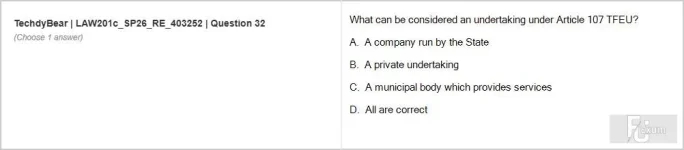
Question 32 (Choose 1 answer): What can be considered an undertaking under Article 107 TFEU?
A. A company run by the State
B. A private undertaking
C. A municipal body which provides services
D. All are correct
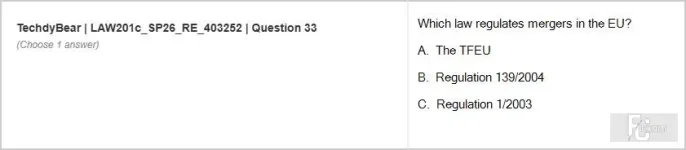
Question 33 (Choose 1 answer): Which law regulates mergers in the EU?
A. The TFEU
B. Regulation 139/2004
C. Regulation 1/2003
Question 34 (Choose 1 answer): Why is the distinction between the EU and its member states important when entering into international agreements?
A. To eliminate all agreements completely.
B. To clarify legal responsibilities and competences of each party.
C. To ensure all actions are taken solely by member states.
D. To prevent the EU from acting internationally.
Question 35 (Choose 1 answer): Is bill of lading an ownership document?
A. Yes
B. No
Question 36 (Choose 1 answer): How does EU law practically ensure that gender equality is promoted in workplaces across member states?
A. By allowing unrestricted discriminatory practices.
B. By making gender equality optional for businesses.
C. By enforcing policies that mandate equal treatment and opportunities.
D. By encouraging gender-specific employment sectors.
Question 37 (Choose 1 answer): Practically, why might negative integration be important for businesses operating across EU borders?
A. It requires businesses to adopt complex new regulations.
B. It helps remove national barriers and protectionist measures hindering cross-border activities.
C. It limits cross-border trade.
D. It promotes protectionist national policies.
Question 38 (Choose 1 answer): The core rule of company law can be said to consist of three types of rules. Which is one of these?
A. Rules concerning the responsibilities for the company's debts.
B. Rules concerning the company's relation to its stakeholders.
C. Rules concerning the bodies of the company and their internal relations.
D. Rules concerning the membership in the company.
Question 39 (Choose 2 answers): Rules regarding the decision-making authority on behalf of the company fall into two groups. Which?
A. One group of rules tell us when a company decision exists.
B. One group of rules tells us which rights members have with respect to the content of company decisions.
C. One group of rules draws the limit between lawful and unlawful company decisions.
D. One group of rules tells us which rights other stakeholders than members have with respect to the content of company decisions.
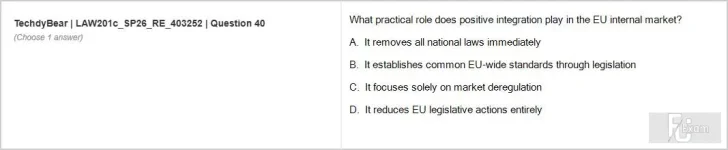
Question 40 (Choose 1 answer): What practical role does positive integration play in the EU internal market?
A. It removes all national laws immediately.
B. It establishes common EU-wide standards through legislation.
C. It focuses solely on market deregulation.
D. It reduces EU legislative actions entirely.
Question 41 (Choose 1 answer): Following EU Member States have been granted special standing regarding the EU private international law rules:
A. Sweden
B. Denmark
C. Italy
D. All are granted
Question 42 (Choose 1 answer): In State aid procedure, which is not the supervisory body?
A. The Member State's competition authority
B. The European Commission
C. A and B are correct
D. A and B are not correct
Question 43 (Choose 1 answer): What practical problem does EUR-Lex solve when dealing with complex EU legislative documents?
A. It eliminates the need for legal professionals entirely.
B. It allows efficient and structured access to documents with search functions.
C. It removes the obligation to comply with EU law.
D. It encourages studying non-European laws instead.
Question 44 (Choose 1 answer): Why is understanding EU fundamental rights principles practically beneficial for businesses operating across multiple EU member states?
A. They can avoid any legal responsibilities.
B. They can ensure compliance with fundamental rights standards uniformly across member states.
C. They can freely ignore rights protections.
D. They are restricted to operating within one EU member state only.
Question 45 (Choose 1 answer): Within the meaning of EU competition law, an agreement must be written or at least legally bound parties. True or false?
A. True
B. False
Question 46 (Choose 1 answer): Which of the following statements is true of intellectual property?
A. Intellectual property requires that certain types of information are not disclosed to the public.
B. The type of information is irrelevant in determining the time, effort, and money required to convert intellectual property to intangible assets.
C. The basic economic system of intellectual property is grounded in the idea of incentives.
D. There is little correlation between research and development and intellectual property in determining the competitive advantage of a firm.
E. An economic system based on intellectual property presumes that the long-term benefits of increased information and investment are lower than the short-term costs.
Question 47 (Choose 2 answers): Rules regarding the representational authority on behalf of the company fall into two groups. Which of the two following options are correct?
A. One group of rules tells us when a representative has acted wrongly.
B. One group of rules identifies the conditions under which a person or set of persons is empowered to affect changes in the company's external legal relations.
C. One group of rules tells us when a representative is allowed to perform legal acts on behalf of the company.
D. One group of rules draws the limit between valid and invalid legal acts which a representative has performed on behalf of the company.
Question 48 (Choose 1 answer): EU competition law can only be applied to entities which are recognized as companies in a member State. True or false?
A. True
B. False
Question 49 (Choose 1 answer): Which of the following abuses is typically not considered to be exclusionary?
A. Excessive pricing
B. Exclusive dealing
C. Exclusionary discounts and rebates
D. Refusal to supply
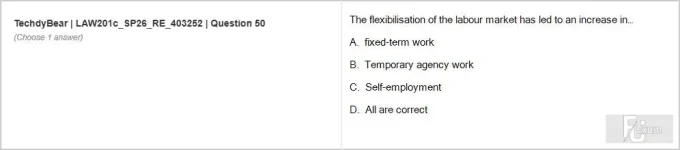
Question 50 (Choose 1 answer): The flexibilisation of the labour market has led to an increase in:
A. fixed-term work
B. Temporary agency work
C. Self-employment
D. All are correct
Đính kèm
-
 LAW201c SP26 FE RE_001.webp13.9 KB · Lượt xem: 4
 -
 LAW201c SP26 FE RE_002.webp18 KB · Lượt xem: 4
 -
 LAW201c SP26 FE RE_003.webp18 KB · Lượt xem: 1
 -
 LAW201c SP26 FE RE_004.webp16.3 KB · Lượt xem: 1
 -
 LAW201c SP26 FE RE_005.webp11.9 KB · Lượt xem: 1
 -
 LAW201c SP26 FE RE_006.webp21.8 KB · Lượt xem: 0
 -
 LAW201c SP26 FE RE_007.webp23.6 KB · Lượt xem: 0
 -
 LAW201c SP26 FE RE_008.webp20 KB · Lượt xem: 0
 -
 LAW201c SP26 FE RE_009.webp19.8 KB · Lượt xem: 0
 -
 LAW201c SP26 FE RE_010.webp12.7 KB · Lượt xem: 0
 -
 LAW201c SP26 FE RE_011.webp11 KB · Lượt xem: 0
 -
 LAW201c SP26 FE RE_012.webp21.6 KB · Lượt xem: 0
 -
 LAW201c SP26 FE RE_013.webp19.4 KB · Lượt xem: 0
 -
 LAW201c SP26 FE RE_014.webp16.1 KB · Lượt xem: 0
 -
 LAW201c SP26 FE RE_015.webp14.1 KB · Lượt xem: 0
 -
 LAW201c SP26 FE RE_016.webp21.1 KB · Lượt xem: 0
 -
 LAW201c SP26 FE RE_017.webp8.5 KB · Lượt xem: 0
 -
 LAW201c SP26 FE RE_018.webp10.1 KB · Lượt xem: 0
 -
 LAW201c SP26 FE RE_019.webp15.3 KB · Lượt xem: 0
 -
 LAW201c SP26 FE RE_020.webp14.4 KB · Lượt xem: 0
 -
 LAW201c SP26 FE RE_021.webp11.2 KB · Lượt xem: 0
 -
 LAW201c SP26 FE RE_022.webp19.9 KB · Lượt xem: 0
 -
 LAW201c SP26 FE RE_023.webp18.3 KB · Lượt xem: 0
 -
 LAW201c SP26 FE RE_024.webp25.3 KB · Lượt xem: 0
 -
 LAW201c SP26 FE RE_025.webp14 KB · Lượt xem: 0
 -
 LAW201c SP26 FE RE_026.webp14.9 KB · Lượt xem: 0
 -
 LAW201c SP26 FE RE_027.webp14.1 KB · Lượt xem: 0
 -
 LAW201c SP26 FE RE_028.webp15 KB · Lượt xem: 0
 -
 LAW201c SP26 FE RE_029.webp19.5 KB · Lượt xem: 0
 -
 LAW201c SP26 FE RE_030.webp16.1 KB · Lượt xem: 0
 -
 LAW201c SP26 FE RE_031.webp20.1 KB · Lượt xem: 0
 -
 LAW201c SP26 FE RE_032.webp14.1 KB · Lượt xem: 0
 -
 LAW201c SP26 FE RE_033.webp9.5 KB · Lượt xem: 0
 -
 LAW201c SP26 FE RE_034.webp17.7 KB · Lượt xem: 0
 -
 LAW201c SP26 FE RE_035.webp7.2 KB · Lượt xem: 0
 -
 LAW201c SP26 FE RE_036.webp18.4 KB · Lượt xem: 0
 -
 LAW201c SP26 FE RE_037.webp19.9 KB · Lượt xem: 0
 -
 LAW201c SP26 FE RE_038.webp20.8 KB · Lượt xem: 0
 -
 LAW201c SP26 FE RE_039.webp23.6 KB · Lượt xem: 0
 -
 LAW201c SP26 FE RE_040.webp18.4 KB · Lượt xem: 0
 -
 LAW201c SP26 FE RE_041.webp11.5 KB · Lượt xem: 0
 -
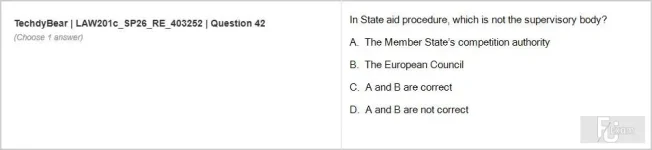 LAW201c SP26 FE RE_042.webp13.8 KB · Lượt xem: 0
 -
 LAW201c SP26 FE RE_043.webp20.2 KB · Lượt xem: 0
 -
 LAW201c SP26 FE RE_044.webp20.1 KB · Lượt xem: 0
 -
 LAW201c SP26 FE RE_045.webp9.8 KB · Lượt xem: 0
 -
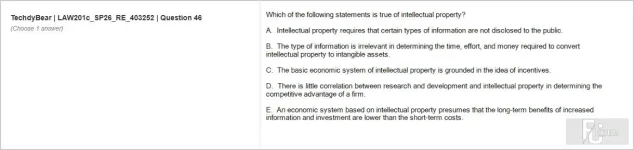 LAW201c SP26 FE RE_046.webp31.8 KB · Lượt xem: 0
 -
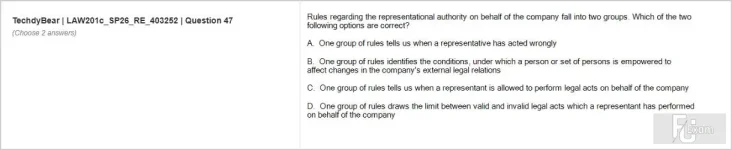 LAW201c SP26 FE RE_047.webp28.5 KB · Lượt xem: 0
 -
 LAW201c SP26 FE RE_048.webp10.2 KB · Lượt xem: 0
 -
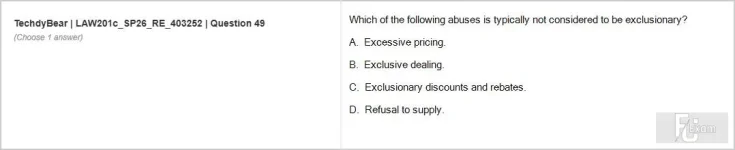 LAW201c SP26 FE RE_049.webp14.3 KB · Lượt xem: 0
 -
 LAW201c SP26 FE RE_050.webp12 KB · Lượt xem: 4