
- Học kỳ
- SP2026
- Thời Gian
- 3/5/26
- Loại tài liệu
- FE
ITE302c SP26 FE
Question 1
(Choose 1 answer)
Which type of bias occurs when training data is not representative of the population?
A. Confirmation bias
B. Selection bias
C. Anchoring bias
D. Availability bias
Question 2
(Choose 1 answer)
Why is stakeholder communication vital in managing ethical risk?
A. To improve company branding only
B. To ensure stakeholder expectations and values are understood
C. To avoid legal responsibilities
D. To control product pricing strategies
Question 3
(Choose 1 answer)
Which of the following best describes capability caution as referenced in the Asilomar Al Principles?
A. If there is no understanding of the internal mechanisms of Al, then Al development should be halted
B. Given a lack of consensus, we should avoid strong assumptionis regarding upper limits on future Al capabilities.
C. Should there be a greater reliance on Al, measures should be taken to ensure that humans are still capable of finding work.
D. We should keep limits on on what artificial general intelligence (AGI) is capable of
Question 4
(Choose 1 answer)
Which of the following is a notable aspect of the Personal Information Protection and Electronic Documents Act (PIPEDA) when compared to similar laws and regulations?
A. Its exclusive focus on a single domain rather than a breadth of domains
B. The early date of its inauguration
C. Its nationwide scope and specific national focus
D. A stipulation to continue providing service even if data usage is denied
Question 5
(Choose 1 answer)
What does informed consent require in the context of Al?
A. Legal approval of Al patents
B. Clear communication of data use and user permission
C. Selling user data to partners
D. Disabling all tracking features
Question 6
(Choose 1 answer)
If you were faced with an Al system that identifies exactly what individuals will be infected in a pandemic of a novel disease before the first case occurs, what kind of Al is this?
A. Narrow Al
B. General AI
C. Superintelligence
D. Basic Al
Question 7
(Choose 1 answer)
Which of the following resources does the National Institute of Standards and Technology (NIST) provide to organizations?
A. Measurement technologies
B. Reference materials
C. Security tools
D. Industrial configurations
Question 8
(Choose 1 answer)
Which method can be implemented to effectively communicate with the media during an ethical crisis?
A. Provide regular updates to keep the media informed
B. Ignore media inquiries until the crisis resolves
C. Offer incentives for positive coverage
D. Release information only to major news networks
Question 9
(Choose 1 answer)
What percentage of frameworks include privacy as core tenet?
A. 50%
B. 85%
C. 25%
D. 99%
Question 10
(Choose 1 answer)
An example of automation bias is
A. using biased survey data instead of parsed survey data
B. using parsed twitter data over parsed Facebook data
C. using new data over existing data
D. using scraped twitter data over survey data
Question 11
(Choose 1 answer)
What is one outcome of not considering ethics in algorithm design?
A. Lower electricity bilis
B. Enhanced system performance
C. Discriminatory or unsafe results
D. Better customer loyalty
Question 12
(Choose 1 answer)
How do Al and other data-driven technologies use probability?
A. By determining the objective likelihood of some event happening
B. By estimating the likelihood of some event happening without input data
C. By providing a model of belief about the likelihood of some event happening
D. By guaranteeing that some event will occur with 100% likelihood
Question 13
(Choose 1 answer)
Which of the following is a key element of communications with internal and external stakeholders regarding an organization's ethics policies?
A. Simple to follow examples
B. Daily communications
C. Dense procedural descriptions
D. Flexible verbiage
Question 14
(Choose 1 answer)
In which of the following could STRIDE or VAST classifications be applied?
A. Black box mitigation methods
B. Network optimization tools
C. Bias mitigation techniques
D. Threat modeling or analysis tools
Question 15
(Choose 3 answers)
Which of the following statements are promoted by the categorical imperative? (Select three)
A. You have a moral duty to choose your actions based on their potential outcomes
B. Act in such a way that your actions may become a universal law
C. Don't treat people as a means to an end; treat them always as an end.
D. Each person must use reason to will moral laws
Question 16
(Choose 1 answer)
Which technique helps improve algorithmic faimess?
A. Using larger datasets only
B. Bias testing and diverse training data
C. Increasing processing speed
D. Reducing system complexity
Question 17
(Choose 1 answer)
What is non-maleficence?
A. The principle of doing no harm
B. The principle of having no bias
C. The principle of having no security risk.
D. The principle of having security risk
Question 18
(Choose 1 answer)
Which principle emphasizes treating people as ends in themselves, not merely as means?
A. Utilitarianism
B. Virtue ethics
C. Kantian deontology
D. Social contract theory
Question 19
(Choose 1 answer)
Which element is essential for system accountability?
A. Complete automation
B. Clear responsibility assignment
C. Maximum data collection
D. Fastest processing speed
Question 20
(Choose 1 answer)
What is the benefit of hosting a virtual reality press conference over a traditional in-person press conference?
A. It will be easier to communicate your overall message to your audience.
B. The conference will be easily accessible to all willing participants
C. The conference can be interactive without the participants needing to be co-located
D. The participants will be impressed by your leveraging of new and exciting technologies
Question 21
(Choose 1 answer)
Why is deciding how to act using moral reasoning not always a feasible goal for human beings?
A. Most people are not educated on normative ethical theories and therefore cannot perform true moral reasoning
B. Moral reasoning is too complicated to apply to a real-world situation
C. Moral reasoning has few tangible benefits for most people.
D. Human decision making is often influenced by emotion and not logic.
Question 22
(Choose 1 answer)
Our goals for building an ethical predictive model include making sure the results are
A. precise, explainable, predictable
B. accurate, precise, fair
C. precise, methodical, ethical
D. accurate, fair and explainable
Question 23
(Choose 1 answer)
Which of the following is a misuse of intellectual property (IP) when it comes to ethical accountability for an organization?
A. Collecting retums on investments made in research and development
B. Filing a patent for the IP that makes non-obvious information known to the public
C. Enhancing the security posture of a product or service.
D. Using IP as a defensive mechariism to eschew transparency requirements
Question 24
(Choose 1 answer)
How can organizations ensure continuous ethical improvement?
A. By implementing systems once and forgetting them
B. Through regular assessment, feedback, and adaptation
C. By following competitors only
D. By focusing solely on compliance
Question 25
(Choose 1 answer)
What can be learned from a predictive model should not change if the ________ is either included or excluded in the training set
A. dataset filter
B. biased dataset
C. model fairness score
D. Individual's data
Question 26
(Choose 1 answer)
Why is equity an important principle in emerging tech ethics?
A. It increases brand value
B. It ensures faimess in access and outcomes
C. It simplifies design
D. It boosts marketing campaigns
Question 27
(Choose 1 answer)
Why is it important to engage stakeholders at the beginning of the ethical nsk management process?
A. It proves that you are completely equipped to address any ethical risks in your data-driven systems
B. It lets stakeholders know that the organization cannot address ethical risks in data-driven systems without input from stakeholders first.
C. It helps the organization avoid legal trouble during the development and deployment of data-driven systems
D. It demonstrates that the organization is committed to accountability and transparency in their data-driven systems
Question 28
(Choose 2 answers)
Why is it important to categorize ethical risks into different types? (Select two)
A. It makes it easier for us to identify and manage different types of risks
B. It ensures that customers and other external stakeholders know that we take ethical risks senously.
C. It helps us understand the many complexities involved in different types of ethical risks
D. It helps us consider risk mitigation in terms of universal tactics that apply to all potential kinds of ethical risk.
Question 29
(Choose 1 answer)
Which of the following constitute external stakeholders in the context of a code of ethics?
A. Business managers
B. Developers
C. Regulators
D. Designers
Question 30
(Choose 1 answer)
Which ethical framework emphasizes the importance of moral duties and rules when addressing ethical dilemmas?
A. Deontological Ethics
B. Ethical Relativism
C. Utilitarianism
D. Virtue Ethics
Question 31
(Choose 1 answer)
How can small organizations implement ethical practices with limited resources?
A. Wait until they grow larger
B. Focus on core ethical principles and gradual implementation
C. Copy larger organizations exactly
D. Ignore ethics until legally required
Question 32
(Choose 1 answer)
Which of the following types of malware monitors a user's behavior without their knowledge or permission?
A. Virus
B. Spyware
C. Ransomware
D. Trojan horse
Question 33
(Choose 1 answer)
How can artificial intelligence facilitate feedback and monitoring processes in crisis communication strategies?
A. By automating sentiment analysis to gauge public opinion
B. By creating holding statements for immediate use
C. By replacing human oversight in communication strategies
D. By predicting future crises through historical data analysis
Question 34
(Choose 2 answers)
Which of the following are potential training data inadequacies that you should communicate to your users in support of transparency? (Select two)
A. The amount of time it took to collect the data
B. Any known bias in the sample data
C. The relatively large size of a dataset used in training
D. Any missing values in the dataset and how they were handled
Question 35
(Choose 1 answer)
Unknown Unknowns refer to
A. being unsure about the morals of the research team
B. lack of explainability and what a model is actually looking at to make it's prediction
C. facing unknown empirical data with an incomplete dataset
D. an uncertainty of how the data is gathered
Question 36
(Choose 1 answer)
A type of artificial intelligence that outperforms humans in all tasks is known as
A. General Al
B. Outwit Al
C. Specific Al
D. Encompassing Al
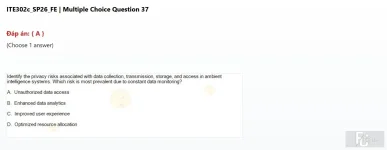
Question 37
(Choose 1 answer)
Identify the privacy risks associated with data collection, transmission, storage, and access in ambient intelligence systems. Which risk is most prevalent due to constant data monitoring?
A. Unauthorized data access
B. Enhanced data analytics
C. Improved user experience
D. Optimized resource allocation
Question 38
(Choose 1 answer)
Which psychological reason contributes to automation bias?
A. Over-reliance on technology
B. Fear of technology
C. Lack of technical skills
D. Distrust in human judgment
Question 39
(Choose 1 answer)
The nature of a predictive model may reveal
A. the researchers behind it
B. the algorithm's bias
C. the data it is trained on
D. the ethics of the individual inputs
Question 40
(Choose 1 answer)
What is the purpose of change management in terms of creating an ethical organizational culture?
A. To create a fast transition through training
B. To create a management transition
C. To create a smooth transition
D. To create a slow transition through training
Question 41
(Choose 1 answer)
In the following scatter plot, the GrossIncome variable is plotted against the Revenue variable. What type of correlation does this plot suggest?
A. There is a weak negative correlation between both variables.
B. There is a strong negative correlation between both variables.
C. There is a weak positive correlation between both variables.
D. There is a strong positive correlation between both variables.
Question 42
(Choose 1 answer)
Which of the following is the most important idea that a crisis communication program should manage?
A. The public's perception of a crisis
B. The real-world effects of a crisis
C. The individual details of a crisis
D. Internal stakeholder consensus about how to approach a crisis
Question 43
(Choose 1 answer)
What is one risk of ignoring ethical concerns in Al design?
A. Reduced testing time
B. Improved speed of deployment
C. Public backlash and regulatory consequences
D. Higher profit margins
Question 44
(Choose 1 answer)
As a cognitive bias, humans see lack of context/meaning around a piece of information and tend to
A. fill in gaps with existing knowledge
B. use biased sources of research
C. seek authority figures
D. disagree with their previous beliefs
Question 45
(Choose 1 answer)
What is the long-term impact of ignoring ethical considerations in technology development?
A. Faster time to market
B. Loss of public trust and potential regulatory backlash
C. Higher profits
D. Simplified development processes
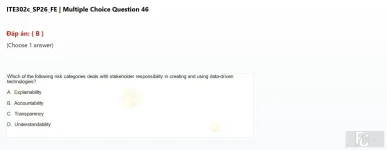
Question 46
(Choose 1 answer)
Which of the following risk categories deals with stakeholder responsibility in creating and using data-driven technologies?
A. Explainability
B. Accountability
C. Transparency
D. Understandability
Question 47
(Choose 1 answer)
Which of the following is one explanation for why cognitive biases exist?
A. We receive too much information and are overloaded.
B. We use then to help remember things.
C. They help us think logically instead of emotionally.
D. They are taught to us in school
Question 48
(Choose 1 answer)
Pseudocode can best be defined as
A. an explainable description of code that is meant for humans, not computers
B. a Python library for machine learning
C. a middle ground between code and plain writing that can be fed into a computer
D. a type of Javascript that is both human and machine-readable
Question 49
(Choose 1 answer)
How can effective communication mitigate ethical risks in Al and Data Science?
A. By ensuring transparency and understanding of ethical guidelines
B. By limiting access to Al technologies
C. By prioritizing speed over accuracy in data processing
D. By encouraging the concealment of ethical concerns
Question 50
(Choose 1 answer)
What is a key step in monitoring ethical organizational policies?
A. Establishing a policy committee
B. Regular compliance checks
C. Creating a rewards system
D. Hosting annual policy workshops
Question 51
(Choose 1 answer)
Which approach to corporate governance is more likely to create an ethical organizational culture?
A. A systemic approach with incentive systems
B. An oversight committee focus on rules.
C. A board focused on legal and regulatory compliance
D. An oversight committee focus on frameworks
Question 52
(Choose 1 answer)
What is the primary motivating factor behind hacktivism?
A. The desire to make money
B. The desire to serve an authority figure
C. The desire to spread fear.
D. The desire for social change.
Question 53
(Choose 1 answer)
If one group comprises the majority of the training data, they will skew the dataset and give the model
A. less fairness for that group
B. more confidence about that group
C. less confidence about that group
D. more faimess for that group
Question 54
(Choose 1 answer)
Which strategy is key to building and maintaining an ethical organizational culture?
A. Implementing ethics training and effective sessions
B. Focusing solely on financial performance
C. Ignoring regional and diversity differences
D. Minimizing leadership roles
Question 55
(Choose 1 answer)
Which of the following describes an ethical framework?
A. Ethical frameworks raise timeless ethical questions that are not easily put into action
B. Ethical frameworks apply meta-ethical theories to everyday business operations.
C. Ethical frameworks consolidate regulatory requirements for an industry.
D. Ethical frameworks seek to mitigate ethical concerns by creating actionable steps
Question 56
(Choose 1 answer)
Why is it important to take a proactive approach to addressing liability issues?
A. The law often lags behind innovation
B. The law is not always applied consistently
C. The law is not always clear
D. The law often difficult to understand
Question 57
(Choose 1 answer)
What distinguishes consequentialist ethics from deontological ethics?
A. Consequentialism focuses on outcomes, deontology on duties
B. Consequentialism ignores results, deontology focuses on happiness
C. They are essentially the same approach
D. Consequentialism is newer than deontology
Question 58
(Choose 1 answer)
What does a code of ethics provide for a data-driven organization?
A. Specific employee salaries
B. Legal immunity from lawsuits
C. Guiding values and expectations for ethical behavior
D. Product development timelines
Question 59
(Choose 1 answer)
Which of the following best describes beneficence?
A. Beneficence is a term coined by IBM that relates to their Green Horizons initiative in 2014
B. Beneficence is the promotion of well-being, not just for moral agents like humans, but of animals, the environment, and societies.
C. Beneficence is the promotion of well-being for moral agents like humans
D. Beneficence is the promotion of efficient systems that perform rapidly and benefit companies.
Question 60
(Choose 2 answers)
Which of the following are tools of an effective media communication plan? (Select two.)
A. Mission statement
B. Press release
C. Public education campaign
D. Video briefing
Đính kèm
-
 ITE302c SP26 FE RE_001.webp19.3 KB · Lượt xem: 13
 -
 ITE302c SP26 FE RE_002.webp23.6 KB · Lượt xem: 12
 -
 ITE302c SP26 FE RE_003.webp39.5 KB · Lượt xem: 10
 -
 ITE302c SP26 FE RE_004.webp32.1 KB · Lượt xem: 9
 -
 ITE302c SP26 FE RE_005.webp21.7 KB · Lượt xem: 6
 -
 ITE302c SP26 FE RE_006.webp23.2 KB · Lượt xem: 6
 -
 ITE302c SP26 FE RE_007.webp22.6 KB · Lượt xem: 6
 -
 ITE302c SP26 FE RE_008.webp26.7 KB · Lượt xem: 4
 -
 ITE302c SP26 FE RE_009.webp15.9 KB · Lượt xem: 4
 -
 ITE302c SP26 FE RE_010.webp22.9 KB · Lượt xem: 3
 -
 ITE302c SP26 FE RE_011.webp20.5 KB · Lượt xem: 2
 -
 ITE302c SP26 FE RE_012.webp29.4 KB · Lượt xem: 3
 -
 ITE302c SP26 FE RE_013.webp24.4 KB · Lượt xem: 2
 -
 ITE302c SP26 FE RE_014.webp21.7 KB · Lượt xem: 2
 -
 ITE302c SP26 FE RE_015.webp30.6 KB · Lượt xem: 2
 -
 ITE302c SP26 FE RE_016.webp20.9 KB · Lượt xem: 2
 -
 ITE302c SP26 FE RE_017.webp19.7 KB · Lượt xem: 3
 -
 ITE302c SP26 FE RE_018.webp19.9 KB · Lượt xem: 2
 -
 ITE302c SP26 FE RE_019.webp19.9 KB · Lượt xem: 2
 -
 ITE302c SP26 FE RE_020.webp33.3 KB · Lượt xem: 2
 -
 ITE302c SP26 FE RE_021.webp33 KB · Lượt xem: 2
 -
 ITE302c SP26 FE RE_022.webp22.1 KB · Lượt xem: 3
 -
 ITE302c SP26 FE RE_023.webp32.5 KB · Lượt xem: 2
 -
 ITE302c SP26 FE RE_024.webp23.8 KB · Lượt xem: 2
 -
 ITE302c SP26 FE RE_025.webp21.4 KB · Lượt xem: 2
 -
 ITE302c SP26 FE RE_026.webp21 KB · Lượt xem: 3
 -
 ITE302c SP26 FE RE_027.webp41.4 KB · Lượt xem: 4
 -
 ITE302c SP26 FE RE_028.webp35.8 KB · Lượt xem: 2
 -
 ITE302c SP26 FE RE_029.webp19.1 KB · Lượt xem: 2
 -
 ITE302c SP26 FE RE_030.webp21.3 KB · Lượt xem: 3
 -
 ITE302c SP26 FE RE_031.webp24.1 KB · Lượt xem: 1
 -
 ITE302c SP26 FE RE_032.webp19.4 KB · Lượt xem: 1
 -
 ITE302c SP26 FE RE_033.webp29.6 KB · Lượt xem: 1
 -
 ITE302c SP26 FE RE_034.webp30.1 KB · Lượt xem: 1
 -
 ITE302c SP26 FE RE_035.webp25.1 KB · Lượt xem: 1
 -
 ITE302c SP26 FE RE_036.webp18.3 KB · Lượt xem: 1
 -
 ITE302c SP26 FE RE_037.webp27.4 KB · Lượt xem: 2
 -
 ITE302c SP26 FE RE_038.webp20.1 KB · Lượt xem: 1
 -
 ITE302c SP26 FE RE_039.webp19.2 KB · Lượt xem: 1
 -
 ITE302c SP26 FE RE_040.webp24.6 KB · Lượt xem: 1
 -
 ITE302c SP26 FE RE_041.webp58.4 KB · Lượt xem: 1
 -
 ITE302c SP26 FE RE_042.webp25.7 KB · Lượt xem: 1
 -
 ITE302c SP26 FE RE_043.webp20.9 KB · Lượt xem: 1
 -
 ITE302c SP26 FE RE_044.webp23.6 KB · Lượt xem: 1
 -
 ITE302c SP26 FE RE_045.webp23.2 KB · Lượt xem: 1
 -
 ITE302c SP26 FE RE_046.webp21.4 KB · Lượt xem: 2
 -
 ITE302c SP26 FE RE_047.webp24.3 KB · Lượt xem: 1
 -
 ITE302c SP26 FE RE_048.webp26.6 KB · Lượt xem: 1
 -
 ITE302c SP26 FE RE_049.webp26.9 KB · Lượt xem: 2
 -
 ITE302c SP26 FE RE_050.webp21.4 KB · Lượt xem: 1
 -
 ITE302c SP26 FE RE_051.webp26.6 KB · Lượt xem: 1
 -
 ITE302c SP26 FE RE_052.webp20.7 KB · Lượt xem: 1
 -
 ITE302c SP26 FE RE_053.webp23.5 KB · Lượt xem: 1
 -
 ITE302c SP26 FE RE_054.webp24.8 KB · Lượt xem: 2
 -
 ITE302c SP26 FE RE_055.webp31.7 KB · Lượt xem: 2
 -
 ITE302c SP26 FE RE_056.webp23.2 KB · Lượt xem: 2
 -
 ITE302c SP26 FE RE_057.webp26.7 KB · Lượt xem: 1
 -
 ITE302c SP26 FE RE_058.webp22.4 KB · Lượt xem: 2
 -
 ITE302c SP26 FE RE_059.webp34.2 KB · Lượt xem: 6
 -
 ITE302c SP26 FE RE_060.webp20.7 KB · Lượt xem: 15
Sửa lần cuối: