
- Học kỳ
- SP2026
- Thời Gian
- 5/5/26
- Loại tài liệu
- FE
DBI202 SP26 B5 FE RE
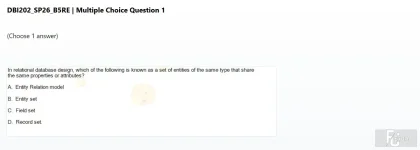
Multiple Choice Question 1 (Choose 1 answer)In relational database design, which of the following is known as a set of entities of the same type that share the same properties or attributes?
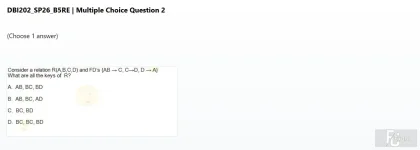
Multiple Choice Question 2 (Choose 1 answer)Consider a relation R(A,B,C,D) and FD's (AB->C, C->D, D->A). What are all the keys of R?
- A. Entity Relation model
- B. Entity set
- C. Field set
- D. Record set
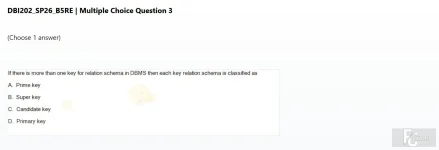
Multiple Choice Question 3 (Choose 1 answer)If there is more than one key for relation schema in DBMS then each key relation schema is classified as:
- A. AB, BC, BD
- B. AB, BC, AD
- C. BC, BD
- D. BC, BC, BD
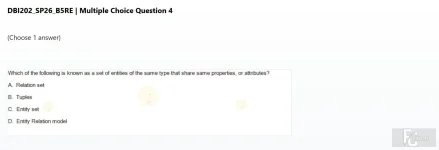
Multiple Choice Question 4 (Choose 1 answer)Which of the following is known as a set of entities of the same type that share same properties, or attributes?
- A. Prime key
- B. Super key
- C. Candidate key
- D. Primary key
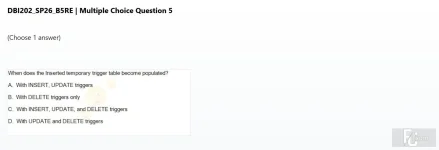
Multiple Choice Question 5 (Choose 1 answer)When does the Inserted temporary trigger table become populated?
- A. Relation set
- B. Tuples
- C. Entity set
- D. Entity Relation model
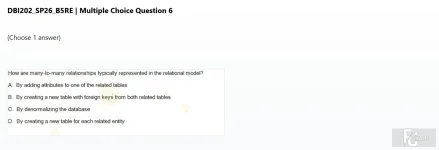
Multiple Choice Question 6 (Choose 1 answer)How are many-to-many relationships typically represented in the relational model?
- A. With INSERT, UPDATE triggers
- B. With DELETE triggers only
- C. With INSERT, UPDATE, and DELETE triggers
- D. With UPDATE and DELETE triggers
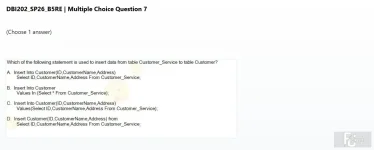
Multiple Choice Question 7 (Choose 1 answer)Which of the following statement is used to insert data from table Customer_Service to table Customer?
- A. By adding attributes to one of the related tables
- B. By creating a new table with foreign keys from both related tables
- C. By denormalizing the database
- D. By creating a new table for each related entity
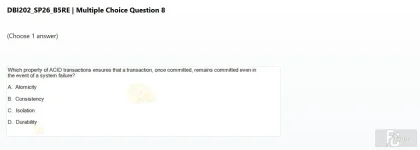
Multiple Choice Question 8 (Choose 1 answer)Which property of ACID transactions ensures that a transaction, once committed, remains committed even in the event of a system failure?
- A. Insert Into Customer (ID, CustomerName, Address) Select ID, CustomerName, Address From Customer_Service
- B. Insert Into Customer Values In (Select From Customer_Service)
- C. Insert into Customer (ID, CustomerName, Address) Values (Select ID, CustomerName, Address From Customer_Service);
- D. Insert Customer (ID, CustomerName, Address) from Select ID, CustomerName, Address From Customer_Service
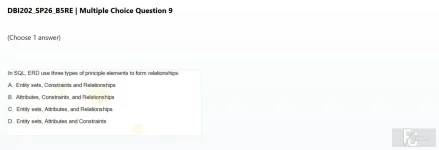
Multiple Choice Question 9 (Choose 1 answer)In SQL, ERD use three types of principle elements to form relationships:
- A. Atomicity
- B. Consistency
- C. Isolation
- D. Durability
Multiple Choice Question 10 (Choose 2 answers)Suppose that we have a relation R(ID, full name, address) and FDs (ID->full name, ID->address). What is the highest normal form of R in relational database design?
- A. Entity sets, Constraints and Relationships
- B. Attributes, Constraints, and Relationships
- C. Entity sets, Attributes, and Relationships
- D. Entity sets, Attributes and Constraints
Multiple Choice Question 11 (Choose 1 answer)Which of the following is the way to execute the procedure "CountOfCustomers"?
- A. 2NF
- B. 1NF
- C. 3NF
- D. BCNF
Multiple Choice Question 12 (Choose 1 answer)Given two relations R(A,B,C,D) with primary key A and S(D,E,F) with unique key D. How to make a R.D foreign key referencing S.D?
- A. DECLARE @CountCustomers int; EXEC CountOfCustomers @City = 'Berlin', @CountCus = @CountCustomers;
- B. DECLARE @CountCustomers int; EXEC CountOfCustomers @City = 'Berlin', @CountCus = @CountCustomers OUTPUT.
- C. EXECUTE Count_Of_Customers 'Berlin', @CountCus @CountCustomers OUTPUT;
- D. DECLARE @CountCustomers int; EXEC CountOfCustomers @CountCus = @CountCustomers OUTPUT
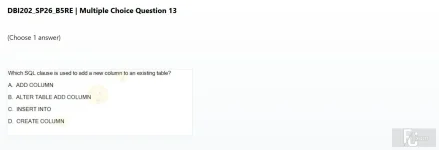
Multiple Choice Question 13 (Choose 1 answer)Which SQL clause is used to add a new column to an existing table?
- A. ADD CONSTRAINT fk_R_D FOREIGN KEY R(D) REFERENCES S(D)
- B. ALTER TABLE R ALTER CONSTRAINT fk_R_D FOREIGN KEY (D) REFERENCES S(D)
- C. Can not add a foreign key in the R table because the S's D column is not the primary key
- D. ALTER TABLE R ADD CONSTRAINT fk_R_D FOREIGN KEY (D) REFERENCES S(D)
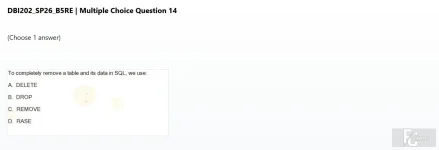
Multiple Choice Question 14 (Choose 1 answer)To completely remove a table and its data in SQL, we use:
- A. ADD COLUMN
- B. ALTER TABLE ADD COLUMN
- C. INSERT INTO
- D. CREATE COLUMN
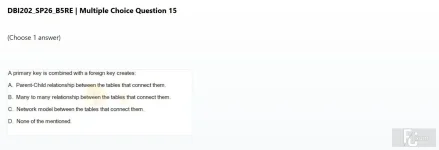
Multiple Choice Question 15 (Choose 1 answer)A primary key is combined with a foreign key creates:
- A. DELETE
- B. DROP
- C. REMOVE
- D. ERASE
Multiple Choice Question 16 (Choose 1 answer)Consider the table (StudentID, StudentName, CourseID, CourseName, InstructorName, InstructorEmail). Redesign to achieve 3NF:
- A. Parent-Child relationship between the tables that connect them
- B. Many to many relationship between the tables that connect them
- C. Network model between the tables that connect them
- D. None of the mentioned
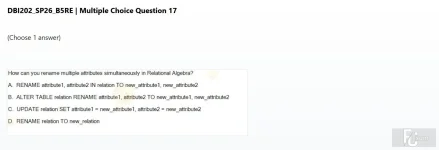
Multiple Choice Question 17 (Choose 1 answer)How can you rename multiple attributes simultaneously in Relational Algebra?
- A. Students (StudentID, StudentName); Courses (CourseID, CourseName, InstructorName, InstructorEmail); Enrollments (StudentID, CourseID)
- B. Students (StudentID, StudentName, CourseID); Courses (CourseID, CourseName, InstructorName, InstructorEmail)
- C. Courses (CourseID, CourseName, InstructorName, InstructorEmail); Enrollments (StudentID, StudentName, CourseID)
- D. Students (StudentID, StudentName, CourseID); Courses (CourseID, CourseName, InstructorName, InstructorEmail); Enrollments (StudentID, InstructorName)
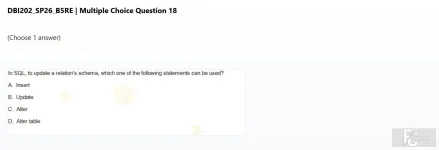
Multiple Choice Question 18 (Choose 1 answer)In SQL, to update a relation's schema, which one of the following statements can be used?
- A. RENAME attribute1, attribute2 IN relation TO new_attribute1, new_attribute2
- B. ALTER TABLE relation RENAME attribute1, attribute2 TO new_attribute1, new_attribute2
- C. UPDATE relation SET attribute1=new_attribute1, attribute2=new_attribute2
- D. RENAME relation TO new_relation
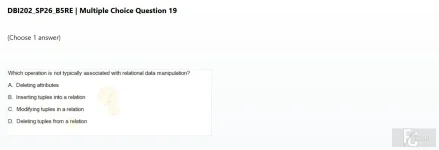
Multiple Choice Question 19 (Choose 1 answer)Which operation is not typically associated with relational data manipulation?
- A. Insert
- B. Update
- C. Alter
- D. Alter table
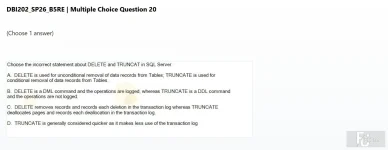
Multiple Choice Question 20 (Choose 1 answer)Choose the incorrect statement about DELETE and TRUNCATE in SQL Server.
- A. Deleting attributes
- B. Inserting tuples into a relation
- C. Modifying tuples in a relation
- D. Deleting tuples from a relation
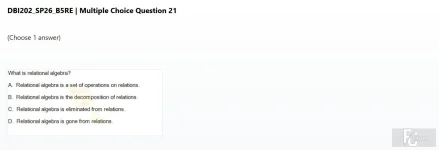
Multiple Choice Question 21 (Choose 1 answer)What is relational algebra?
- A. DELETE is used for unconditional removal of data records; TRUNCATE is used for conditional removal...
- B. DELETE is a DML command (logged), TRUNCATE is a DDL command (not logged)
- C. DELETE records each deletion in log; TRUNCATE deallocates pages
- D. TRUNCATE is generally quicker as it makes less use of the transaction log
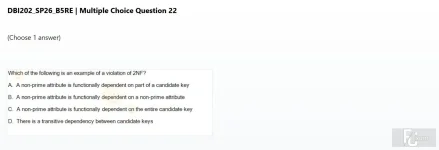
Multiple Choice Question 22 (Choose 1 answer)Which of the following is an example of a violation of 2NF?
- A. Relational algebra is a set of operations on relations.
- B. Relational algebra is the decomposition of relations
- C. Relational algebra is eliminated from relations
- D. Relational algebra is gone from relations
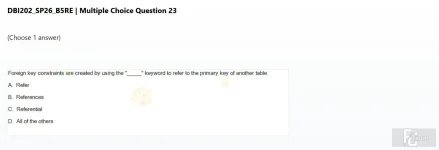
Multiple Choice Question 23 (Choose 1 answer)Foreign key constraints are created by using the ____ keyword to refer to the primary key of another table.
- A. A non-prime attribute is functionally dependent on part of a candidate key
- B. A non-prime attribute is functionally dependent on a non-prime attribute
- C. A non-prime attribute is functionally dependent on the entire candidate key
- D. There is a transitive dependency between candidate keys
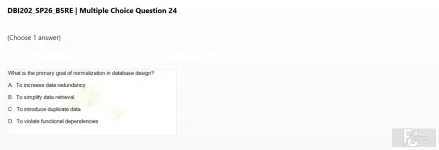
Multiple Choice Question 24 (Choose 1 answer)What is the primary goal of normalization in database design?
- A. Refer
- B. References
- C. Referential
- D. All of the others
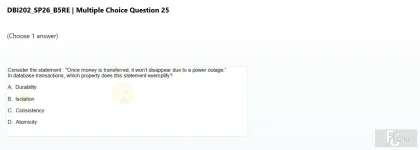
Multiple Choice Question 25 (Choose 1 answer)Consider the statement: "Once money is transferred, it won't disappear due to a power outage." Which property does this exemplify?
- A. To increase data redundancy
- B. To simplify data retrieval (Note: Reducing redundancy is the primary technical goal)
- C. To introduce duplicate data
- D. To violate functional dependencies
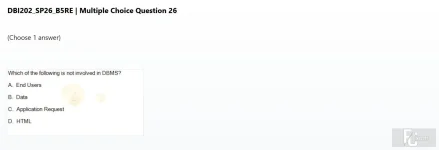
Multiple Choice Question 26 (Choose 1 answer)Which of the following is not involved in DBMS?
- A. Durability
- B. Isolation
- C. Consistency
- D. Atomicity
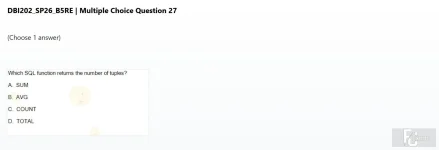
Multiple Choice Question 27 (Choose 1 answer)Which SQL function returns the number of tuples?
- A. End Users
- B. Data
- C. Application Request
- D. HTML
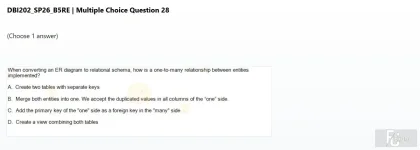
Multiple Choice Question 28 (Choose 1 answer)When converting an ER diagram to relational schema, how is a one-to-many relationship implemented?
- A. SUM
- B. AVG
- C. COUNT
- D. TOTAL
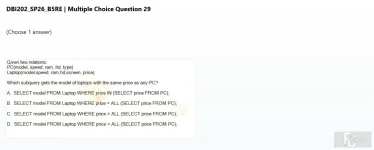
Multiple Choice Question 29 (Choose 1 answer)Which subquery gets the model of laptops with the same price as any PC?
- A. Create two tables with separate keys
- B. Merge both entities into one
- C. Add the primary key of the "one" side as a foreign key in the "many" side
- D. Create a view combining both tables
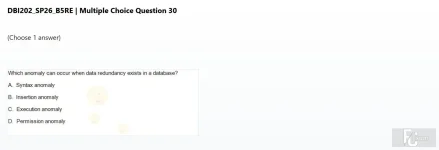
Multiple Choice Question 30 (Choose 1 answer)Which anomaly can occur when data redundancy exists in a database?
- A. SELECT model FROM Laptop WHERE price IN (SELECT price FROM PC);
- B. SELECT model FROM Laptop WHERE price = ALL (SELECT price FROM PC)
- C. SELECT model FROM Laptop WHERE price > ALL (SELECT price FROM PC);
- D. SELECT model FROM Laptop WHERE price < ALL (SELECT price FROM PC);
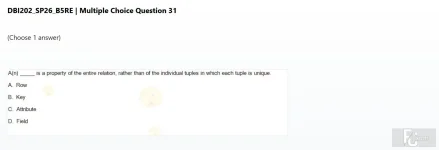
Multiple Choice Question 31 (Choose 1 answer)A
- A. Syntax anomaly
- B. Insertion anomaly
- C. Execution anomaly
- D. Permission anomaly
____ is a property of the entire relation, rather than of the individual tuples in which each tuple is unique.
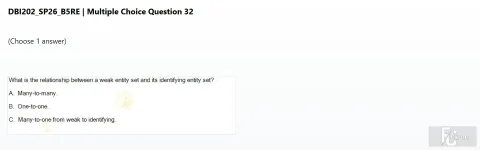
Multiple Choice Question 32 (Choose 1 answer)What is the relationship between a weak entity set and its identifying entity set?
- A. Row
- B. Key
- C. Attribute
- D. Field
Multiple Choice Question 33 (Choose 1 answer)Which operation is commonly used to display all the properties derived from the original property?
- A. Many-to-many
- B. One-to-one
- C. Many-to-one from weak to identifying.
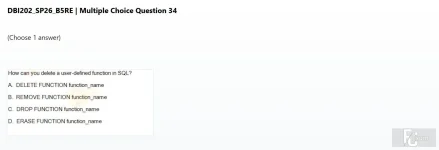
Multiple Choice Question 34 (Choose 1 answer)How can you delete a user-defined function in SQL?
- A. Union
- B. Intersection
- C. Closure
- D. Projection
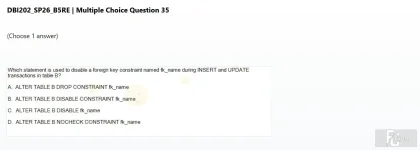
Multiple Choice Question 35 (Choose 1 answer)Which statement is used to disable a foreign key constraint named fk_name during INSERT/UPDATE in table B?
- A. DELETE FUNCTION function_name
- B. REMOVE FUNCTION function_name
- C. DROP FUNCTION function_name
- D. ERASE FUNCTION function_name
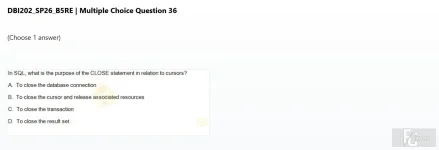
Multiple Choice Question 36 (Choose 1 answer)In SQL, what is the purpose of the CLOSE statement in relation to cursors?
- A. ALTER TABLE B DROP CONSTRAINT fk_name
- B. ALTER TABLE B DISABLE CONSTRAINT fk_name
- C. ALTER TABLE B DISABLE fk_name
- D. ALTER TABLE B NOCHECK CONSTRAINT fk_name
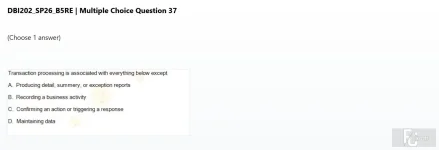
Multiple Choice Question 37 (Choose 1 answer)Transaction processing is associated with everything below except:
- A. To close the database connection
- B. To close the cursor and release associated resources
- C. To close the transaction
- D. To close the result set
Multiple Choice Question 38 (Choose 1 answer)The conceptual model is:
- A. Producing detail, summary, or exception reports
- B. Recording a business activity
- C. Confirming an action or triggering a response
- D. Maintaining data
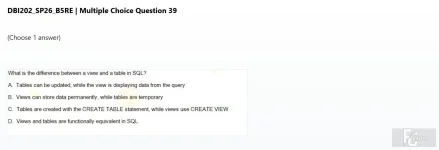
Multiple Choice Question 39 (Choose 1 answer)What is the difference between a view and a table in SQL?
- A. Independent of both hardware and software
- B. Dependent on both hardware and software
- C. Dependent on software
- D. Dependent on hardware
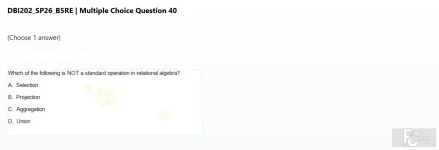
Multiple Choice Question 40 (Choose 1 answer)Which of the following is NOT a standard operation in relational algebra?
- A. Tables can be updated, while the view is displaying data from the query
- B. Views can store data permanently, while tables are temporary
- C. Tables are created with CREATE TABLE, while views use CREATE VIEW
- D. Views and tables are functionally equivalent in SQL
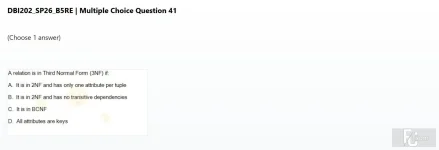
Multiple Choice Question 41 (Choose 1 answer)A relation is in Third Normal Form (3NF) if:
- A. Selection
- B. Projection
- C. Aggregation
- D. Union
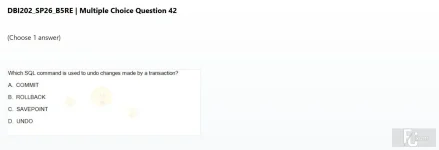
Multiple Choice Question 42 (Choose 1 answer)Which SQL command is used to undo changes made by a transaction?
- A. It is in 2NF and has only one attribute per tuple
- B. It is in 2NF and has no transitive dependencies
- C. It is in BCNF
- D. All attributes are keys
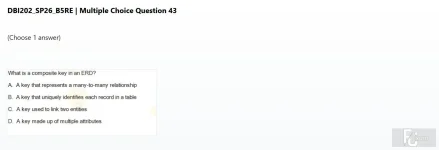
Multiple Choice Question 43 (Choose 1 answer)What is a composite key in an ERD?
- A. COMMIT
- B. ROLLBACK
- C. SAVEPOINT
- D. UNDO
Multiple Choice Question 44 (Choose 1 answer)In which line of the following code is the error? (CREATE TRIGGER... SELECT FROM INSERTED)
- A. A key that represents a many-to-many relationship
- B. A key that uniquely identifies each record in a table
- C. A key used to link two entities
- D. A key made up of multiple attributes
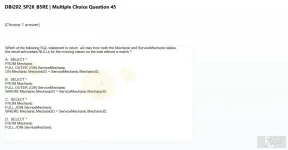
Multiple Choice Question 45 (Choose 1 answer)Which SQL statement returns all rows from both tables, containing NULLs for missing values on either side?
- A. Line 1
- B. Line 2
- C. Line 3
- D. Line 5
- E. Line 6 (SELECT * is missing)
- F. There are no lines in error
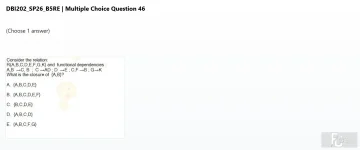
Multiple Choice Question 46 (Choose 1 answer)Consider R(A,B,C,D,E,F,G,K) and FDs: AB->C, C->A, D->E, C->F, B->G, F->K. What is the closure of (A,B)?
- A. SELECT * FROM Mechanic FULL OUTER JOIN ServiceMechanic ON Mechanic.MechanicID = ServiceMechanic.MechanicID
- B. SELECT ... WHERE Mechanic.MechanicID = ServiceMechanic.MechanicID
- C. SELECT ... FULL JOIN ... WHERE ...
- D. SELECT ... FULL JOIN ... (Missing ON clause)
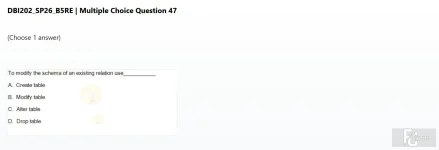
Multiple Choice Question 47 (Choose 1 answer)To modify the schema of an existing relation use:
- A. (A,B,C,D,E)
- B. (A,B,C,F,K) (Note: Based on logic, but listed options vary. Closest match is E: A,B,C,F,G)
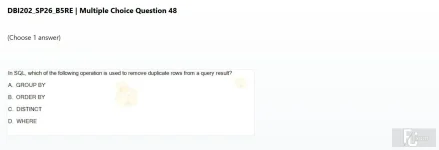
Multiple Choice Question 48 (Choose 1 answer)In SQL, which of the following operation is used to remove duplicate rows from a query result?
- A. Create table
- B. Modify table
- C. Alter table
- D. Drop table
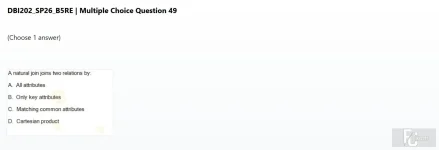
Multiple Choice Question 49 (Choose 1 answer)A natural join joins two relations by:
- A. GROUP BY
- B. ORDER BY
- C. DISTINCT
- D. WHERE
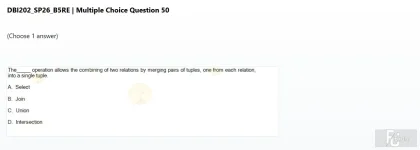
Multiple Choice Question 50 (Choose 1 answer)The ____ operation allows combining two relations by merging pairs of tuples into a single tuple.
- A. All attributes
- B. Only key attributes
- C. Matching common attributes
- D. Cartesian product
- A. Select
- B. Join
- C. Union
- D. Intersection
Đính kèm
-
 DBI202 SP26 B5 FE RE_001.webp26 KB · Lượt xem: 4
 -
 DBI202 SP26 B5 FE RE_002.webp47.3 KB · Lượt xem: 4
 -
 DBI202 SP26 B5 FE RE_003.webp21.7 KB · Lượt xem: 4
 -
 DBI202 SP26 B5 FE RE_004.webp15.4 KB · Lượt xem: 4
 -
 DBI202 SP26 B5 FE RE_005.webp17.8 KB · Lượt xem: 4
 -
 DBI202 SP26 B5 FE RE_006.webp16.6 KB · Lượt xem: 4
 -
 DBI202 SP26 B5 FE RE_007.webp18.6 KB · Lượt xem: 4
 -
 DBI202 SP26 B5 FE RE_008.webp20.8 KB · Lượt xem: 4
 -
 DBI202 SP26 B5 FE RE_009.webp17.3 KB · Lượt xem: 4
 -
 DBI202 SP26 B5 FE RE_010.webp18.5 KB · Lượt xem: 4
 -
 DBI202 SP26 B5 FE RE_011.webp19.1 KB · Lượt xem: 4
 -
 DBI202 SP26 B5 FE RE_012.webp22 KB · Lượt xem: 4
 -
 DBI202 SP26 B5 FE RE_013.webp25.6 KB · Lượt xem: 4
 -
 DBI202 SP26 B5 FE RE_014.webp40.2 KB · Lượt xem: 4
 -
 DBI202 SP26 B5 FE RE_015.webp20.2 KB · Lượt xem: 4
 -
 DBI202 SP26 B5 FE RE_016.webp23.4 KB · Lượt xem: 4
 -
 DBI202 SP26 B5 FE RE_017.webp21.9 KB · Lượt xem: 4
 -
 DBI202 SP26 B5 FE RE_018.webp57.9 KB · Lượt xem: 4
 -
 DBI202 SP26 B5 FE RE_019.webp38 KB · Lượt xem: 4
 -
 DBI202 SP26 B5 FE RE_020.webp18.4 KB · Lượt xem: 4
 -
 DBI202 SP26 B5 FE RE_021.webp14.9 KB · Lượt xem: 4
 -
 DBI202 SP26 B5 FE RE_022.webp24.9 KB · Lượt xem: 4
 -
 DBI202 SP26 B5 FE RE_023.webp51.8 KB · Lượt xem: 4
 -
 DBI202 SP26 B5 FE RE_024.webp30.1 KB · Lượt xem: 4
 -
 DBI202 SP26 B5 FE RE_025.webp16.8 KB · Lượt xem: 3
 -
 DBI202 SP26 B5 FE RE_026.webp20.7 KB · Lượt xem: 3
 -
 DBI202 SP26 B5 FE RE_027.webp44.9 KB · Lượt xem: 3
 -
 DBI202 SP26 B5 FE RE_028.webp22.7 KB · Lượt xem: 3
 -
 DBI202 SP26 B5 FE RE_029.webp29.4 KB · Lượt xem: 3
 -
 DBI202 SP26 B5 FE RE_030.webp18.6 KB · Lượt xem: 3
 -
 DBI202 SP26 B5 FE RE_031.webp20.7 KB · Lượt xem: 3
 -
 DBI202 SP26 B5 FE RE_032.webp21.7 KB · Lượt xem: 3
 -
 DBI202 SP26 B5 FE RE_033.webp15.3 KB · Lượt xem: 3
 -
 DBI202 SP26 B5 FE RE_034.webp14.2 KB · Lượt xem: 3
 -
 DBI202 SP26 B5 FE RE_035.webp30 KB · Lượt xem: 3
 -
 DBI202 SP26 B5 FE RE_036.webp38.4 KB · Lượt xem: 3
 -
 DBI202 SP26 B5 FE RE_037.webp18.6 KB · Lượt xem: 3
 -
 DBI202 SP26 B5 FE RE_038.webp17.3 KB · Lượt xem: 3
 -
 DBI202 SP26 B5 FE RE_039.webp17.9 KB · Lượt xem: 3
 -
 DBI202 SP26 B5 FE RE_040.webp17.7 KB · Lượt xem: 3
 -
 DBI202 SP26 B5 FE RE_041.webp20.8 KB · Lượt xem: 3
 -
 DBI202 SP26 B5 FE RE_042.webp28.2 KB · Lượt xem: 3
 -
 DBI202 SP26 B5 FE RE_043.webp22 KB · Lượt xem: 3
 -
 DBI202 SP26 B5 FE RE_044.webp22 KB · Lượt xem: 3
 -
 DBI202 SP26 B5 FE RE_045.webp19 KB · Lượt xem: 3
 -
 DBI202 SP26 B5 FE RE_046.webp29.2 KB · Lượt xem: 3
 -
 DBI202 SP26 B5 FE RE_047.webp16.7 KB · Lượt xem: 3
 -
 DBI202 SP26 B5 FE RE_048.webp19.3 KB · Lượt xem: 3
 -
 DBI202 SP26 B5 FE RE_049.webp16.6 KB · Lượt xem: 3
 -
 DBI202 SP26 B5 FE RE_050.webp21.4 KB · Lượt xem: 3